



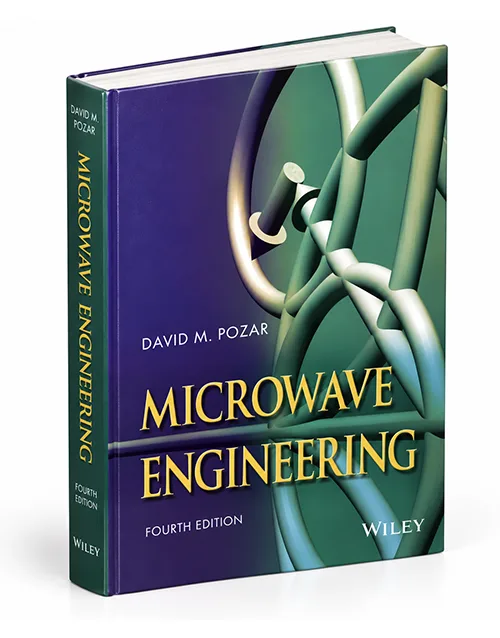


Microwave Engineering, Fourth Edition by David M. Pozar
Microwave Engineering, 4th Edition by David M. Pozar is a comprehensive textbook covering the fundamental principles and practical applications of radio-frequency (RF) and microwave engineering. Published by Wiley, this widely used engineering reference helps students develop a strong understanding of electromagnetic theory, microwave circuits, transmission lines, waveguides, and RF system design.
The book connects theoretical foundations with engineering applications, making it useful for undergraduate and graduate students in electrical engineering, electronics, communications engineering, and related technical disciplines. It also serves as a reference for engineers and researchers working with microwave devices, high-frequency circuits, wireless systems, and electromagnetic applications.
Electromagnetic Theory and Fundamental Principles
A solid understanding of electromagnetic theory is essential for studying microwave engineering. The textbook introduces the principles governing electromagnetic fields, wave propagation, material properties, and boundary conditions. These concepts provide the theoretical foundation for analyzing the behavior of electrical signals at high frequencies.
Readers can study Maxwell’s equations, plane waves, energy flow, and electromagnetic interactions with different materials. This foundational knowledge helps explain how electromagnetic energy travels through transmission structures and interacts with microwave components.
Transmission Lines and Waveguides
Transmission lines and waveguides are fundamental components of RF and microwave systems. This textbook examines their operating principles, electrical characteristics, and applications in high-frequency signal transmission.
Readers explore concepts such as impedance, propagation, standing waves, reflection coefficients, and transmission-line behavior. The material supports a deeper understanding of how microwave signals travel through different structures and how engineers analyze their performance.
These principles are important when designing communication equipment, RF test systems, antennas, and microwave circuits where signal integrity and impedance characteristics influence overall system performance.
Microwave Network Analysis and Impedance Matching
Microwave Engineering provides detailed coverage of microwave network analysis, an important part of designing and evaluating high-frequency circuits. The book examines scattering parameters, network characteristics, and the methods used to describe the behavior of microwave components.
Impedance matching and tuning are also major topics. Proper impedance matching can help reduce unwanted reflections and improve the transfer of power between connected components. The textbook discusses analytical methods and design principles that students can use to evaluate matching networks and solve practical engineering problems.
Microwave Resonators, Filters, and Passive Components
Microwave circuits rely on components that control signal frequency, distribution, and transmission. The book explores microwave resonators, filters, power dividers, directional couplers, and hybrid devices, explaining the principles behind their operation and design.
Additional coverage includes ferrite devices and related components used in microwave applications. These subjects help readers understand how passive components function within larger RF systems and how their electrical properties affect circuit performance.
Noise, Nonlinear Effects, and Active Devices
Noise and nonlinear distortion are important considerations in high-frequency electronics. This edition examines the concepts used to analyze noise, intermodulation distortion, and other nonlinear effects that may influence the performance of RF and microwave circuits.
The book also covers active RF and microwave devices and their applications in circuit design. Readers can study the principles associated with microwave amplifiers, oscillators, and mixers, including the factors that affect gain, stability, signal quality, and circuit performance.
These topics provide useful background for students and engineers who want to understand how individual electronic components work together to process and generate high-frequency signals.
Microwave Systems and Wireless Applications
The textbook extends beyond individual components to examine microwave and RF systems. Coverage includes wireless communications, radar, radiometry, and radiation hazards. These applications demonstrate how electromagnetic principles are used in communication networks, sensing equipment, measurement technologies, and other engineering systems.
By connecting circuit theory with practical applications, the book helps readers understand how microwave components contribute to the design and operation of complete systems.
Updated Material and Engineering Problem Solving
The fourth edition includes new and updated material relating to RF and microwave systems, noise, active devices and circuits, power waves, transient behavior, and RF CMOS circuits. These subjects broaden the textbook’s coverage of modern high-frequency engineering concepts.
Numerous worked examples and end-of-chapter problems give students opportunities to apply mathematical methods, evaluate circuit behavior, and reinforce their understanding of the material. Answers to selected problems allow readers to check their progress and develop more structured problem-solving techniques.
Who Should Read Microwave Engineering, 4th Edition?
This book is suitable for electrical engineering students, electronics students, communications engineers, RF design professionals, microwave engineers, and researchers working in high-frequency electronics. It can be used as a primary or supplementary textbook in university courses covering microwave engineering, electromagnetic applications, RF circuits, and wireless systems.
Its combination of theoretical explanation, circuit analysis, practical applications, and numerical problems makes it a useful learning resource for readers developing both conceptual knowledge and analytical engineering skills.
Why Choose Microwave Engineering by David M. Pozar?
- Comprehensive coverage: Explores electromagnetic theory, microwave circuits, transmission lines, and RF systems.
- Practical engineering topics: Covers impedance matching, filters, couplers, amplifiers, oscillators, and mixers.
- Updated fourth edition: Includes additional and revised material on active circuits, noise, and RF systems.
- Worked examples: Helps students apply theory to engineering problems.
- Practice exercises: Provides end-of-chapter problems and answers to selected questions.
- Academic and professional value: Suitable for engineering courses, independent study, and technical reference.
About the Book
Title: Microwave Engineering
Edition: Fourth Edition
Author: David M. Pozar
Publisher: Wiley
Publication Date: November 2011
ISBN-13: 9780470631553
Format: Hardcover
Pages: 752
For anyone studying high-frequency electronics or microwave circuit design, Microwave Engineering, 4th Edition offers a detailed introduction to the theories, analytical techniques, and practical systems used in this engineering field.
There are no reviews yet.