

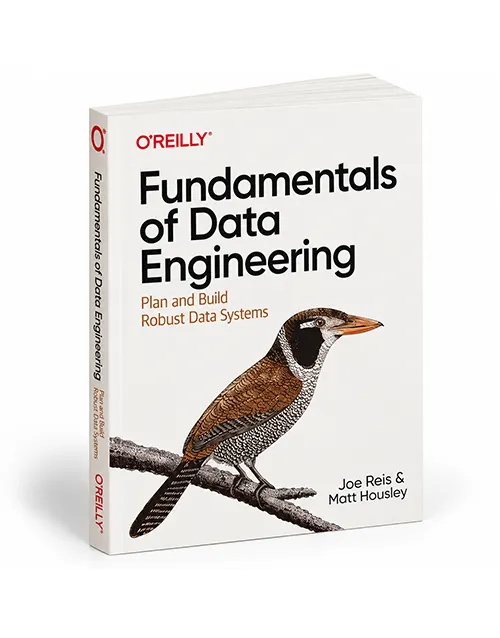


Fundamentals of Data Engineering: Plan and Build Robust Data Systems
Fundamentals of Data Engineering by Joe Reis and Matt Housley is a practical textbook and professional reference for understanding how to design, build, and maintain reliable data systems. Published by O’Reilly Media, this book introduces the principles, technologies, and architectural decisions that support modern data engineering. It provides a structured overview of the data engineering lifecycle and explains how data systems can be designed to serve organizational and customer needs.
Modern businesses depend on reliable data to support analytics, reporting, machine learning, and operational decision-making. Data engineers help make this possible by building the infrastructure that collects, processes, stores, and delivers data. This book explores the processes and design considerations behind those systems, helping readers understand how the different parts of a data platform work together.
Understand the Data Engineering Lifecycle
A major focus of Fundamentals of Data Engineering is the data engineering lifecycle. The authors explain how data moves from its point of generation through ingestion, orchestration, transformation, and storage before being made available to downstream users and systems.
Readers learn why each stage matters and how decisions made at one stage can affect the reliability, performance, and maintainability of the entire data platform. This lifecycle-based perspective helps readers think beyond individual tools and consider the complete system architecture.
Design Reliable Data Architectures
Building robust data systems involves selecting suitable technologies, defining data flows, managing dependencies, and considering future operational requirements. The book introduces a framework for evaluating data engineering problems and making technology decisions based on practical needs rather than marketing claims.
Topics include architectural design, data infrastructure, cloud technologies, and the trade-offs involved in building and operating data platforms. These concepts help readers understand how to select components that work together and support the needs of downstream data consumers.
Explore Data Ingestion, Transformation, and Storage
Data engineering systems must collect data from different sources and prepare it for analysis or other uses. The book discusses data generation and ingestion, transformation workflows, orchestration, and storage as connected stages of the data engineering process.
Readers can develop an understanding of how data moves between systems, why dependable pipelines matter, and how processing choices influence data quality and usability. These foundations are useful when working with analytical databases, cloud platforms, batch processing, and other data infrastructure components.
Learn About Data Orchestration and Operational Reliability
Data workflows often consist of multiple tasks that must execute in the correct order and respond appropriately to failures. Orchestration helps coordinate these tasks and manage their dependencies. Understanding orchestration is important for building repeatable workflows that produce data consistently.
The book’s system-oriented perspective encourages readers to consider the reliability and maintainability of data pipelines, rather than focusing only on whether an individual job runs successfully. This approach supports better thinking about operational practices and the long-term management of data infrastructure.
Incorporate Data Governance and Security
Reliable data engineering requires attention to governance and security throughout the lifecycle. Organizations must consider how data is accessed, protected, managed, and made available to authorized consumers. Governance practices can also help address consistency, accountability, and the appropriate use of organizational information.
Fundamentals of Data Engineering incorporates governance and security into its wider discussion of data systems. This helps readers recognize that these responsibilities are integral to data architecture and operation, rather than separate tasks added after a platform has been developed.
Connect Data Engineering with Analytics and Data Science
Data engineering supports the work of data analysts, data scientists, machine learning practitioners, and business teams by providing dependable data infrastructure. Understanding the relationship between these roles helps engineers design systems that meet real downstream requirements.
The book discusses the broader data engineering landscape and the skills and responsibilities associated with the profession. It can help readers understand how engineering decisions influence analytical workflows and why collaboration between technical and business stakeholders matters.
Who Should Read Fundamentals of Data Engineering?
This book is suitable for aspiring and practicing data engineers, software engineers working with data platforms, data scientists, analytics engineers, database professionals, and technology students. It may also interest technical leaders who need a broader understanding of data architecture and the processes required to build dependable data systems.
Readers who are new to the field can use the book to develop a structured overview of data engineering. Experienced practitioners can use it as a reference when reviewing lifecycle concepts, architectural approaches, governance, and technology trade-offs.
Why Choose This Data Engineering Book?
- Lifecycle-based learning: Explains the connected stages of data generation, ingestion, orchestration, transformation, and storage.
- Practical architecture guidance: Provides a framework for planning and building robust data systems.
- Technology evaluation: Encourages readers to assess tools and technologies according to practical requirements.
- Governance and security: Addresses important responsibilities throughout the data lifecycle.
- Cross-functional relevance: Helps connect data engineering with analytics, data science, and business needs.
- Professional development: Supports learners building knowledge of modern data infrastructure and engineering practices.
About the Book
Title: Fundamentals of Data Engineering: Plan and Build Robust Data Systems
Authors: Joe Reis and Matt Housley
Publisher: O’Reilly Media
Edition: First Edition
Publication Year: 2022
Print ISBN-13: 9781098108304
Pages: 447 in the cited print catalog record
For professionals and students seeking to understand modern data infrastructure, Fundamentals of Data Engineering offers a structured introduction to data lifecycle management, architecture, governance, and the design decisions involved in building robust data systems.
There are no reviews yet.