

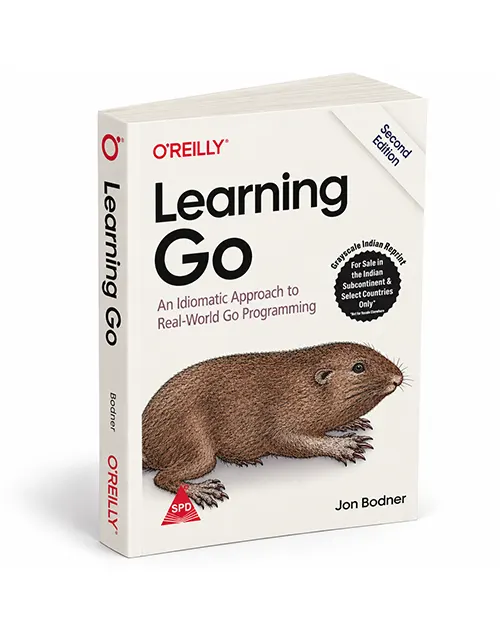


Learning Go, 2nd Edition: An Idiomatic Approach to Real-World Go Programming
Learning Go, 2nd Edition by Jon Bodner is a practical programming guide that teaches readers how to write clear, efficient, and idiomatic Go code. Published for the Indian market by Shroff/O’Reilly, this edition introduces the language’s core features, programming conventions, development tools, and techniques for building reliable software applications.
Go is widely used for backend services, cloud infrastructure, network applications, and command-line tools. Learning the language involves more than memorizing syntax: developers must understand how to organize projects, manage dependencies, handle errors, use concurrency, and take advantage of Go’s tooling. This book explains these concepts with practical examples and an emphasis on writing maintainable code.
Get Started with the Go Programming Language
The book begins with setting up a Go development environment and understanding the tools used to write, build, format, and validate Go programs. Readers are introduced to the Go toolchain, modules, and common development workflows.
These foundations help beginners move from writing their first program to organizing code in a structured project. The book also discusses tools and development environments that can support individual programmers and collaborative engineering teams.
Understand Types, Variables, and Data Structures
Go’s type system is a central part of the language’s design. The book explores built-in types, declarations, constants, strings, numeric values, and type conversions. Readers learn how these features influence program structure and how to use them to express data clearly.
It also covers composite data structures such as arrays, slices, maps, and structs. Understanding these structures is important when representing application data, organizing collections, and writing functions that manipulate information efficiently.
Write Functions, Methods, and Interfaces
Reusable code is essential for maintainable applications. Learning Go explains how functions, methods, and interfaces help developers organize behavior and define relationships between different parts of a program.
Readers can develop an understanding of how Go handles method behavior and abstraction, how interfaces support flexible program design, and how to organize code into reusable components. These concepts are useful for building applications that remain understandable as their size and complexity increase.
Learn Concurrency and Go’s Execution Model
Go includes language features designed to support concurrent programming. The book introduces goroutines, channels, and related synchronization concepts used when programs perform multiple tasks or coordinate work across components.
Understanding concurrency helps developers reason about communication, shared data, coordination, and potential race conditions. These concepts are especially relevant when building network services and applications that need to manage simultaneous requests efficiently.
Master Error Handling and Reliable Code
Handling failures explicitly is an important part of writing robust software. The book explains Go’s approach to errors, including error values, wrapping errors, and techniques for handling exceptional situations.
Readers can also explore testing, code organization, package documentation, and techniques for maintaining software quality. These skills help developers create programs that are easier to debug, test, review, and maintain over time.
Organize Projects with Modules and Packages
As applications grow, developers need a dependable way to manage source code and external dependencies. The textbook covers Go modules, packages, imports, versioning, and dependency management.
This material helps readers understand how to structure projects, share reusable code, update dependencies, and avoid common organizational problems. These practices are particularly valuable for teams developing production services and long-lived software applications.
Explore Generics and Advanced Go Features
The second edition includes coverage of generics, a language feature that allows developers to write reusable functions and data structures with type parameters. Readers can learn how generics work with interfaces and how they can reduce repetitive code while preserving type safety.
The book also explores reflection, unsafe operations, and cgo. These more advanced features can be useful in specialized situations but require careful consideration. Understanding their trade-offs helps developers choose simpler, safer solutions when possible and recognize when advanced techniques may be justified.
Improve Performance and Development Practices
Writing efficient software involves understanding how programs use memory, how garbage collection affects execution, and how to identify performance bottlenecks. The book discusses Go’s tools and language features that help developers investigate performance and optimize applications.
Readers can also learn about formatting, code validation, testing, and other development practices that support consistent, readable code. These tools help establish a workflow in which software can be developed, checked, and maintained systematically.
Who Should Read Learning Go, 2nd Edition?
Learning Go, 2nd Edition is suitable for programmers learning Go for the first time, software engineers moving from another programming language, backend developers, computer science students, and professionals building cloud or network applications.
Readers with programming experience can use the book to learn Go’s idioms and design choices, while newer developers can build a foundation in the language’s syntax, data structures, tooling, and project organization. Practical examples and exercises support self-study and continued skill development.
Why Choose the Second Edition?
- Practical Go instruction: Explains language features through a real-world programming perspective.
- Idiomatic coding: Focuses on Go conventions and maintainable program design.
- Modern language coverage: Includes generics and updated language features.
- Application development: Covers modules, packages, testing, errors, and concurrency.
- Advanced concepts: Introduces reflection, unsafe operations, and cgo.
- Development tools: Explains tooling and techniques for improving code quality and performance.
About the Book
Title: Learning Go
Subtitle: An Idiomatic Approach to Real-World Go Programming
Edition: Second Edition
Author: Jon Bodner
Publisher: Shroff/O’Reilly for the Indian regional edition
Publication Date: January 2024
ISBN-13: 9789355425331 for the Indian edition
Pages: 496
For developers seeking to become proficient in Go, this textbook provides a structured path through the language’s fundamentals, practical programming techniques, concurrency features, and advanced capabilities. It supports the development of clear, idiomatic code for real-world software projects.
There are no reviews yet.