

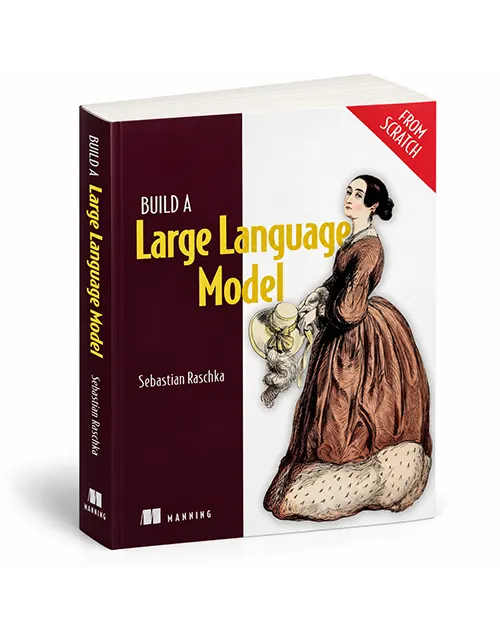


Build a Large Language Model (From Scratch) by Sebastian Raschka
Build a Large Language Model (From Scratch) by Sebastian Raschka is a practical programming guide that explains how large language models (LLMs) work and how to implement a GPT-style model from the ground up. Published by Manning, this technical book connects machine learning theory with hands-on Python and PyTorch programming, helping readers understand the processes involved in developing, training, and fine-tuning language models.
Large language models power many modern generative AI applications, including conversational assistants, text-generation tools, and systems that interpret natural language. Understanding these technologies requires knowledge of tokenization, numerical representations of text, attention mechanisms, transformer architectures, model training, and evaluation. This book presents these components through a progressive, code-focused learning approach.
Understand How Large Language Models Work
The book begins by explaining what large language models are, how they are used, and the main stages involved in building and training them. Readers explore the foundations of transformer-based models and the GPT architecture while developing an understanding of how training data and model components work together.
Rather than relying only on high-level descriptions or prebuilt language-model libraries, the book encourages readers to implement essential components themselves. This approach helps learners understand what happens inside an LLM and why different parts of the architecture are necessary.
Prepare and Process Text Data
Text must be converted into representations that a machine learning model can process. The textbook explains tokenization, token IDs, special tokens, byte-pair encoding, and the creation of training examples from text.
Readers also learn about token embeddings and positional information, which help a model represent the content and order of text. These concepts form an important foundation for understanding how language models process sequences and use context when generating text.
Implement Attention Mechanisms
Attention is a key component of transformer architecture. It allows a model to calculate relationships between elements in a sequence and use contextual information when processing text.
The book guides readers through implementing attention mechanisms in code, building an understanding of the computations behind this central component of GPT-style models. Working through the implementation helps connect mathematical concepts with actual Python and PyTorch operations.
Build a GPT-Style Language Model
After introducing the core components, the book brings them together to implement a GPT-style model capable of generating text. Readers examine how the model architecture is assembled and how its components interact during inference and training.
This hands-on process provides a foundation for understanding transformer blocks, model parameters, text generation, and the overall structure of a language model. It can also help readers become more comfortable inspecting and modifying model code for experimentation and learning.
Explore Pretraining and Model Training
Pretraining teaches a language model to learn patterns from a large collection of text. The book explains how to prepare training data, calculate the training objective, and implement the process used to update model parameters.
Readers can follow the steps involved in training a small, educational language model and understand how training progress is evaluated. The emphasis is on learning the workflow and underlying principles; reproducing a small model is not the same as training a production-scale foundation model, which requires substantially greater data and computational resources.
Fine-Tune Models for Specific Tasks
Once a base language model has been pretrained, fine-tuning can adapt it to particular tasks. The book explores fine-tuning for text classification and other task-specific behavior, illustrating how an existing model can be adapted rather than built entirely anew for every application.
It also covers instruction fine-tuning, which trains a model to respond more appropriately to instructions. These sections help readers understand the distinction between learning general language patterns during pretraining and adapting a model for a more specific purpose.
Learn Python and PyTorch Through Practical Examples
Python and PyTorch are used throughout the book’s coding examples. Readers can follow the implementations, examine model components, and experiment with the training workflow while developing their programming skills.
The appendices provide additional support, including an introduction to PyTorch, references and further reading, exercise solutions, and additional training-loop techniques. These resources make the book useful for learners who want to reinforce concepts while working through the material.
Who Should Read Build a Large Language Model (From Scratch)?
This book is suitable for machine learning engineers, AI developers, data scientists, software engineers, computer science students, and technically minded readers interested in generative AI. It is particularly relevant to learners who want a deeper understanding of model architecture and training rather than relying exclusively on language-model APIs.
Some familiarity with Python, machine learning concepts, and basic mathematics is helpful when working through the code and explanations. Readers can use the book for guided self-study, experimentation, and as a foundation for further learning about transformer models and LLM development.
Why Choose This LLM Programming Book?
- Hands-on learning: Builds important LLM components step by step.
- Transformer architecture: Explains attention mechanisms and GPT-style models.
- Practical coding: Uses Python and PyTorch throughout the examples.
- Model training: Covers data preparation, pretraining, and training workflows.
- Fine-tuning: Explores classification and instruction-following applications.
- Supplementary resources: Includes appendices, exercise solutions, and code resources.
About the Book
Title: Build a Large Language Model (From Scratch)
Author: Sebastian Raschka
Publisher: Manning
Publication Date: September 2024
Print ISBN-13: 9781633437166
Pages: 368
Format: Trade paperback in the standard publisher listing
For readers who want to understand how large language models are constructed, trained, and adapted, Build a Large Language Model (From Scratch) offers a practical, code-driven introduction to the architectures and workflows behind modern generative AI.
There are no reviews yet.