

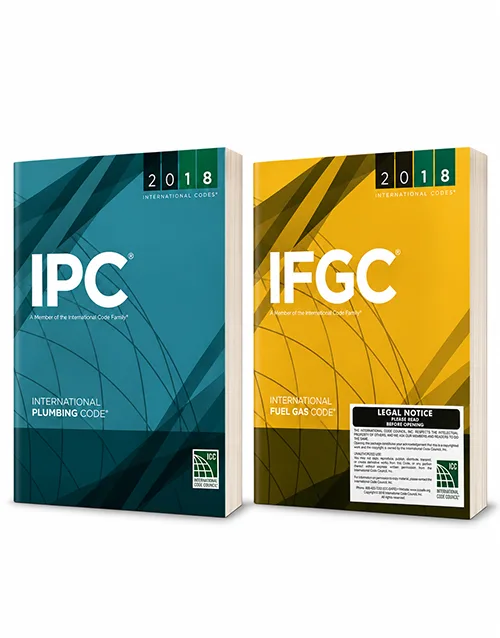


2018 International Plumbing Code and International Fuel Gas Code – Complete Two-Book Set
The 2018 International Plumbing Code (IPC) and International Fuel Gas Code (IFGC) – Complete 2-Book Set brings together two important building systems publications from the International Code Council (ICC). This collection provides technical requirements and reference information for plumbing installations, potable water supply, drainage systems, fuel gas piping, gas-fired appliances, and related building safety considerations.
The 2018 International Plumbing Code establishes minimum requirements for plumbing facilities through prescriptive and performance-based provisions. The 2018 International Fuel Gas Code addresses the design and installation of fuel gas systems and gas-fired appliances through corresponding prescriptive and performance requirements.
Together, these books provide a useful professional reference for plumbing contractors, licensed plumbers, gas installers, mechanical engineers, architects, construction inspectors, and code officials involved in building system design and code compliance.
Book 1: 2018 International Plumbing Code (IPC)
Understand Plumbing Code Administration and Scope
The 2018 International Plumbing Code begins with scope, administration, and definitions that establish how its plumbing requirements apply to buildings and plumbing installations.
These provisions introduce the administrative framework for applying and enforcing the code, including the responsibilities of code officials and the requirements associated with permits, inspections, approvals, and plumbing system compliance.
The code establishes minimum requirements for plumbing facilities while allowing the acceptance of new and innovative products, materials, and systems when applicable requirements are satisfied.
Explore General Plumbing Regulations
Chapter 3 establishes general regulations that apply to plumbing installations and plumbing system components.
It provides a foundation for evaluating plumbing materials, installation conditions, equipment, and other general requirements associated with safe plumbing construction.
These provisions help plumbers, contractors, designers, and inspectors understand the basic requirements that apply across different plumbing applications.
Study Plumbing Fixtures, Faucets, and Fixture Fittings
Chapter 4 covers plumbing fixtures, faucets, fixture fittings, and requirements for their installation in buildings.
It addresses fixture provisions and the minimum number of plumbing fixtures required for different building uses and occupancies.
The 2018 edition includes an updated table for determining the minimum number of required plumbing fixtures. It also clarifies that certain single-user toilet facilities, consisting of one water closet and one lavatory, do not need to be labeled exclusively for male or female use.
These provisions are important for plumbing designers, contractors, architects, building inspectors, and professionals involved in commercial and residential construction.
Understand Water Heater Requirements
Chapter 5 addresses the installation and safety requirements for water heaters and related equipment.
These provisions help professionals evaluate water heater installations and the associated components required for safe operation.
The code provides a reference for contractors and inspectors working with water heating equipment in buildings.
Explore Water Supply and Distribution Systems
Chapter 6 establishes requirements for potable water supply and distribution systems.
It addresses how water is supplied to plumbing fixtures and outlets and includes provisions for water distribution piping, system components, connections, and protection of the potable water supply.
These requirements are important for maintaining water quality and ensuring that plumbing systems provide suitable water supply for building occupants.
The 2018 edition updates requirements for solar thermal water heating systems, referencing ICC 900/SRCC 300. It also introduces requirements for certain well systems to comply with NGWA-01 where local requirements do not adequately address the subject.
Study Sanitary Drainage Systems
Chapter 7 covers sanitary drainage systems and the requirements for conveying wastewater safely away from plumbing fixtures and buildings.
These provisions address drainage system design, piping materials, installation, connections, and other requirements relevant to sanitary plumbing infrastructure.
Properly designed drainage systems help support sanitary building conditions and reduce problems associated with wastewater disposal.
Understand Indirect and Special Waste Systems
Chapter 8 addresses indirect waste and special waste systems.
These provisions are relevant to installations where waste discharge requires specialized connections or additional separation from conventional sanitary drainage systems.
Professionals can use this chapter when evaluating plumbing arrangements for equipment and applications requiring special waste handling.
Review Plumbing Vent Systems
Chapter 9 establishes requirements for plumbing vent systems.
Plumbing vents help maintain suitable pressure conditions within drainage systems and protect fixture trap seals. Proper venting supports reliable drainage and helps prevent unwanted sewer gases from entering occupied spaces.
These provisions are important for designing and inspecting plumbing drainage and vent arrangements.
Explore Traps, Interceptors, and Separators
Chapter 10 addresses the design and installation of plumbing traps, interceptors, and separators.
These components perform important functions in plumbing systems, including maintaining trap seals and separating specific substances from wastewater before discharge into drainage systems.
The chapter provides a technical reference for professionals working with specialized plumbing equipment and waste management installations.
Understand Storm Drainage Systems
Chapter 11 covers storm drainage systems used to collect and convey rainwater and other stormwater from buildings.
These requirements help professionals evaluate drainage arrangements and the plumbing components used for managing stormwater.
Proper storm drainage design is important for building protection and effective water management.
Study Special Piping and Medical Gas Systems
Chapter 12 addresses special piping systems, including medical gas installations.
These applications require additional design, installation, and safety considerations beyond ordinary water supply and drainage systems.
The chapter provides a reference for professionals involved in specialized plumbing and piping installations.
Explore Nonpotable Water Systems
Chapter 13 addresses nonpotable water systems and their use in building plumbing installations.
It provides requirements relevant to the design and installation of systems that use water not intended for drinking or other potable applications.
These provisions help distinguish nonpotable systems from potable water distribution and support appropriate installation practices.
Review Subsurface Graywater Soil Absorption
Chapter 14 covers subsurface graywater soil absorption systems.
This subject is relevant to professionals working with graywater applications and the associated systems used to manage graywater through subsurface absorption arrangements.
Understand Referenced Plumbing Standards
Chapter 15 identifies standards referenced throughout the 2018 IPC.
These technical references provide additional specifications for plumbing products, materials, installations, and system components.
The code also includes supplementary appendices and reference material that support plumbing design, installation, and inspection.
Book 2: 2018 International Fuel Gas Code (IFGC)
Understand Fuel Gas Code Administration and Scope
The 2018 International Fuel Gas Code begins with scope, administration, and definitions that establish how its requirements apply to fuel gas systems and gas-fired appliances.
These provisions explain the framework for applying and enforcing the code and provide a foundation for understanding fuel gas installation requirements.
They are useful for gas contractors, mechanical engineers, architects, inspectors, and building officials involved in fuel gas system design and construction.
Explore General Fuel Gas Regulations
Chapter 3 addresses general regulations affecting fuel gas appliances, equipment locations, clearances, and installation conditions.
It includes requirements relevant to appliance access, protection of structural elements, combustion air, and other general safety considerations.
These provisions help professionals evaluate the conditions necessary for the installation and operation of fuel gas appliances.
Study Fuel Gas Piping Materials and Installation
Chapter 4 addresses the materials, sizing, design, and installation of fuel gas piping systems.
It covers piping materials, joints and connections, pressure regulators, appliance connections, installation methods, and overpressure protection devices.
The code establishes requirements for designing piping systems capable of supplying connected appliances while maintaining the necessary gas pressure.
The 2018 edition introduces a section recognizing arc-resistant corrugated stainless steel tubing (CSST) products. It also permits Schedule 10 steel pipe under specified conditions, whereas Schedule 40 was previously the lightest steel pipe material allowed.
Schedule 10 pipe joints may be welded, brazed, flanged, or assembled with press-connect fittings. Threading Schedule 10 pipe is not permitted under these provisions.
The edition also clarifies that appliance shutoff valves located behind movable appliances, such as ranges and clothes dryers, can satisfy the required access provisions.
Understand Chimneys and Venting Systems
Chapter 5 addresses the design, construction, installation, maintenance, repair, and approval of chimneys and venting systems serving fuel gas appliances.
It covers chimney arrangements, appliance vents, vent connectors, direct-vent systems, integral vent appliances, mechanical draft systems, and related exhaust arrangements.
These requirements help professionals understand how combustion products are safely conveyed outside buildings and how venting arrangements relate to appliance installation and building safety.
The 2018 edition updates requirements for plastic vent pipe material identification and labeling. It also revises clearance requirements between direct-vent appliance terminals and exterior building openings that could allow combustion products to enter a structure.
Review Requirements for Specific Gas-Fired Appliances
Chapter 6 covers specific appliances regulated by the fuel gas code.
These provisions complement the general appliance, piping, and venting requirements in earlier chapters and help professionals evaluate installation requirements for different gas-fired equipment.
Explore Gaseous Hydrogen Systems
Chapter 7 is dedicated to gaseous hydrogen systems and provides additional provisions relevant to their installation and operation.
This coverage extends the code’s subject matter beyond conventional fuel gas applications and offers a technical reference for professionals working with gaseous hydrogen equipment and systems.
Understand Referenced Fuel Gas Standards
Chapter 8 identifies the standards referenced throughout the IFGC.
These technical standards provide additional requirements for fuel gas piping, appliances, chimneys, vents, and installation practices.
Understanding these references helps engineers, gas installers, and inspectors identify the supporting technical publications associated with individual code provisions.
Use the Fuel Gas Code Appendices
The 2018 IFGC contains supporting appendices that provide additional reference information for fuel gas installations.
- Appendix A – Sizing and Capacities of Gas Piping: Provides tables and guidance for determining suitable gas piping sizes and capacities.
- Appendix B – Sizing of Venting Systems: Provides guidance for sizing vents serving appliances equipped with draft hoods, Category I appliances, and appliances listed for use with Type B vents.
- Appendix C – Exit Terminals: Addresses exit terminals for mechanical draft and direct-vent venting systems.
- Appendix D – Safety Inspection of Existing Appliances: Provides recommended procedures for inspecting existing appliance installations.
Important Changes in the 2018 Code Editions
Both publications include changes introduced during the 2018 International Codes cycle.
The 2018 IPC updates the minimum required plumbing fixtures table, revises provisions for single-user toilet facilities, requires solar thermal water heating systems to conform to ICC 900/SRCC 300, and introduces NGWA-01 requirements for certain well systems where local regulations are insufficient.
The 2018 IFGC recognizes arc-resistant CSST products, permits Schedule 10 steel pipe for specified applications, clarifies access to appliance shutoff valves behind movable appliances, and revises plastic vent pipe labeling and direct-vent terminal clearance provisions.
How the IPC and IFGC Work Together
The International Plumbing Code and International Fuel Gas Code address complementary but distinct areas of building systems.
The IPC focuses on plumbing facilities, including fixtures, water heaters, potable water supply, distribution piping, drainage, waste, venting, stormwater, and special piping systems.
The IFGC specifically addresses fuel gas piping systems and gas-fired appliances, including combustion air, chimneys, vents, and gaseous hydrogen systems.
Using both publications provides professionals with a broader reference when a building project involves plumbing infrastructure and fuel gas installations.
Who Should Use the 2018 IPC and IFGC Set?
The 2018 International Plumbing Code and International Fuel Gas Code – Complete 2-Book Set is suitable for licensed plumbers, plumbing contractors, gas installers, mechanical engineers, architects, general contractors, building inspectors, code officials, and construction students.
It is particularly useful for professionals involved in plumbing design, water supply, sanitary drainage, gas piping, appliance installation, building inspections, and construction code compliance.
Why Choose This ICC Two-Book Set?
- Two official ICC publications: Includes the 2018 International Plumbing Code and International Fuel Gas Code.
- Plumbing system coverage: Addresses fixtures, water heaters, water distribution, sanitary drainage, waste, vents, and stormwater.
- Fuel gas installation coverage: Covers gas piping materials, sizing, connections, appliances, chimneys, and vents.
- Specialized systems: Includes medical gas, nonpotable water, graywater absorption, and gaseous hydrogen provisions.
- Updated 2018 requirements: Includes changes to plumbing fixtures, well systems, CSST products, Schedule 10 pipe, and venting provisions.
- Technical appendices: Provides gas piping sizing, venting guidance, and existing appliance inspection procedures.
- Professional reference: Useful for plumbing design, gas installation, construction, inspections, and code compliance.
About the Two-Book Set
Collection Title: 2018 International Plumbing Code (IPC) and International Fuel Gas Code (IFGC)
Collection Type: Complete Two-Book Set
Publisher: International Code Council (ICC)
Code Year: 2018
Format: Softcover
Language: English
Book 1: 2018 International Plumbing Code (IPC)
IPC ISBN-13: 9781609837457
IPC Pages: 192
Book 2: 2018 International Fuel Gas Code (IFGC)
IFGC ISBN-13: 9781609837419
IFGC Pages: 174
Combined Catalogue Page Count: 366
For plumbing and construction professionals seeking a combined reference for plumbing and fuel gas installations, this ICC two-book collection brings together the 2018 IPC and IFGC in one convenient package. It provides technical information for plumbing systems, water supply, drainage, gas piping, gas-fired appliances, venting, and related installation requirements.
Code adoption note: These are the 2018 model code editions. Actual adoption and enforcement depend on state and local jurisdictions. Buyers should verify which code edition applies to their projects, inspections, or licensing requirements.
There are no reviews yet.