

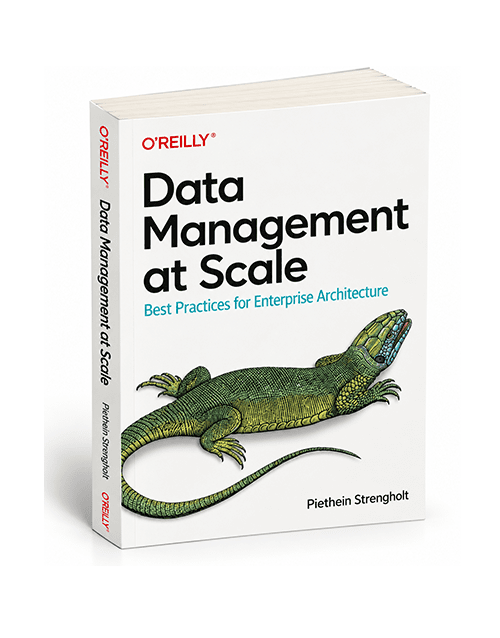


Data Management at Scale: Best Practices for Enterprise Architecture (9781492054788) by Piethein Strengholt is an O’Reilly Media book about designing enterprise data systems that can grow without making every team depend on the same central platform. It starts with a familiar problem. Data may be available somewhere in an organization, but getting it to another team in a usable form can mean waiting for a new integration, duplicating work, or negotiating access. Strengholt uses that problem to explain why architecture and ownership need to be considered together.
The book Data Management at Scale (9781492054788) introduces the Scaled Architecture, an approach that organizes data around business domains and makes it available across organizational boundaries. It draws on domain-driven design to explain why applications have different contexts and why a dataset that serves one application may not be ready for another. Topics include authoritative data sources, domain data stores, and agreements between data providers and consumers. The point is not to copy everything into more places. It is to make clear who provides the data, what others can expect from it, and how it can be shared.
Strengholt explains several ways to make that architecture work. One chapter looks at read-only data stores and the separation of reads from writes, showing why analytical queries and operational updates can place different demands on a system. Another covers application programming interfaces (APIs), service contracts, and gateways. A chapter on event streaming introduces Apache Kafka and discusses how producers and consumers exchange updates asynchronously. These patterns address different needs, from looking up information on demand to distributing changes as they occur.
The discussion of data governance covers what happens when more teams can publish and consume data. The book examines security, privacy, metadata management, and master data management. Metadata helps readers understand how a catalog or marketplace can make datasets discoverable without making them available to everyone. A team may need to know who owns a dataset and whether it is suitable for a given use before it requests access. That difference between finding data and being authorized to use it matters in a distributed enterprise.
The book Data Management at Scale (9781492054788) is written for enterprise architects, data architects, analytics teams, and people responsible for governance or compliance. It compares centralized and decentralized ways of organizing delivery and considers how responsibilities can shift gradually rather than through a single migration. The examples and architecture patterns are useful for readers who want to examine integration, ownership, and access together. The book’s focus is not on picking one database or cloud service. It is on designing an enterprise data architecture that lets teams share and reuse information without losing track of where it came from, who is responsible for it, or which controls still apply.
There are no reviews yet.