



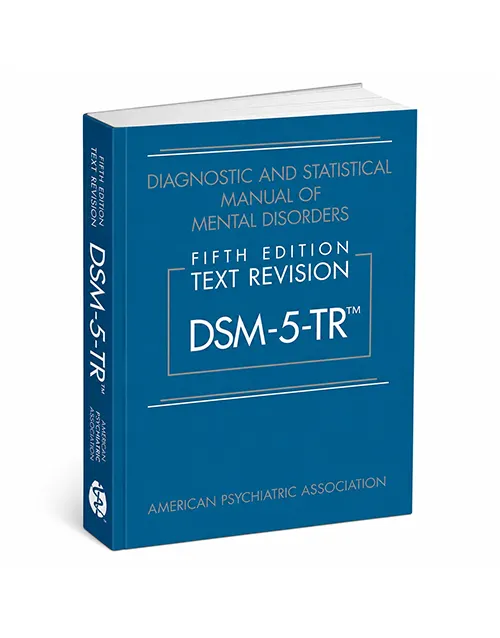



The Diagnostic and Statistical Manual of Mental Disorders (DSM 5 TR) 5th Edition Book (9780890425763) is a major clinical reference for understanding the classification and diagnosis of mental disorders. Published by the American Psychiatric Association Publishing, this fifth-edition text revision provides diagnostic criteria, clinical descriptions, and supporting information for mental health professionals, researchers, and students. The paperback edition carries ISBN 9780890425763 and is intended for readers who need the full DSM 5 TR manual rather than a condensed diagnostic guide.
A central purpose of the DSM 5 TR is to provide a consistent framework for describing and classifying mental health conditions. Its diagnostic entries outline defining symptoms, required criteria, and other clinical considerations that help qualified professionals evaluate presentations in context. The manual covers a broad range of conditions, including neurodevelopmental disorders, schizophrenia spectrum and other psychotic disorders, bipolar and related disorders, depressive disorders, anxiety disorders, obsessive-compulsive and related disorders, trauma- and stressor-related disorders, personality disorders, and substance-related and addictive disorders. This breadth makes it a reference for navigating diagnostic terminology across different areas of mental health practice.
The distinction between DSM 5 and DSM 5 TR is important for buyers choosing the appropriate edition. The text revision incorporates updated descriptions and references, clarifications to diagnostic criteria, and revised ICD-10-CM diagnostic codes. It also introduces prolonged grief disorder as a diagnosable condition and includes codes for documenting suicidal behavior. Changes to discussions of prevalence, risk factors, clinical course, cultural considerations, and differential diagnosis help readers understand the context surrounding diagnostic classifications rather than relying on symptom lists alone.
The manual also addresses the influence of culture, racism, and discrimination on mental health assessment and the interpretation of clinical presentations. Its introductory material explains how the classification system is organized and how diagnostic terminology should be understood. Additional reference sections include alphabetical and numerical listings of diagnoses and their associated ICD-10-CM codes, along with an index to support navigation. These features are useful when consulting a specific diagnostic category, comparing related conditions, or locating terminology used in clinical documentation and academic work.
Psychiatrists, psychologists, clinical researchers, counselors, social workers, psychiatric trainees, and graduate students may use the DSM-5-TR diagnostic manual for professional reference, education, and research. Its standardized terminology can support communication among professionals and provide a common foundation for discussing mental disorders. However, diagnostic criteria must be interpreted alongside an individual’s history, symptoms, circumstances, and professional assessment; the manual is not a substitute for clinical judgment.
For buyers seeking the Diagnostic and Statistical Manual of Mental Disorders DSM 5-TR 5th Edition (9780890425763), this paperback offers the complete reference in a physical book format. It is suitable for clinical offices, university libraries, psychology and psychiatry programs, and personal professional reference collections. Before ordering, verify the ISBN and paperback format to distinguish this edition from the hardcover version, electronic editions, pocket guides, and other DSM-related publications.
There are no reviews yet.