

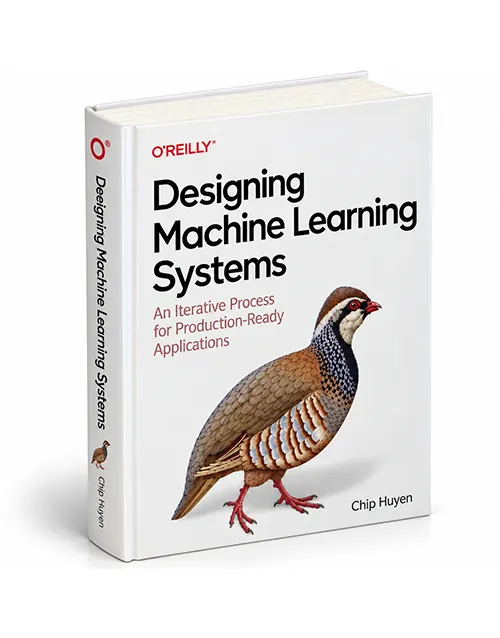


Designing Machine Learning Systems: An Iterative Process for Production-Ready Applications
Designing Machine Learning Systems by Chip Huyen is a technical guide to designing, developing, deploying, and maintaining machine learning applications in real-world environments. Published by O’Reilly Media, this book presents a practical framework for building machine learning systems that are reliable, scalable, maintainable, and adaptable to changing data and business requirements.
Developing a machine learning model is only one part of delivering a successful AI application. Production systems also depend on data pipelines, infrastructure, software integration, model evaluation, monitoring, and ongoing maintenance. This book explores these connected components and helps readers understand how engineering decisions affect the entire machine learning system.
Understand Machine Learning Systems Design
The book begins by examining machine learning systems and how their requirements differ from those of traditional software applications. Readers explore how to frame machine learning problems, connect technical goals with business objectives, and evaluate system requirements such as reliability, scalability, maintainability, and adaptability.
This systems-level approach encourages engineers to consider the complete lifecycle of an ML application rather than focusing exclusively on model accuracy. Selecting appropriate metrics, understanding constraints, and defining practical objectives are important steps in building solutions that deliver useful results.
Build Reliable Data Engineering Workflows
Data quality and data availability are fundamental to successful machine learning. Designing Machine Learning Systems covers data engineering concepts such as data sources, formats, storage systems, processing methods, databases, batch processing, stream processing, and extract-transform-load workflows.
Understanding these concepts helps readers evaluate how data enters a system, how it is transformed, and how it becomes available for training and prediction. The book also explores the relationship between data infrastructure and ML applications, highlighting why pipeline design and data management must be considered alongside model development.
Develop and Evaluate Machine Learning Models
Machine learning systems require a structured approach to creating training data, selecting features, developing models, and measuring performance. The book examines these decisions within the broader system architecture, helping readers understand how model development connects to the application’s objectives and operational requirements.
Readers can explore model evaluation, experimentation, and the metrics used to assess performance. The book also discusses issues such as data leakage, class imbalance, and distribution shifts, which can affect how models behave when deployed beyond their original training environment.
Deploy Models into Production
Turning a trained model into a functioning production application requires more than exporting a model file. Engineers must consider deployment architecture, serving infrastructure, prediction requirements, integration with other systems, and the needs of users and downstream applications.
This book discusses production-oriented design decisions and the challenges involved in deploying machine learning models. Its iterative approach encourages engineers to evaluate system performance in context and refine their implementations as requirements, data, and operating conditions change.
Monitor and Maintain Machine Learning Applications
Machine learning systems can change in effectiveness as user behavior, input data, and operating environments evolve. Monitoring helps teams observe system performance, identify unexpected changes, and investigate problems that may affect predictions or service quality.
Designing Machine Learning Systems explores the importance of developing monitoring systems and continually evaluating deployed applications. Readers can learn why ongoing observation, model updates, and systematic maintenance are important parts of operating machine learning solutions reliably.
Design Adaptable ML Platforms
Organizations often need infrastructure that supports multiple machine learning applications rather than a separate, disconnected platform for every project. The book explores the architectural considerations involved in creating ML platforms that support reuse, operational consistency, and different application requirements.
Readers can consider how data workflows, model development processes, deployment methods, and monitoring practices fit together. These concepts are useful for teams that want to make machine learning development more repeatable while maintaining appropriate flexibility for individual use cases.
Responsible Machine Learning
Building an ML system also involves considering the potential consequences of automated decisions. Data limitations, biases, changing environments, and the ways predictions are used can affect the outcomes of an application. Responsible machine learning requires teams to recognize these issues and incorporate suitable evaluation and oversight into system design.
The book includes discussion of developing responsible ML systems and encourages readers to consider practical and organizational requirements alongside technical performance. This broader view helps engineers understand that a production-ready system should be evaluated by more than a single accuracy metric.
Who Should Read Designing Machine Learning Systems?
Designing Machine Learning Systems is suitable for machine learning engineers, data scientists, software engineers, data engineers, AI developers, and technical professionals involved in deploying models into production. It can also benefit students and practitioners who want to understand the infrastructure and processes that connect machine learning research with real applications.
Readers with experience in machine learning or software development can use the book to explore system design, engineering workflows, model operations, and operational trade-offs. It also provides a framework for thinking about the full lifecycle of an ML project, from defining objectives and preparing data to monitoring and maintaining deployed systems.
Why Choose This Machine Learning Engineering Book?
- Production-focused learning: Examines the challenges of moving ML models from development into real applications.
- End-to-end system design: Connects data engineering, model development, deployment, and monitoring.
- Practical engineering decisions: Discusses reliability, scalability, maintainability, and adaptability.
- Data pipeline fundamentals: Covers data ingestion, processing, storage, and workflow design.
- Operational awareness: Explores model evaluation, monitoring, updates, and changing data conditions.
- Responsible AI perspective: Includes considerations for developing responsible machine learning systems.
About the Book
Title: Designing Machine Learning Systems
Subtitle: An Iterative Process for Production-Ready Applications
Author: Chip Huyen
Publisher: O’Reilly Media
Edition: First Edition
Publication Date: June 2022
Print ISBN-13: 9781098107963
Pages: 386 in the standard print catalog record
For readers looking to develop production-ready machine learning applications, Designing Machine Learning Systems offers a practical introduction to the engineering decisions, workflows, and infrastructure involved in building reliable ML systems.
There are no reviews yet.