

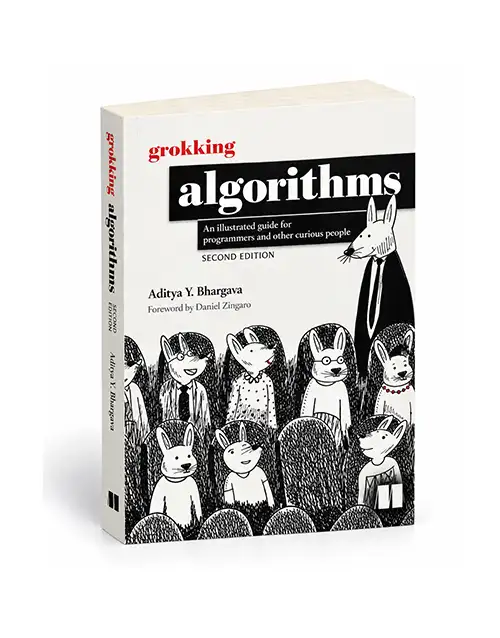


Grokking Algorithms, Second Edition
Grokking Algorithms, 2nd Edition by Aditya Y. Bhargava is an illustrated computer science textbook designed to make algorithms and data structures easier to understand. Published by Manning, this revised edition introduces essential programming algorithms through simple explanations, practical examples, detailed illustrations, and Python 3 code samples.
Algorithms are fundamental to computer programming. They provide step-by-step methods for solving problems, processing information, organizing data, and improving software performance. Understanding algorithms helps programmers write efficient applications, make better technical decisions, and select appropriate solutions for different programming challenges.
This book takes a visual and practical approach to algorithm learning. Instead of relying heavily on complicated mathematical proofs, it uses diagrams, examples, and annotated code to explain how algorithms work and when they should be used.
Understand the Basics of Algorithms
The book begins with an introduction to algorithms and explains how programmers can approach problems systematically. Readers learn how algorithms work, why efficiency matters, and how to compare different solutions to the same problem.
It introduces Big O notation, an important concept for understanding how an algorithm’s running time or resource requirements change as the input size increases.
These foundational concepts help students recognize why an algorithm that works well with a small dataset may become inefficient when processing much larger amounts of information.
Learn Binary Search and Efficient Searching
Searching is one of the most common operations in computer programming. The textbook introduces binary search and explains how it can locate an item in a sorted collection by repeatedly narrowing the search area.
Readers can understand the difference between linear searching and binary searching, how the process works step by step, and why the organization of data affects search performance.
These concepts provide an introduction to algorithmic efficiency and help programmers recognize situations where one search strategy is more suitable than another.
Explore Arrays, Linked Lists, and Selection Sort
The book introduces fundamental data structures, including arrays and linked lists, and explains how the choice of data structure influences program performance.
Readers learn how memory is used by different data structures and how operations such as accessing, inserting, and removing elements can have different performance characteristics.
The chapter also introduces selection sort, demonstrating how a sorting algorithm organizes data by repeatedly selecting the next appropriate element. Through examples and code, readers can understand the algorithm’s behavior and its performance limitations.
Understand Recursion
Recursion is a programming technique in which a function calls itself to solve smaller versions of a problem.
The textbook explains recursive functions, base cases, recursive cases, and the role of the call stack. Visual examples help readers understand how recursive calls are created and how they eventually return results.
Understanding recursion is useful for working with problems involving trees, divide-and-conquer techniques, hierarchical data, and other structures that can be naturally broken into smaller subproblems.
Learn Quicksort and Divide-and-Conquer Algorithms
Quicksort is a widely used sorting algorithm that demonstrates the power of divide-and-conquer problem solving.
The book explains how a problem can be divided into smaller parts, processed independently, and combined into a final solution. Readers can understand the role of pivot selection, partitioning, recursive calls, and algorithm performance.
It also revisits Big O notation to help readers compare algorithm efficiency and develop a stronger understanding of why certain approaches scale better than others.
Study Hash Tables and Fast Data Retrieval
Hash tables are important data structures used for efficient storage and retrieval of information. They are commonly used in applications involving dictionaries, lookup operations, caching, and database-related programming.
Readers learn how hash functions connect keys to stored values and how hash tables support efficient retrieval. The book also explains collisions and the importance of choosing appropriate approaches for managing stored data.
These concepts help programmers understand one of the most useful data structures in everyday software development.
Explore Graph Algorithms and Breadth-First Search
Graphs are data structures used to represent relationships and connections between objects. They are useful in social networks, maps, recommendation systems, and other applications involving interconnected information.
The textbook introduces graph representation and breadth-first search (BFS). Readers can learn how BFS explores a graph level by level and how it can be used to find the shortest path in an unweighted graph.
Practical examples make it easier to understand how graph traversal works and how algorithms can solve relationship and path-finding problems.
Learn Trees and Balanced Trees
The second edition adds expanded coverage of trees, including binary search trees, balanced trees, and B-trees.
Trees provide hierarchical structures for organizing information. They are important in search operations, data storage, indexing, and many computer science applications.
Readers can understand how binary search trees organize values and how balanced trees help improve search and update performance. The addition of B-trees introduces another important data structure used in systems that manage large collections of information.
This new material expands the book’s coverage of data structures and helps readers understand how different tree structures support efficient data access.
Understand Dijkstra’s Algorithm and Shortest Paths
Dijkstra’s algorithm is an important graph algorithm used to find shortest paths in weighted graphs with nonnegative edge weights.
The book introduces how the algorithm evaluates possible routes and determines the shortest path from a starting point to other reachable nodes.
Through illustrations and examples, readers can follow the algorithm’s steps and understand how it can be applied to route planning, network analysis, and other graph-based problems.
Study Greedy Algorithms and Optimization
Greedy algorithms solve problems by making a locally attractive choice at each step. The textbook explains the reasoning behind greedy techniques and demonstrates how they can be applied to practical optimization problems.
Readers can examine how these algorithms make decisions, where they are useful, and why a locally optimal choice does not always guarantee a globally optimal solution.
The chapter helps students recognize optimization problems and understand when greedy strategies can provide efficient solutions.
Explore NP-Complete Problems
NP-complete problems represent an important area of computer science because they involve computational challenges that can become extremely difficult as problem sizes increase.
The book introduces the idea of NP-completeness and explains how to recognize problems that may be difficult to solve exactly in a reasonable amount of time.
Readers learn why approximation and alternative problem-solving strategies may be useful when exact solutions become impractical.
Learn Dynamic Programming
Dynamic programming is a technique used to solve complex problems by breaking them into smaller overlapping subproblems and storing intermediate results.
The textbook introduces the principles behind dynamic programming and demonstrates how it can reduce repeated computation.
Readers can develop an understanding of how to identify suitable problems, define subproblems, and construct solutions using previously calculated results.
This approach is especially useful when working with optimization, sequence problems, and other computational challenges involving repeated subproblems.
Understand the K-Nearest Neighbors Algorithm
The book introduces the k-nearest neighbors (KNN) algorithm and explains how it can be used to identify patterns and make predictions based on nearby data points.
Readers can understand the basic principles of similarity-based learning and how the choice of neighboring observations influences the result.
This provides an accessible introduction to machine learning concepts and demonstrates how algorithmic techniques can be used in predictive applications.
Compare Algorithm Performance and Data Structure Trade-Offs
Choosing an appropriate algorithm requires understanding both the problem and the characteristics of the available data structures.
The second edition includes updated discussion of data structure performance that takes modern CPUs into account. This helps readers understand that practical performance depends on more than theoretical complexity alone.
The book encourages programmers to evaluate efficiency, memory usage, implementation complexity, and the requirements of a particular programming task before choosing a solution.
Practice with Python 3 Code Samples
The second edition updates its fully annotated code examples to Python 3, making the programming demonstrations relevant to contemporary Python-based learning environments.
Readers can follow the code alongside the explanations and observe how algorithms operate in practical examples.
Exercises and code samples are included throughout the chapters, giving learners opportunities to test their understanding and apply the techniques they have studied.
Learn Through More Than 400 Illustrations
A defining feature of Grokking Algorithms is its illustration-focused approach. The second edition includes more than 400 illustrations that visually explain algorithms, data structures, and their operations.
Diagrams help readers follow processes such as searching, sorting, recursion, graph traversal, tree operations, and shortest-path calculations.
This visual teaching style makes the book particularly approachable for beginners who find traditional algorithm textbooks difficult to follow.
Who Should Read Grokking Algorithms?
Grokking Algorithms, Second Edition is suitable for computer science students, beginner programmers, self-taught developers, software engineers, coding interview candidates, and anyone interested in understanding essential algorithms.
It is particularly useful for learners who want to build a foundation in algorithms and data structures before moving on to more advanced computer science subjects.
Professional developers can also use it to refresh their understanding of common algorithms, compare data structure choices, and improve their approach to everyday programming problems.
Why Choose the Second Edition?
- Beginner-friendly explanations: Introduces algorithms without requiring advanced mathematics or extensive programming experience.
- Visual learning: Uses more than 400 illustrations and detailed walkthroughs.
- Essential algorithms: Covers searching, sorting, recursion, quicksort, graph algorithms, and shortest paths.
- Important data structures: Explains arrays, linked lists, hash tables, trees, balanced trees, and B-trees.
- Advanced problem solving: Introduces greedy algorithms, NP-complete problems, and dynamic programming.
- Machine learning introduction: Includes k-nearest neighbors.
- Updated programming examples: Uses Python 3 code samples.
- Practical exercises: Includes exercises and code examples throughout the chapters.
- Modern performance insights: Discusses data structure performance with modern CPUs in mind.
About the Book
Title: Grokking Algorithms
Subtitle: An Illustrated Guide for Programmers and Other Curious People
Edition: Second Edition
Author: Aditya Y. Bhargava
Foreword: Daniel Zingaro
Publisher: Manning Publications
Publication Date: March 26, 2024
ISBN-13: 9781633438538
Format: Trade Paperback
Pages: 320
Language: English
For readers beginning their study of computer science algorithms, Grokking Algorithms, Second Edition provides an accessible introduction to searching, sorting, data structures, graph algorithms, optimization techniques, dynamic programming, and machine learning concepts through practical Python 3 examples and extensive illustrations.
There are no reviews yet.