

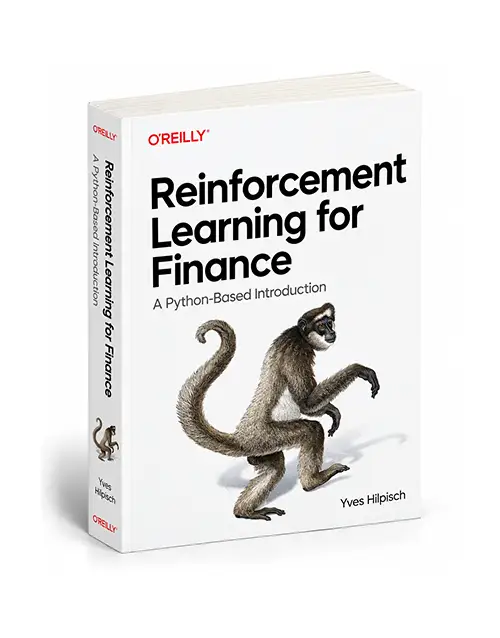


Reinforcement Learning for Finance: A Python-Based Introduction
Reinforcement Learning for Finance by Yves Hilpisch is a practical guide to understanding and applying reinforcement learning techniques to financial problems. Published by O’Reilly Media in 2024, this book combines the foundations of reinforcement learning with Python-based implementations and examples from quantitative finance.
Reinforcement learning is a machine learning approach in which an agent learns how to make decisions by interacting with an environment and receiving rewards or penalties. In finance, this approach can be applied to decision-making problems involving trading, portfolio allocation, hedging, and the execution of financial transactions.
The book introduces these ideas progressively, beginning with basic reinforcement learning concepts and deep Q-learning before moving into financial applications. It also examines how simulated and generated data can support the development and evaluation of learning agents.
Understand Learning Through Interaction
The first chapter introduces the foundations of learning through interaction and explains how an agent can improve its decisions based on observations and feedback from an environment.
Readers begin with Bayesian learning and practical probability examples, including tossing a biased coin and rolling a biased die. These examples provide an accessible way to understand how probabilities and prior beliefs can be updated when new information becomes available.
The chapter then introduces reinforcement learning, its historical development, major breakthroughs, and the building blocks required to understand learning agents.
It also introduces deep Q-learning and explains how reinforcement learning differs from approaches that simply learn from fixed training examples.
Explore Deep Q-Learning
Deep Q-learning combines Q-learning with neural networks to help an agent learn decision-making strategies in more complex environments.
The book introduces decision problems and dynamic programming before explaining the principles of Q-learning. Readers can understand how an agent evaluates possible actions, learns from rewards, and improves its behavior through repeated interaction.
A practical example uses the CartPole environment. The chapter develops an understanding of the game environment, begins with a random agent, and then progresses to a deep Q-learning agent.
It also compares Q-learning with supervised learning, helping readers understand the differences between learning through interaction and learning from labeled examples.
Understand Financial Q-Learning
After establishing the foundations of deep Q-learning, the book applies these concepts to financial decision-making.
Readers are introduced to a financial environment and a deep Q-learning agent designed for financial applications. The chapter examines how the decision-making process can be translated into a financial setting and how an agent can interact with a simulated market environment.
It also discusses where the analogy between game environments and financial markets becomes limited. Topics include limited data availability and the potential impact of actions within a financial environment.
This discussion is important because financial markets have different characteristics from controlled game simulations. Financial observations may be limited, noisy, uncertain, and influenced by external events.
Learn with Simulated Financial Data
Financial machine learning often requires data that can support repeated experimentation and model development. The book explores simulated data as a way to create controlled learning environments.
Readers can study noisy time-series data and simulated time-series data. These examples demonstrate how synthetic observations can be generated and used in reinforcement learning experiments.
The chapter also develops a Python implementation through a DQLAgent class, connecting the theoretical ideas with practical code.
Working with simulated data helps readers examine how an agent behaves under different conditions and understand the effect of changing the environment or model parameters.
Explore Generated Data for Financial Applications
The book continues with generated data and examines how artificial datasets can support financial machine learning workflows.
Readers begin with a simple example and then explore a financial example involving generated observations.
The chapter also introduces the Kolmogorov-Smirnov test, a statistical method used to compare distributions. This provides a way to examine whether generated data resembles the intended reference data.
These techniques help readers understand the role of data generation and statistical evaluation when preparing financial environments for reinforcement learning experiments.
Apply Reinforcement Learning to Algorithmic Trading
Algorithmic trading involves using computer programs and systematic rules to make trading decisions. The book demonstrates how reinforcement learning can be applied to this area through a practical trading environment.
The chapter revisits the prediction game and develops a trading environment in which a learning agent can make decisions.
Readers can explore the structure of the trading environment, the responsibilities of a trading agent, and the Python components involved in the simulation.
The DQLAgent class and simulation environment provide a practical framework for understanding how an agent interacts with financial data and evaluates trading decisions.
This chapter connects deep Q-learning concepts with systematic trading research and helps readers understand how reinforcement learning can be incorporated into algorithmic trading experiments.
Understand Dynamic Hedging
Hedging is an important part of financial risk management. Dynamic hedging involves adjusting a financial position over time as market conditions and other relevant variables change.
The book explores delta hedging and explains how a hedging environment can be modeled for reinforcement learning.
Readers can examine how a hedging agent interacts with the environment and how learning-based methods can be used to study hedging decisions.
The chapter also refers to the Black-Scholes-Merton (1973) formula, providing a financial modeling foundation for the hedging example.
Through this application, readers can connect reinforcement learning with option-related risk management and dynamic financial decision-making.
Explore Dynamic Asset Allocation
Asset allocation concerns how capital is distributed among different investments. Dynamic asset allocation examines how these allocations may change as market conditions, objectives, and financial information evolve.
The textbook introduces two-fund separation and examines portfolio allocation through two-asset and three-asset cases.
Readers can study how reinforcement learning can be applied to portfolio decisions and compare an equally weighted portfolio with learning-based allocation approaches.
The chapter also includes a practical three-asset example and associated Python code, connecting theoretical portfolio concepts with computational experimentation.
Learn Optimal Execution with Reinforcement Learning
Optimal execution focuses on how financial orders can be carried out under specific market and trading conditions.
The book presents an execution model and explains how it can be implemented within a learning environment.
Readers can explore an execution environment, begin with a random agent, and then examine an execution agent that learns through interaction.
This chapter provides another practical application of reinforcement learning in financial markets, extending the discussion beyond trading signals and portfolio decisions to the execution process itself.
Understand the Complete Reinforcement Learning Workflow
A key strength of Reinforcement Learning for Finance is the progression from general machine learning concepts to financial applications.
Readers first learn how an agent interacts with an environment, how Q-learning works, and how deep Q-learning can be implemented. They then explore simulated and generated data before applying these techniques to trading, hedging, asset allocation, and optimal execution.
This structure helps connect the mathematical and computational foundations of reinforcement learning with practical financial decision problems.
Develop Python-Based Reinforcement Learning Skills
The book emphasizes hands-on implementations using Python. Its examples demonstrate how reinforcement learning concepts can be translated into working programs and financial simulations.
Readers can follow agent implementations, environment definitions, simulation workflows, and the calculations involved in different financial applications.
This practical approach is useful for programmers and quantitative professionals who want to experiment with reinforcement learning rather than study the concepts only at a theoretical level.
Who Should Read Reinforcement Learning for Finance?
Reinforcement Learning for Finance: A Python-Based Introduction is suitable for machine learning practitioners, quantitative analysts, financial traders, portfolio managers, investment strategists, financial researchers, and Python developers.
It is particularly useful for readers interested in applying Q-learning and deep Q-learning to financial decision-making, algorithmic trading, dynamic hedging, portfolio allocation, and trade execution.
Readers should have some familiarity with Python programming and basic quantitative or machine learning concepts to get the most from the practical examples.
Why Choose This Book?
- Reinforcement learning foundations: Explains learning through interaction, Bayesian learning, and Q-learning.
- Deep Q-learning: Introduces the DQL approach through practical decision problems and CartPole examples.
- Financial applications: Connects reinforcement learning with real financial decision-making problems.
- Data simulation: Covers simulated time-series data, generated data, and statistical distribution testing.
- Algorithmic trading: Develops a financial trading environment and learning agent.
- Dynamic hedging: Explores delta hedging and learning-based hedging decisions.
- Asset allocation: Examines two-asset and three-asset portfolio allocation examples.
- Optimal execution: Introduces learning agents for financial trade execution.
- Python implementations: Uses practical code examples and agent classes to demonstrate the methods.
About the Book
Title: Reinforcement Learning for Finance
Subtitle: A Python-Based Introduction
Author: Yves Hilpisch
Publisher: O’Reilly Media, Inc.
Publication Date: November 19, 2024
Publication Year: 2024
Edition: First Edition
Print ISBN-13: 9781098169145
Format: Paperback
Pages: 212
Language: English
For readers interested in combining artificial intelligence with quantitative finance, Reinforcement Learning for Finance provides a focused introduction to Python-based learning agents and financial applications. Its coverage of deep Q-learning, simulated data, algorithmic trading, dynamic hedging, asset allocation, and optimal execution makes it a useful resource for studying reinforcement learning in financial environments.
Note: The book presents educational implementations and simulations. Its examples should not be interpreted as guarantees of profitable trading or investment performance.
There are no reviews yet.