

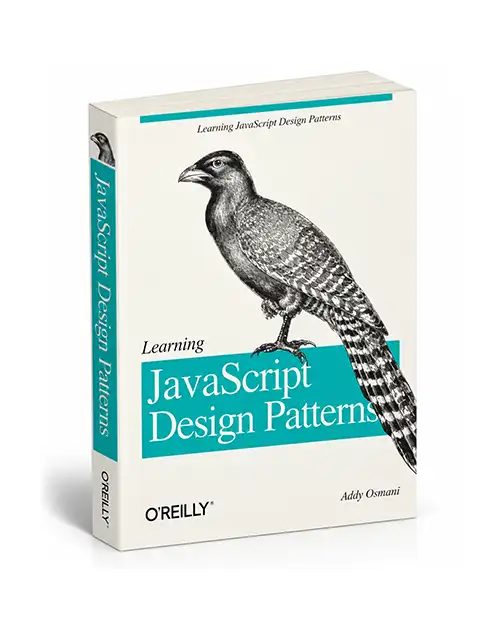


Learning JavaScript Design Patterns: A JavaScript and jQuery Developer’s Guide
Learning JavaScript Design Patterns by Addy Osmani is a practical guide to writing organized, reusable, and maintainable JavaScript applications through proven software design patterns. Published by O’Reilly Media in 2012, this book introduces the principles behind design patterns and demonstrates how they can be applied to JavaScript and jQuery development.
As JavaScript applications grow, developers often face challenges involving code organization, reusable components, application architecture, communication between modules, and long-term maintainability. Design patterns provide established approaches to solving common software design problems.
This book explains how classical object-oriented design concepts can be adapted to JavaScript’s features, including functions, objects, closures, prototypes, and modular code. It combines theoretical explanations with practical examples to help developers understand not only how patterns work but also when they are appropriate.
Understand the Foundations of Design Patterns
The opening chapters introduce the history, purpose, and structure of software design patterns. Readers learn what a design pattern represents and how recurring programming problems can be addressed through reusable solutions.
The book explains how developers encounter patterns in everyday programming and why recognizing these approaches can improve software design.
It also introduces the concept of proto-patterns and the Rule of Three, helping readers understand when a recurring solution may be mature enough to become a documented design pattern.
These foundations prepare developers to evaluate patterns rather than simply copying implementations without understanding the problem they are intended to solve.
Learn How to Identify and Write Design Patterns
A useful design pattern needs a clearly understood problem, an organized solution, and an explanation of its consequences. The textbook examines the structure of a design pattern and the elements involved in documenting one effectively.
Readers can explore how patterns are described, how their components relate to one another, and why examples are important when explaining a reusable design approach.
The chapter also discusses how developers can write their own patterns by examining recurring problems and identifying solutions that may be useful in other situations.
Understand Anti-Patterns in JavaScript
Not every commonly used programming approach produces good results. Anti-patterns are practices that may appear useful initially but can create unnecessary complexity, poor performance, or maintenance difficulties.
The book introduces anti-patterns and explains why developers should recognize problematic approaches before they become established throughout an application.
This discussion encourages programmers to evaluate their code carefully, distinguish effective practices from harmful habits, and avoid repeating mistakes that reduce software quality.
Explore the Main Categories of Design Patterns
The book organizes design patterns into three important categories: creational, structural, and behavioral patterns.
Creational Design Patterns
Creational patterns address how objects are created and initialized. They provide approaches for controlling object construction and reducing unnecessary dependencies between application components.
The chapter introduces patterns such as Constructor, Module, Singleton, Prototype, and Factory. Readers can understand the situations in which these approaches may help organize JavaScript applications.
Structural Design Patterns
Structural patterns focus on how objects and components are combined to create larger software structures.
The book examines patterns including Facade, Decorator, Flyweight, and other techniques that help developers organize functionality, simplify interfaces, and reuse existing components.
Behavioral Design Patterns
Behavioral patterns describe how objects and application components communicate and distribute responsibilities.
The textbook covers patterns such as Observer, Mediator, and Command, explaining how they can support communication, event handling, and coordination within JavaScript applications.
Understanding these categories gives readers a framework for selecting appropriate design solutions rather than treating every pattern as interchangeable.
Learn JavaScript Design Patterns Through Practical Examples
A central part of the book focuses on implementing classical and modern design patterns using JavaScript.
Constructor Pattern
The Constructor pattern provides an approach to object creation in JavaScript. The book explores basic constructors and constructors using prototypes, helping readers understand how JavaScript objects can be initialized and organized.
Module Pattern
The Module pattern is an important technique for organizing JavaScript code into separate components. It helps developers structure related functionality and control access to internal implementation details.
Readers can explore object literals, privacy, module variations, import mixins, and exports. The chapter also discusses module pattern implementations associated with frameworks and toolkits such as Dojo, ExtJS, YUI, and jQuery.
Revealing Module Pattern
The Revealing Module pattern builds on the module approach by making the relationship between private implementation details and publicly accessible functions more explicit.
The book explains its structure, advantages, and disadvantages to help developers understand when this approach may be useful.
Singleton Pattern
The Singleton pattern focuses on controlling the creation and access of a particular object instance. Readers can understand its intended purpose and how it can be represented in JavaScript.
Observer Pattern
The Observer pattern enables one component to notify other components when an event or state change occurs.
The book also discusses the Publish/Subscribe pattern, compares the two approaches, and demonstrates how event-based communication can help decouple application components.
Mediator Pattern
The Mediator pattern provides an approach to coordinating communication between different components through a central mediator.
Readers can examine basic and advanced implementations and understand the differences between Mediator, Observer, and Facade approaches.
Prototype Pattern
The Prototype pattern uses existing objects as the basis for creating other objects. This topic connects design pattern concepts with JavaScript’s prototypal inheritance model.
Command Pattern
The Command pattern encapsulates operations as separate objects or structures, helping organize actions and the components responsible for executing them.
Facade Pattern
The Facade pattern provides a simplified interface to a more complicated subsystem. The book explains how abstraction can make application components easier to use and maintain.
Factory Pattern
The Factory pattern addresses object creation by separating construction decisions from the code that uses the resulting objects.
Readers can study when factory methods and abstract factories are useful and when introducing a factory may create unnecessary complexity.
Mixin Pattern
The Mixin pattern explores techniques for sharing reusable functionality across objects and components.
The book discusses subclassing and mixins, along with the advantages and disadvantages of these approaches.
Decorator Pattern
The Decorator pattern provides a method for extending functionality without changing the original object structure directly.
Readers can explore decorator implementations in JavaScript, including approaches involving jQuery, and understand their practical trade-offs.
Flyweight Pattern
The Flyweight pattern focuses on efficient memory usage by sharing reusable data and minimizing unnecessary object duplication.
The chapter explores the separation of intrinsic and extrinsic state and demonstrates how the pattern can be applied to JavaScript and DOM-related development.
Understand JavaScript Architectural Patterns
Beyond individual design patterns, the book examines architectural approaches for organizing complete applications.
Model-View-Controller (MVC)
MVC separates an application into models, views, and controllers. This separation helps organize data, user-interface presentation, and application logic.
The book explores traditional MVC concepts and examines how they can be applied to JavaScript development, including examples involving Backbone.js and Spine.js.
Model-View-Presenter (MVP)
MVP separates presentation logic from the model and view through a presenter component. Readers can examine the responsibilities of each component and compare MVP with MVC.
Model-View-ViewModel (MVVM)
MVVM introduces the ViewModel as an intermediary between the view and the model.
The textbook explores data binding, the role of the ViewModel, and the differences between MVC, MVP, and MVVM. It also discusses how frameworks such as KnockoutJS support these architectural approaches.
These architectural patterns help developers evaluate different ways to structure larger JavaScript applications and organize user-interface logic.
Explore Modern Modular JavaScript Development
As JavaScript projects become larger, managing dependencies and organizing code into modules becomes increasingly important.
The book examines multiple module formats and the tools used to load and organize JavaScript components.
Asynchronous Module Definition (AMD)
AMD provides a module-loading approach designed to support asynchronous dependency management. The textbook discusses AMD modules, Dojo and jQuery integrations, module loading, and the reasons developers may choose this format.
CommonJS
CommonJS introduces a different module structure that is particularly relevant to server-side JavaScript environments.
Readers can explore dependency consumption, loaders and frameworks that support CommonJS, and the challenges associated with using CommonJS in browser environments.
ES Harmony and Modern JavaScript Modules
The book also discusses ES Harmony, including imports, exports, module loading, and language features associated with the evolution of JavaScript.
These topics help readers understand the development of JavaScript module systems and the different approaches available for structuring code.
Study jQuery Design Patterns
jQuery became an important part of JavaScript web development by providing a consistent interface for DOM manipulation, events, and other browser operations.
The textbook explores how established design patterns can be implemented through the jQuery library.
Topics include Composite, Adapter, Facade, Observer, Iterator, Lazy Initialization, Proxy, and Builder patterns.
Through these examples, readers can understand how design patterns can support the organization of browser-based functionality and improve code reuse.
Build Maintainable jQuery Plugins
Developing a reusable jQuery plugin involves more than creating a function that performs a particular operation. It requires thoughtful organization, configurable options, compatibility, and clear interfaces.
The book introduces several plugin design approaches, including lightweight initialization, the jQuery UI Widget Factory, nested namespacing, custom events, and widget-related integration patterns.
It also explores RequireJS integration and techniques for providing globally configurable and per-call options.
The chapter concludes by discussing qualities of well-designed plugins, including code style, compatibility, reliability, performance, documentation, and long-term maintenance.
Improve JavaScript Code Organization with Namespacing
Namespacing helps developers organize related functions, objects, and application components while reducing the risk of naming collisions.
The textbook explores basic namespacing techniques, including single global variables, prefixes, object literal notation, nested namespaces, immediately invoked function expressions (IIFEs), and namespace injection.
It also introduces advanced approaches such as automated nested namespacing, dependency declaration, and deep object extension.
These techniques provide useful foundations for organizing larger applications and managing reusable JavaScript components.
Understand the Practical Value of Design Patterns
A central theme of Learning JavaScript Design Patterns is that patterns should be used to solve real design problems rather than introduced unnecessarily.
The author explains the benefits and limitations of different approaches and encourages readers to evaluate how patterns affect complexity, flexibility, and maintainability.
This makes the book useful not only for learning individual implementations but also for developing better judgment when designing JavaScript applications.
Who Should Read Learning JavaScript Design Patterns?
Learning JavaScript Design Patterns is suitable for JavaScript developers, frontend engineers, web programmers, software development students, and professionals interested in application architecture.
It is particularly useful for developers who already understand JavaScript fundamentals and want to improve their knowledge of reusable components, modular programming, object-oriented techniques, and application design.
Developers working with jQuery, Backbone.js, browser-based applications, and JavaScript libraries may also find the examples useful for understanding the design approaches used in those ecosystems.
Why Choose This Book?
- Design pattern foundations: Explains pattern structure, anti-patterns, and the purpose of reusable design solutions.
- Three pattern categories: Covers creational, structural, and behavioral patterns.
- JavaScript implementations: Explores Module, Observer, Singleton, Factory, Prototype, Decorator, and other patterns.
- Application architecture: Explains MVC, MVP, and MVVM approaches for JavaScript applications.
- Modular development: Covers AMD, CommonJS, and ES Harmony module systems.
- jQuery patterns: Examines design patterns used within the jQuery ecosystem.
- Plugin development: Introduces reusable plugin structures and the jQuery UI Widget Factory.
- Code organization: Explores namespacing techniques for structured and maintainable applications.
- Practical code examples: Demonstrates patterns through JavaScript and jQuery implementations.
About the Book
Title: Learning JavaScript Design Patterns
Subtitle: A JavaScript and jQuery Developer’s Guide
Author: Addy Osmani
Publisher: O’Reilly Media, Inc.
Edition: First Edition
Publication Date: July 2012
Print ISBN-13: 9781449331818
Format: Paperback
Pages: 251 in O’Reilly’s online book listing
Language: English
For developers interested in writing structured and maintainable JavaScript applications, Learning JavaScript Design Patterns provides a practical introduction to reusable design solutions, object creation, application architecture, modular JavaScript, jQuery development, and namespacing. Its examples and explanations help programmers understand how established software design principles can be applied to JavaScript and web application development.
Edition note: This is the original 2012 edition. Its examples include older JavaScript module formats and jQuery-era development approaches. It remains useful for understanding classical JavaScript design patterns, but it should not be presented as a current guide to modern JavaScript frameworks and tooling.
There are no reviews yet.