

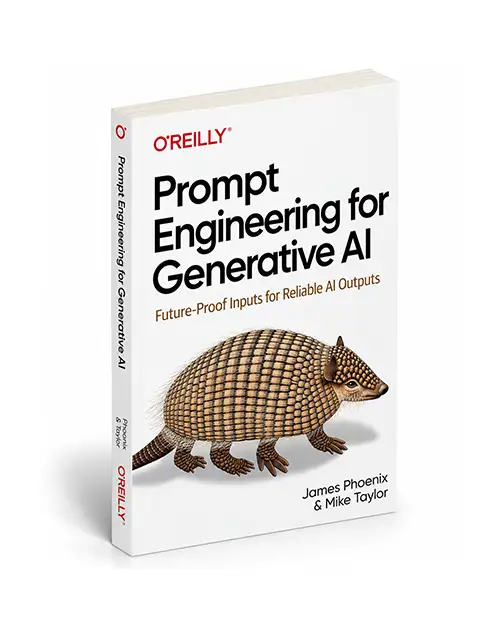


Prompt Engineering for Generative AI: Future-Proof Inputs for Reliable AI Outputs
Prompt Engineering for Generative AI by James Phoenix and Mike Taylor is a practical technical guide to designing effective prompts and developing reliable workflows with generative AI technologies. Published by O’Reilly Media in 2024, this book explores how large language models (LLMs) and diffusion models interpret instructions, process information, and generate text, images, and code.
Generative AI systems can perform a wide range of tasks, but obtaining consistent and useful results requires more than entering a simple question. Developers need to understand model behavior, provide clear instructions, structure inputs, manage context, evaluate outputs, and design workflows that handle errors and limitations.
This book introduces prompt engineering principles and connects them with practical development techniques using ChatGPT, LangChain, vector databases, autonomous agents, and image-generation tools. Its examples help readers move from individual prompts toward more structured AI-powered applications.
Understand the Five Principles of Prompt Engineering
The first chapter introduces five foundational principles for creating more effective prompts:
- Give Direction: Provide clear instructions so the model understands the task and expected outcome.
- Specify Format: Describe the required structure of the response, such as lists, tables, JSON, or other formats.
- Provide Examples: Use examples to demonstrate the desired style, structure, and type of output.
- Evaluate Quality: Review generated results against defined expectations rather than assuming every response is correct.
- Divide Labor: Break complex tasks into smaller steps that can be handled and evaluated separately.
These principles provide a foundation for designing prompts that are easier to evaluate, reuse, and integrate into automated applications.
Explore Large Language Models for Text Generation
The second chapter introduces the architecture and fundamental concepts behind large language models.
Readers learn how text-generation models process information and how vector representations provide numerical ways of representing language.
The chapter explores transformer architecture, contextual relationships, and probabilistic text generation. It also examines the historical development of transformer-based models and their role in modern generative AI.
Coverage includes OpenAI’s GPT models, ChatGPT, Google Gemini, Meta Llama, Mistral, Anthropic Claude, and open-source approaches. The discussion also introduces quantization and Low-Rank Adaptation (LoRA), providing context for understanding how models can be optimized and adapted.
This foundation helps developers understand why different models can produce different outputs and why prompt design must account for the capabilities and limitations of the model being used.
Master Standard Practices for Text Generation with ChatGPT
The third chapter focuses on practical prompt engineering techniques for working with ChatGPT and other text-generation models.
It explores structured text generation, including ordinary lists, hierarchical lists, JSON, YAML, and mock CSV data. Readers learn how to request specific output formats and handle invalid or incorrectly structured responses.
The chapter also covers content generation and transformation techniques, such as explaining complex concepts in simpler language, universal translation, identifying textual features, and generating new content in a requested style.
Context management is another important topic. The book explains summarization, context-window limitations, chunking strategies, sentence detection, sliding windows, and tokenization using tools such as spaCy and tiktoken.
Additional techniques include sentiment analysis, classification, role prompting, least-to-most planning, prompt evaluation, and approaches for reducing hallucinations by providing reference information.
These examples help developers create more structured prompts and evaluate the reliability of generated text.
Build Advanced Text Generation Workflows with LangChain
The fourth chapter explores advanced text-generation techniques using LangChain.
Readers are introduced to chat models, streaming chat models, multiple model generations, and prompt templates. The chapter explains LangChain Expression Language (LCEL) and how components can be connected into structured workflows.
It also covers output parsers, evaluations, function calling, parallel function calling, and the extraction of structured information from model responses.
Few-shot prompting is explored through fixed-length examples and techniques for selecting examples based on token limits.
Another important topic is prompt chaining and task decomposition. Readers can learn how a complex task can be divided into smaller operations and connected using sequential chains, document chains, and other processing strategies.
The chapter also explores document loading, text splitting, task planning, and the Map Reduce and Map Re-rank approaches to processing larger collections of information.
Understand Vector Databases and Retrieval-Augmented Generation
The fifth chapter introduces vector databases and retrieval-augmented generation (RAG), two important technologies used in AI applications that need to work with external information.
Readers explore embeddings and how text or other information can be represented as numerical vectors for similarity-based retrieval.
The chapter demonstrates document loading, memory retrieval, and the use of FAISS for building retrieval workflows.
It also introduces hosted vector databases using Pinecone and examines self-querying and alternative retrieval mechanisms.
These techniques provide a foundation for building applications that retrieve relevant information from external datasets and use that information as context for generative AI responses.
Explore Autonomous AI Agents with Memory and Tools
The sixth chapter examines autonomous agents and how language models can be connected to tools and memory to perform more complex tasks.
Readers are introduced to Chain-of-Thought concepts and the Reason and Act (ReAct) approach, which combines reasoning steps with actions performed through tools.
The chapter covers tool integration, OpenAI function calling, and comparisons between function-based approaches and ReAct.
It also explores agent toolkits, custom agents, and agent development using LangChain Expression Language (LCEL).
Memory is an important part of this discussion. Readers can examine long-term and short-term memory, conversation agents, conversation state, and memory types such as ConversationBufferMemory, ConversationBufferWindowMemory, ConversationSummaryMemory, and ConversationTokenBufferMemory.
Further topics include Plan-and-Execute agents, Tree of Thoughts, callbacks, request-specific callbacks, and token counting with LangChain.
Understand Diffusion Models for Image Generation
The seventh chapter moves from text generation to image-generation technologies.
It introduces diffusion models and explores the development of AI image-generation systems. Readers can examine tools and platforms including OpenAI DALL-E, Midjourney, Stable Diffusion, and Google Gemini.
The chapter also introduces text-to-video generation, demonstrating how generative AI extends beyond written content and still images.
These concepts help developers understand how image-generation models can interpret textual descriptions and produce visual outputs.
Learn Practical Image Generation with Midjourney
The eighth chapter explores prompt-writing techniques for generating images with Midjourney.
Readers can study format modifiers, art-style modifiers, reverse engineering prompts, quality boosters, negative prompts, and weighted terms.
The chapter also discusses prompting with reference images, inpainting, outpainting, and techniques for maintaining consistent characters across generated visuals.
Additional subjects include prompt rewriting, meme unbundling, meme mapping, and prompt analysis.
These techniques help readers understand how image prompts can be structured and refined to produce more controlled and consistent visual results.
Explore Advanced Image Generation with Stable Diffusion
The ninth chapter focuses on practical workflows involving Stable Diffusion.
It introduces environment setup and the AUTOMATIC1111 web user interface, providing a foundation for working with image-generation tools.
Readers can explore image-to-image generation, upscaling, image interrogation using CLIP, and inpainting and outpainting.
Advanced topics include ControlNet, the Segment Anything Model (SAM), DreamBooth fine-tuning, and the Stable Diffusion XL Refiner.
This chapter helps readers understand different approaches to modifying, refining, and controlling AI-generated images.
Build AI-Powered Applications
The tenth chapter brings together the ideas introduced throughout the book and examines how generative AI can be incorporated into complete applications.
It uses an AI-powered content workflow as a practical example, covering research, expert interviews, outline generation, text generation, writing-style control, title optimization, and AI-generated images.
Readers can understand how individual model interactions can be organized into a larger application workflow and how different generative AI capabilities can support the creation of useful digital products.
The examples connect prompt engineering, language models, image generation, and structured workflows with real-world application development.
Connect Prompt Engineering with Practical AI Development
A major strength of Prompt Engineering for Generative AI is its coverage of multiple layers of generative AI development.
It begins with the fundamentals of prompting and model architecture before moving into text-generation techniques, structured outputs, context management, LangChain workflows, vector databases, and autonomous agents.
The later chapters extend these concepts into image generation and application development, giving readers a broader perspective on how different generative AI technologies can be combined.
By connecting prompt design with tools, memory, retrieval, and model integration, the book provides a useful foundation for developers who want to move beyond simple chatbot interactions.
Who Should Read Prompt Engineering for Generative AI?
Prompt Engineering for Generative AI is suitable for AI developers, software engineers, Python programmers, data scientists, machine learning practitioners, automation specialists, and technical professionals exploring generative AI.
It is particularly useful for readers interested in LLM integration, structured text generation, LangChain development, RAG applications, autonomous agents, and AI-powered image workflows.
Developers who want to incorporate AI into software products, content systems, automation processes, and data-driven applications can also use the book as a practical learning resource.
Why Choose This Book?
- Prompt engineering foundations: Explains five practical principles for creating clearer and more reliable AI instructions.
- LLM fundamentals: Introduces transformer architecture, embeddings, probabilistic text generation, and model comparisons.
- ChatGPT techniques: Covers structured outputs, summarization, classification, role prompting, and context management.
- LangChain development: Explores prompt templates, LCEL, function calling, output parsers, and prompt chaining.
- Vector databases and RAG: Introduces embeddings, FAISS, Pinecone, and information retrieval.
- Autonomous AI agents: Covers ReAct, tools, function calling, memory, custom agents, and planning approaches.
- AI image generation: Explores DALL-E, Midjourney, Stable Diffusion, and text-to-video concepts.
- Advanced image techniques: Covers ControlNet, DreamBooth, inpainting, outpainting, and image refinement.
- AI-powered applications: Demonstrates how generative AI techniques can be organized into complete workflows.
About the Book
Title: Prompt Engineering for Generative AI
Subtitle: Future-Proof Inputs for Reliable AI Outputs
Authors: James Phoenix and Mike Taylor
Publisher: O’Reilly Media, Inc.
Edition: First Edition
Publication Date: June 25, 2024
Publication Year: 2024
Print ISBN-13: 9781098153434
Format: Paperback
Pages: 422
Language: English
For readers interested in developing practical generative AI skills, Prompt Engineering for Generative AI provides a broad introduction to prompt design, LLMs, ChatGPT, LangChain, retrieval-augmented generation, autonomous agents, diffusion models, and AI-powered applications. Its combination of explanations and hands-on development topics makes it a valuable resource for learning how to design, evaluate, and integrate generative AI workflows.
Technology note: The book’s examples refer to the AI platforms and development tools covered in its 2024 edition. Model names, APIs, frameworks, and interfaces can change, so consult current documentation when implementing the examples with newer releases.
There are no reviews yet.