

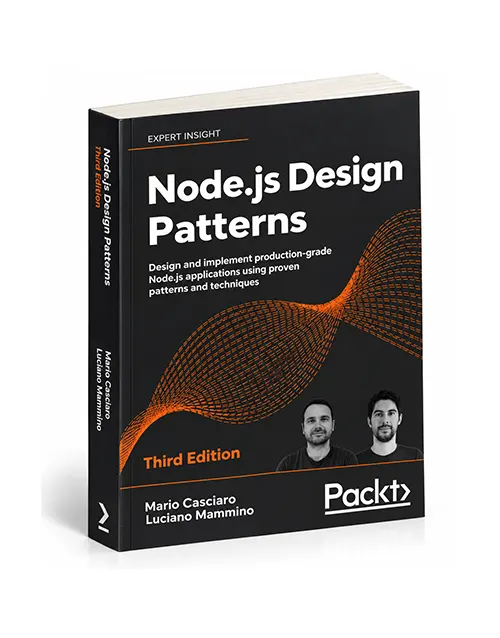


Node.js Design Patterns, Third Edition
Node.js Design Patterns, 3rd Edition by Mario Casciaro and Luciano Mammino is a comprehensive programming guide that explains how to build efficient, scalable, maintainable, and production-ready applications using Node.js. Published by Packt in July 2020, this edition combines JavaScript programming techniques with proven software design patterns and practical approaches to modern server-side development.
Node.js allows developers to use JavaScript outside the browser and build applications that interact with operating systems, databases, networks, and other services. Developing reliable Node.js software requires an understanding of its asynchronous, event-driven architecture, module system, streams, and the tools available throughout its ecosystem.
This book moves from the foundations of Node.js to advanced application architecture. It explains how to organize code, manage asynchronous operations, apply reusable design patterns, connect services, and develop applications that can grow as their requirements become more complex.
Understand the Node.js Platform
The first chapter introduces the philosophy and architecture of Node.js. Readers explore the principles behind its small core, modular ecosystem, simplicity, and pragmatic approach to application development.
The book explains how Node.js works internally, including the differences between blocking and non-blocking input/output operations. It introduces event demultiplexing, the Reactor pattern, and libuv, the underlying I/O engine used by Node.js.
Readers also examine how JavaScript operates within Node.js and how applications can interact with operating system services and native code.
These foundations help developers understand why Node.js is suited to I/O-intensive applications and how its execution model influences application architecture.
Explore the Node.js Module System
Modular design is essential for building applications that are easier to maintain, test, and extend. The second chapter examines why modules are needed and how module systems organize JavaScript code.
Readers can study the revealing module pattern, CommonJS modules, and the structure of module definitions in Node.js.
The chapter also introduces ECMAScript modules (ESM) and explains the differences between ESM and CommonJS, including interoperability between the two systems.
Understanding these approaches helps developers organize application components, manage dependencies, and choose suitable module structures for different projects.
Learn Callbacks and Events
Callbacks and events are fundamental concepts in asynchronous Node.js programming. The textbook explains the callback pattern and the Observer pattern, showing how functions and event notifications can be used to coordinate operations without blocking program execution.
Readers can understand how callbacks communicate the results of asynchronous operations and how event-based designs allow different components to respond to changes in application state.
These techniques provide the foundation for understanding the asynchronous control flow patterns used throughout Node.js applications.
Understand Asynchronous Control Flow with Callbacks
Asynchronous programming can become complicated when multiple operations depend on one another. The book examines common difficulties associated with asynchronous control flow and introduces practical techniques for organizing callback-based code.
Readers explore callback best practices, control flow patterns, and the use of the Async library.
The chapter helps developers understand how to coordinate asynchronous tasks, manage errors, and structure code that remains readable as application workflows become more complex.
Explore Promises and Async/Await
Promises and async/await provide important tools for writing structured asynchronous JavaScript. This chapter explains how these techniques can simplify asynchronous control flow and improve the readability of Node.js applications.
Readers can understand how Promises represent the eventual completion or failure of operations and how async/await offers a clearer way to work with asynchronous functions.
The book connects these language features with practical programming patterns, helping developers manage dependencies between asynchronous tasks and organize application logic more effectively.
Learn to Work with Node.js Streams
Streams are an important part of the Node.js platform, particularly for applications that process large amounts of data or handle continuous input and output.
The textbook explores stream-based programming and explains how data can be processed in manageable chunks rather than being loaded entirely into memory.
Readers can study the use of streams to build asynchronous data-processing pipelines and understand how stream composition can make applications more efficient and flexible.
These techniques are useful for file processing, network communication, data transformation, and other applications involving continuous data flows.
Understand Creational Design Patterns
Creational design patterns provide reusable approaches to object creation and resource management. The book introduces these patterns in the context of Node.js applications.
Readers can explore techniques for organizing object creation, controlling dependencies, and creating flexible components. These practices help reduce unnecessary coupling and make application code easier to extend.
The chapter demonstrates how established software design principles can be adapted to JavaScript and Node.js development.
Explore Structural Design Patterns
Structural patterns focus on how application components and objects are organized and connected.
The textbook examines ways to combine modules, wrap functionality, and build flexible component structures. It explains how structural patterns can simplify complex applications and improve the reuse of existing code.
These principles are useful when developing large Node.js projects that contain multiple services, modules, and interacting components.
Learn Behavioral Design Patterns
Behavioral design patterns describe how objects and components communicate and distribute responsibilities.
The book explores established approaches to organizing interactions between different parts of an application. Readers can understand how behavioral patterns help manage communication, coordinate operations, and keep application logic organized.
Using these techniques can make complex systems easier to maintain and improve as new requirements are introduced.
Build Universal JavaScript Applications
Universal JavaScript applications share code across server-side and browser environments. The textbook explores how developers can use JavaScript on both sides of a web application.
Readers can examine code-sharing strategies and understand how common modules can support both Node.js and browser-based functionality.
This approach can reduce duplicated development effort and encourage more consistent application architecture.
Explore Advanced Node.js Recipes
The advanced recipes chapter brings together practical techniques for solving common development challenges in Node.js applications.
It builds on the foundational material from earlier chapters and demonstrates how established patterns can be applied to more advanced scenarios.
This section is useful for developers who want to improve their existing projects and gain practical experience with more sophisticated Node.js programming techniques.
Understand Scalability and Architectural Patterns
As applications grow, software architecture becomes increasingly important. The book examines scalability and architectural patterns for developing Node.js applications that can handle increasing workloads and more complex requirements.
Readers can explore methods for structuring applications, separating responsibilities, and organizing services so that individual components can evolve without making the entire system difficult to maintain.
The coverage also introduces the design considerations involved in building scalable microservices and distributed systems powered by Node.js.
Learn Messaging and Integration Patterns
Modern applications often depend on communication between multiple services and external systems. The book examines messaging and integration patterns that help different application components exchange information.
Readers can explore message-based communication and the integration of Node.js applications with technologies such as Redis, RabbitMQ, ZeroMQ, and LevelDB.
These technologies introduce different approaches to messaging, data storage, and communication between software components.
Understanding integration patterns helps developers design applications that can interact with external systems while keeping their internal architecture organized.
Build Production-Grade Node.js Applications
A central theme of Node.js Design Patterns is the practical application of software design principles. The authors explain how proven patterns can help developers avoid common programming mistakes and create applications that are easier to maintain and extend.
The book connects asynchronous programming, module design, streams, software architecture, and system integration into a coherent approach to backend development.
It emphasizes readable code, reusable components, effective application structure, and the ability to adapt software as technical requirements change.
Who Should Read Node.js Design Patterns?
Node.js Design Patterns, Third Edition is suitable for JavaScript developers, Node.js programmers, backend engineers, software architects, full-stack developers, and computer science students with some programming experience.
It is particularly useful for developers who already understand basic JavaScript and Node.js and want to improve their application design, asynchronous programming, scalability, and software architecture skills.
Professionals building APIs, web applications, microservices, and distributed systems can also use it as a practical reference for implementing proven Node.js development patterns.
Why Choose the Third Edition?
- Node.js fundamentals: Explains the platform, asynchronous architecture, event loop concepts, and libuv.
- Module systems: Covers CommonJS, ECMAScript modules, and interoperability.
- Asynchronous programming: Explores callbacks, events, Promises, and async/await.
- Stream processing: Explains how to build asynchronous data-processing pipelines.
- Software design patterns: Covers creational, structural, and behavioral patterns.
- Universal JavaScript: Shows how code can be shared between Node.js and browser applications.
- Scalable architecture: Introduces microservices and distributed application design.
- Messaging and integration: Covers technologies such as Redis, RabbitMQ, ZeroMQ, and LevelDB.
- Production-focused development: Emphasizes readable, extensible, and maintainable applications.
About the Book
Title: Node.js Design Patterns
Subtitle: Design and Implement Production-Grade Node.js Applications Using Proven Patterns and Techniques
Edition: Third Edition
Authors: Mario Casciaro and Luciano Mammino
Publisher: Packt Publishing
Publication Date: July 29, 2020
ISBN-13: 9781839214110
Format: Paperback
Pages: 660
Language: English
For developers seeking to improve their Node.js programming skills, Node.js Design Patterns, Third Edition provides practical guidance on asynchronous programming, module systems, software design patterns, streams, universal JavaScript, scalable architecture, and messaging integration. Its examples and production-oriented approach make it a valuable reference for building modern server-side JavaScript applications.
Edition note: This edition was published in 2020 and includes examples based on the Node.js and JavaScript ecosystem of that period. Consult current Node.js documentation when applying techniques to newer runtime versions.
There are no reviews yet.