

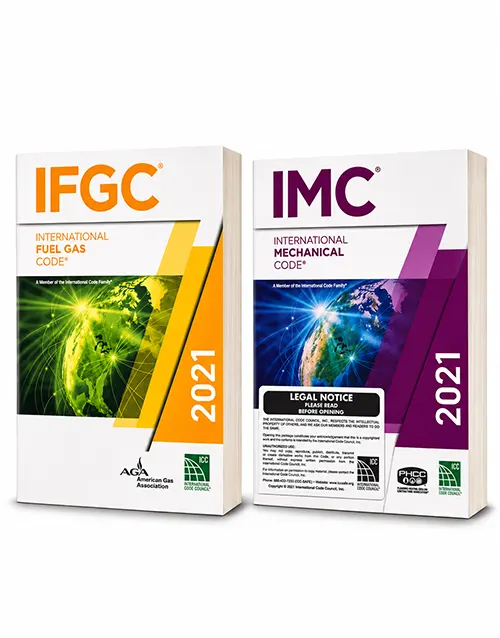


2021 International Fuel Gas Code and International Mechanical Code – Complete Two-Book Set
The 2021 International Fuel Gas Code (IFGC) and International Mechanical Code (IMC) – Complete 2-Book Set brings together two important building systems publications from the International Code Council (ICC). This collection provides technical requirements and reference information for fuel gas piping, gas-fired appliances, HVAC installations, ventilation, exhaust systems, refrigeration, boilers, and other mechanical equipment.
The 2021 International Fuel Gas Code establishes minimum requirements for the design and installation of fuel gas systems and gas-fired appliances. The 2021 International Mechanical Code provides minimum regulations for mechanical systems through prescriptive and performance-related provisions.
Together, these publications provide a useful professional reference for HVAC contractors, mechanical engineers, gas installers, architects, construction inspectors, and code officials involved in building system design and installation.
Book 1: 2021 International Fuel Gas Code (IFGC)
Understand Fuel Gas Code Administration and Scope
The 2021 International Fuel Gas Code begins with scope, administration, and definitions that establish how its requirements apply to fuel gas systems and gas-fired appliances.
These provisions introduce the administrative framework for applying and enforcing the code, including construction documents, permits, approvals, inspections, and the responsibilities of code officials.
They help gas contractors, engineers, architects, and inspectors understand the requirements involved in planning and reviewing fuel gas installations.
Explore General Fuel Gas Installation Requirements
Chapter 3 addresses general regulations affecting fuel gas appliances and their installation. It covers appliance access, equipment locations, protection of structural elements, clearances to combustible materials, and combustion air requirements.
These provisions are important when evaluating appliance locations and the conditions necessary for safe installation and operation.
Study Gas Piping Materials, Sizing, and Installation
Chapter 4 covers the allowable materials, sizing, and installation of fuel gas piping systems.
It addresses pressure regulators, appliance connections, piping support, installation methods, and overpressure protection devices.
The code provides requirements for sizing piping systems to supply the maximum demand of connected appliances while maintaining the necessary pressure for proper operation.
The 2021 edition includes provisions permitting press-connect joints for certain indoor high-pressure applications exceeding 5 psig. It also requires concealed condensate piping terminations to be marked to identify primary and secondary drains.
Understand Chimneys and Venting Systems
Chapter 5 addresses the design, construction, installation, maintenance, repair, and approval of chimneys and vents serving fuel gas appliances.
Topics include factory-built and site-built chimneys, appliance vents, connectors, direct-vent systems, integral vent appliances, mechanical draft systems, and exhaust hoods.
These requirements help professionals understand how combustion products are conveyed safely outside buildings and how venting arrangements relate to appliance installation and building safety.
Review Requirements for Specific Gas-Fired Appliances
Chapter 6 covers specific appliances regulated by the fuel gas code. It provides appliance-related requirements that complement the general installation, piping, and venting provisions in the earlier chapters.
These provisions are useful when selecting, installing, evaluating, and inspecting gas-fired equipment in residential and commercial projects.
The 2021 edition also establishes restrictions on commercial cooking appliances within dwelling units.
Explore Gaseous Hydrogen Systems
Chapter 7 is dedicated to gaseous hydrogen systems and their associated equipment.
It extends the code’s technical coverage beyond conventional fuel gas applications and addresses requirements relevant to hydrogen generation, storage, distribution, and utilization systems.
This material is useful for professionals studying alternative fuel technologies and the safety requirements associated with gaseous hydrogen installations.
Understand Referenced Fuel Gas Standards
Chapter 8 identifies the technical standards referenced throughout the IFGC.
These standards provide supporting requirements for fuel gas piping, appliances, chimneys, vents, and installation practices. They help engineers, gas installers, and inspectors identify the additional technical publications associated with individual code provisions.
Use the Fuel Gas Code Appendices
The IFGC includes supporting appendices that provide additional technical reference information.
- Gas Piping Capacities and Sizing: Provides information for determining fuel gas piping capacities and selecting appropriate pipe sizes.
- Venting System Sizing: Offers guidance for sizing venting arrangements for different appliance categories.
- Venting Exit Terminals: Addresses exit terminals for mechanical draft and direct-vent systems.
- Safety Inspection of Existing Appliances: Provides recommended procedures for evaluating the safety of existing appliance installations.
- Board of Appeals: Addresses appeals and the establishment of a board of appeals.
Book 2: 2021 International Mechanical Code (IMC)
Understand Mechanical Code Administration and Scope
The 2021 International Mechanical Code establishes minimum requirements for mechanical systems through prescriptive and performance-related provisions.
Its opening chapters introduce the scope, administration, definitions, and general requirements applicable to mechanical equipment and installations.
The code uses broad-based principles that allow new materials, installation methods, and mechanical system designs while establishing minimum regulatory requirements.
Explore General Mechanical System Requirements
The IMC addresses the installation, location, operation, and protection of mechanical appliances and associated equipment.
These provisions provide a reference for evaluating equipment placement, access, service clearances, piping connections, and other mechanical installation considerations.
They also establish the foundation for the more specialized ventilation, exhaust, ductwork, and equipment requirements covered in later chapters.
Study Ventilation Systems
Ventilation is an important part of HVAC system design and indoor environmental quality.
The code addresses ventilation requirements for different building environments and provides provisions relevant to mechanical air circulation systems.
The 2021 edition includes a 30% reduction in minimum mechanical ventilation requirements for whole-house balanced ventilation systems in the specified circumstances.
These provisions are useful for HVAC designers, mechanical engineers, contractors, and building inspectors.
Understand Exhaust Systems and Commercial Kitchen Hoods
The IMC covers exhaust systems used to remove unwanted air, contaminants, moisture, and other materials from buildings.
Topics include commercial kitchen hoods, exhaust equipment, makeup air, hazardous exhaust systems, dust and refuse conveying systems, smoke control systems, and energy recovery ventilation.
The 2021 edition includes a continuous-operation requirement for manicure and pedicure station exhaust systems. It also requires grease-duct horizontal cleanouts to be located within 3 feet of a horizontal discharge fan in the specified installations.
Explore Duct Systems and Installation Requirements
Duct systems distribute conditioned air throughout buildings and are essential components of heating, ventilation, and air-conditioning installations.
The IMC addresses duct construction, installation, insulation, plenums, air filters, smoke detection controls, and duct openings.
The 2021 edition introduces requirements for polyurethane spray-applied foam on the exterior of ducts in attics and crawl spaces, including specified smoke and flame index limits.
These provisions help HVAC professionals evaluate duct materials, construction methods, and installation practices.
Understand Combustion Air Requirements
Mechanical equipment that uses combustion requires appropriate air supply arrangements. The code includes provisions governing combustion air and its relationship with appliance installation and operation.
These requirements are important when designing mechanical rooms, choosing equipment locations, and reviewing installations involving fuel-burning appliances.
Study Chimneys and Vent Systems
The IMC addresses chimneys, vents, connectors, direct-vent systems, and mechanical draft arrangements.
These provisions help professionals evaluate the systems used to convey combustion products and exhaust from mechanical equipment.
They are particularly relevant to heating equipment installations and other mechanical applications requiring safe venting arrangements.
Review Specific Mechanical Appliances and Equipment
The code covers different types of mechanical appliances and specialized equipment used in buildings.
Its requirements provide technical guidance for equipment installation, clearances, connections, and associated safety considerations.
The 2021 edition also includes coverage of updated equipment requirements and combinations of factory-built intake and exhaust terminations.
Understand Boilers, Water Heaters, and Pressure Vessels
The IMC includes requirements for boilers, water heaters, and pressure vessels used in mechanical systems.
These provisions address installation, connections, controls, safety devices, and other considerations associated with heating equipment and pressurized systems.
They are useful for mechanical engineers, heating contractors, equipment installers, and building inspectors.
Explore Refrigeration Systems
Refrigeration is an important area of mechanical engineering covered by the IMC.
The code addresses refrigeration system classifications, applications, machinery rooms, refrigerant piping, field testing, and other installation considerations.
The 2021 edition updates refrigerant tables to include new refrigerants and includes revised provisions relevant to refrigeration equipment and installations.
Study Hydronic Piping Systems
The IMC addresses hydronic piping systems and the components used to circulate fluids through mechanical installations.
Topics include piping materials, joints, connections, insulation, valves, installation, and system testing.
These provisions provide useful technical guidance for professionals designing and installing hydronic heating and cooling systems.
Review Fuel Oil Piping and Storage
The code also covers fuel oil piping and storage systems associated with mechanical equipment.
These requirements address materials, connections, installation, piping support, storage arrangements, and related safety considerations.
Understand Solar Thermal Systems and Referenced Standards
The IMC includes provisions for solar thermal systems and their installation.
It also identifies the technical standards referenced throughout the code, providing additional requirements and specifications relevant to mechanical equipment, materials, and installations.
Important Changes in the 2021 Code Editions
Both publications include technical changes introduced during the 2021 International Codes cycle.
The 2021 IFGC addresses concealed condensate drain identification, press-connect joints for certain high-pressure indoor applications, and restrictions on commercial cooking appliances within dwelling units.
The 2021 IMC includes revised clothes dryer exhaust terminal clearances, updated refrigerant tables, access requirements for fire and smoke dampers, condensate termination markings, and revised whole-house balanced ventilation provisions.
These updates make the 2021 publications useful references for professionals who need to work with requirements specific to this code cycle.
How the IFGC and IMC Work Together
The International Fuel Gas Code and International Mechanical Code address complementary areas of building system design and installation.
The IFGC focuses on fuel gas piping systems, gas-fired appliances, combustion air, chimneys, vents, and gaseous hydrogen systems. The IMC covers broader mechanical installations, including HVAC systems, ventilation, exhaust, ductwork, refrigeration, boilers, and hydronic piping.
Using both books provides a wider technical reference for projects involving mechanical equipment and fuel gas installations.
Who Should Use the 2021 IFGC and IMC Set?
The 2021 International Fuel Gas Code and International Mechanical Code – Complete 2-Book Set is suitable for HVAC contractors, mechanical engineers, gas installers, architects, general contractors, building inspectors, code officials, and construction students.
It is particularly useful for professionals involved in HVAC design, mechanical equipment installation, fuel gas piping, ventilation, refrigeration, appliance inspections, and building code compliance.
Why Choose This ICC Two-Book Set?
- Two official ICC publications: Includes the 2021 International Fuel Gas Code and International Mechanical Code.
- Fuel gas coverage: Addresses fuel gas piping, gas-fired appliances, combustion air, chimneys, and vents.
- HVAC and mechanical coverage: Explains ventilation, exhaust systems, ductwork, refrigeration, boilers, and hydronic piping.
- Specialized applications: Includes gaseous hydrogen systems, fuel oil installations, and solar thermal provisions.
- Updated 2021 requirements: Covers changes relating to refrigerants, exhaust clearances, press-connect piping joints, and mechanical ventilation.
- Professional code reference: Useful for system design, construction, installation, inspections, and compliance work.
- Technical appendices: Provides fuel gas piping sizing, venting information, and safety inspection guidance.
About the Two-Book Set
Collection Title: 2021 International Fuel Gas Code (IFGC) and International Mechanical Code (IMC)
Collection Type: Complete Two-Book Set
Publisher: International Code Council (ICC)
Code Year: 2021
Format: Softcover
Language: English
Book 1: 2021 International Fuel Gas Code (IFGC)
IFGC ISBN-13: 9781609839666
IFGC Pages: 200
Book 2: 2021 International Mechanical Code (IMC)
IMC ISBN-13: 9781609839642
IMC Pages: 186
Combined Catalogue Page Count: 386
For professionals seeking a combined reference for mechanical and fuel gas installations, this ICC two-book collection brings together the 2021 IFGC and IMC in one convenient package. It provides technical requirements for gas piping, gas-fired equipment, HVAC systems, ventilation, exhaust, refrigeration, and mechanical installations.
Code adoption note: These are the 2021 model code editions. Actual adoption and enforcement depend on state and local jurisdictions. Buyers should verify which code edition applies to their project, inspection, or licensing requirements.
There are no reviews yet.