

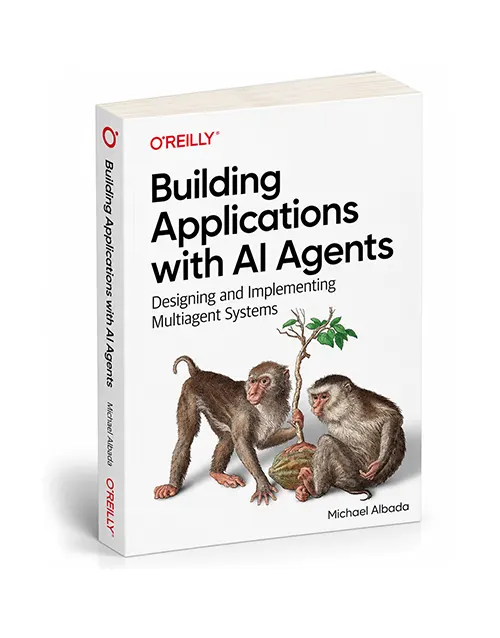


Building Applications with AI Agents (9781098176501) by Michael Albada, published by O’Reilly Media, is a practical book about designing, building, and evaluating applications powered by foundation models. Its focus is what happens beyond a single model response. An agent can use tools, retrieve information, and decide what to do next as a task unfolds. Albada explains how those pieces fit together and when a predictable workflow is a better choice than giving a model more control.
The book starts with the design of a single agent. It covers model selection, tool integration, short-term and long-term memory, and orchestration, which is how an application coordinates its steps. Albada looks at the choices behind each component rather than treating them as features every agent needs. A tool might give an agent access to information the model does not have, for example, but the application still needs a way to use that information and handle an unexpected result. The early chapters also introduce frameworks such as LangGraph, AutoGen, and CrewAI.
One distinction the book makes is between knowledge and memory. Knowledge gives an agent access to outside material, such as documentation it can retrieve while answering a question. Memory preserves useful information from earlier interactions or steps in a task. The chapters on context and retrieval explain how approaches such as semantic search, vector stores, and retrieval-augmented generation (RAG) affect what information reaches the model. They also make clear why adding more context is not the same as giving the model better context.
Albada then turns to multiagent systems. The book building applications with ai agents considers when a single agent is enough, when dividing work among several agents makes sense, and what that division adds in communication and coordination. It compares approaches such as assigning a manager to delegate tasks and organizing agents in a hierarchy. The tradeoffs are practical. More agents can make it possible to work on parts of a task in parallel, but the application still has to pass information between them and combine their results.
The later chapters follow an application into testing and production. They explain how to evaluate tools, planning, and memory separately, then measure how the application handles complete tasks. Production monitoring and feedback loops help reveal problems that a test set might miss, including changes in how people use the system. The book also covers human review and approaches to protecting agentic applications.
Written for software developers and technical readers who are new to building agents, the book (9781098176501) progresses from a first agent to systems with several cooperating components. It is about building applications around existing models, not training a foundation model from scratch. The emphasis stays on design decisions that affect reliability, speed, and cost as the application grows.
There are no reviews yet.