



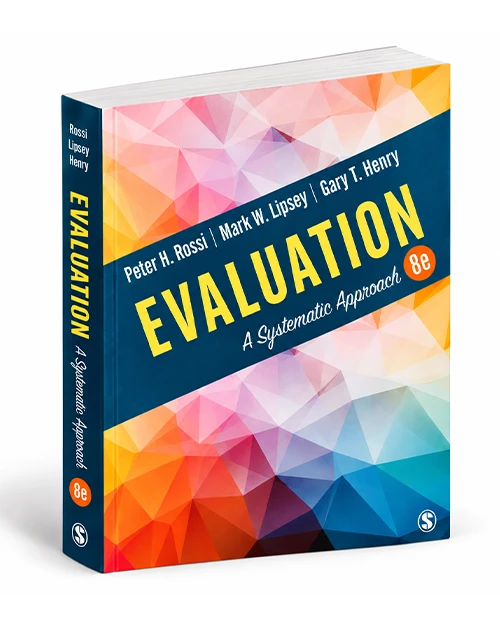



Evaluating a program requires more than determining whether it achieved its intended outcomes. Evaluation: A Systematic Approach 8th Edition by Peter Rossi, Mark W. Lipsey & Gary T. Henry provides a structured foundation for understanding how social programs are assessed, how evidence is collected, and how evaluation findings can inform decisions. Published by SAGE Publications, this edition is intended for readers studying program evaluation, research methods, public policy, and evidence-based decision-making. ISBN 9781506307886 identifies this edition for buyers seeking the specific textbook.
At the heart of the book is the relationship between a program’s goals, its implementation, and the outcomes it produces. Program evaluation involves examining whether an intervention addresses a defined problem, reaches its intended participants, and produces meaningful results. The text helps readers understand why evaluation questions must be clearly framed before selecting research methods or interpreting findings. This perspective is useful for examining public services, community initiatives, educational interventions, health programs, and social welfare projects.
A major theme is the selection of appropriate evaluation strategies for different questions and circumstances. Readers explore the role of needs assessment, program theory, process evaluation, and impact assessment in understanding how programs operate and what they accomplish. These approaches address different aspects of program performance: identifying the problem being addressed, examining how services are delivered, assessing whether intended outcomes occur, and investigating whether observed changes can reasonably be attributed to an intervention. Understanding these distinctions helps readers interpret evaluation evidence more carefully.
The book also introduces the methodological considerations involved in gathering and analyzing information. Evaluation work may draw on quantitative data, qualitative evidence, administrative records, surveys, interviews, and other sources suited to the question under investigation. Decisions about research design, measurement, comparison groups, and data interpretation influence the conclusions an evaluator can support. By connecting evaluation questions with research methods, the text helps students develop a more systematic approach to assessing programs rather than relying on assumptions or isolated observations.
Evaluation: A Systematic Approach is relevant to students and instructors in public administration, social work, sociology, public health, education, policy studies, and applied social research. Program evaluators, nonprofit professionals, government personnel, and researchers may also find its framework useful when learning how to assess services and communicate findings to stakeholders. The subject matter supports coursework and professional development for readers who need to understand both the reasoning behind evaluation designs and the practical questions involved in examining program effectiveness.
For anyone searching for the 8th edition of Evaluation: A Systematic Approach (9781506307886), this textbook offers a foundation for studying evaluation as a disciplined process of inquiry. It connects program objectives, implementation, research design, evidence, and outcomes within a coherent framework. Whether you are selecting a textbook for an evaluation course, building a research reference collection, or strengthening your understanding of social program assessment, confirm the edition and ISBN before ordering to ensure the book matches your course requirements or intended use.
There are no reviews yet.