

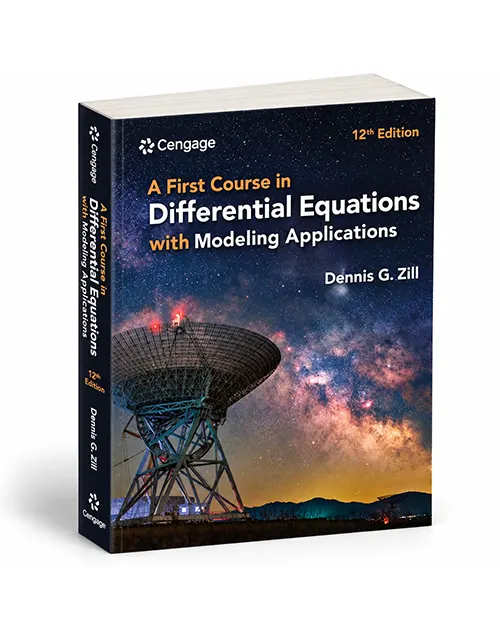


A First Course in Differential Equations with Modeling Applications, 12th Edition
A First Course in Differential Equations with Modeling Applications, 12th Edition by Dennis G. Zill is a college-level mathematics textbook that teaches the principles and methods used to solve differential equations and apply them to practical problems. Published by Cengage, the book balances analytical techniques, qualitative reasoning, and quantitative methods to help students understand both the mathematics and its applications.
Differential equations are used to describe systems that change over time or vary with respect to another quantity. They play an important role in engineering, physics, biology, and other scientific fields. This textbook introduces the mathematical tools required to formulate, solve, and interpret these equations, with examples that connect theoretical concepts to real-world models.
Learn the Fundamentals of Differential Equations
The book begins with the basic definitions and terminology used in differential equations. Students learn to recognize the order and structure of an equation, understand initial-value problems, and identify situations in which differential equations can represent mathematical models.
These foundational concepts help readers understand what a solution represents and how mathematical conditions affect the solution. Worked examples and explanatory notes support a step-by-step approach to learning, making the material useful for students taking their first college course in differential equations.
Explore First-Order Differential Equations
First-order differential equations provide an essential foundation for more advanced mathematical analysis. The textbook examines several methods for solving these equations, including separable, linear, and exact equations.
Readers can practice applying the appropriate solution method to different problem types while strengthening their algebraic and analytical skills. The book also explores how initial conditions can be used to identify a particular solution and how solution curves help illustrate the behavior of a mathematical model.
Study Mathematical Modeling Applications
Mathematical modeling uses equations to represent real-world processes and investigate how different variables interact. The textbook includes dedicated chapters on modeling with first-order and higher-order differential equations.
Students can explore how mathematical relationships are formulated from a problem, how assumptions influence the resulting equations, and how solutions can be interpreted in context. These applications help connect differential equations with scientific and engineering questions involving changing quantities and dynamic systems.
Understand Higher-Order Differential Equations
Higher-order differential equations are useful for analyzing more complex systems, including mechanical motion, oscillations, and other processes described by multiple derivatives. The book introduces methods for solving higher-order equations and interpreting their solutions.
Through worked examples and practice problems, readers can develop their understanding of linear differential equations, initial-value conditions, and the mathematical techniques used to analyze higher-order systems. These topics are particularly valuable for students continuing into engineering mathematics and applied science courses.
Learn Series Solutions of Linear Equations
Some differential equations cannot be solved easily using elementary functions. Series methods provide an alternative approach for expressing solutions in terms of infinite series under appropriate conditions.
The textbook introduces series solutions of linear equations and demonstrates how these methods can extend the range of problems students are able to investigate. This material develops mathematical reasoning and prepares readers for more advanced work in differential equations and applied mathematics.
Explore the Laplace Transform
The Laplace transform is an important method for solving many linear differential equations, especially problems involving initial conditions. It converts differential equations into algebraic equations in a transformed domain, which can simplify the solution process for suitable problems.
The book presents the Laplace transform and its applications, helping students understand the underlying method and practice using it to solve differential equations. Supplementary material on Laplace transforms supports further review of this topic.
Study Systems of Differential Equations
Many real-world problems involve several interacting quantities rather than a single variable. Systems of linear differential equations provide a framework for representing these relationships mathematically.
Readers learn how systems are formulated and solved, and how their solutions describe the behavior of related variables. These methods are relevant to applications in engineering, physical sciences, population models, and other fields involving interacting processes.
Understand Numerical Solutions
Not every differential equation has a convenient analytical solution. Numerical methods allow students to approximate solutions and study the behavior of equations when exact methods are difficult or unavailable.
The textbook includes a chapter on numerical solutions of ordinary differential equations. This subject helps readers understand how approximate results are obtained and why numerical techniques are valuable in scientific computing, engineering analysis, and mathematical modeling.
Strengthen Problem-Solving Skills
The 12th edition uses examples, explanations, definitions, and remarks to guide students through mathematical procedures. Exercise sets provide opportunities to practice solving equations and applying concepts introduced in each chapter.
Cengage also supports the title through WebAssign, an online learning platform that may provide assignments, learning resources, and assessment tools depending on the course and purchased access. Availability of digital resources should be verified for the specific product being sold.
Who Should Read This Differential Equations Textbook?
A First Course in Differential Equations with Modeling Applications, 12th Edition is suitable for undergraduate mathematics students, engineering students, physics students, and learners in applied science programs. It can support introductory differential equations courses, classroom assignments, examination preparation, and independent study.
Its balance of analytical methods and modeling examples helps readers build the mathematical foundation needed for further study in engineering analysis, numerical methods, physics, and other technical subjects.
Why Choose the 12th Edition?
- Balanced mathematical approach: Combines analytical, qualitative, and quantitative perspectives.
- Broad topic coverage: Includes first-order equations, higher-order equations, series solutions, and systems.
- Practical modeling: Connects mathematical methods with applications in science and engineering.
- Laplace transforms: Explains a widely used method for solving differential equations.
- Numerical methods: Introduces approximate solutions of ordinary differential equations.
- Learning support: Provides worked examples, definitions, exercises, and potential WebAssign resources.
About the Book
Title: A First Course in Differential Equations with Modeling Applications
Edition: 12th Edition
Author: Dennis G. Zill
Publisher: Cengage Learning
Copyright Year: 2024
ISBN-13: 9780357760192
Format: Paperback
Pages: 464
For students seeking an introduction to differential equations and their practical applications, this textbook provides a structured learning path through analytical techniques, mathematical modeling, Laplace transforms, systems of equations, and numerical methods.
There are no reviews yet.