

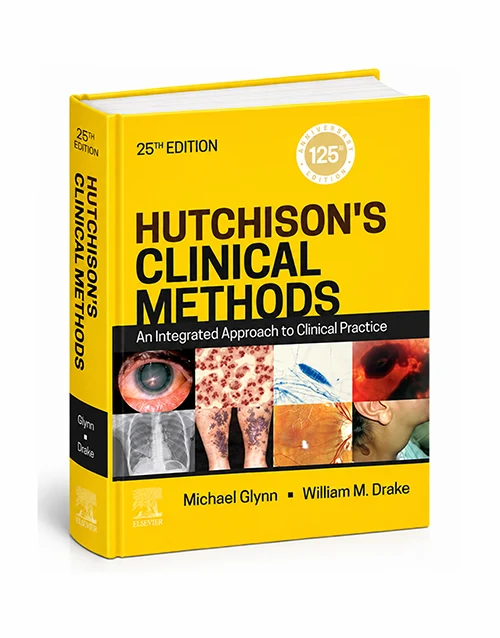


Hutchison’s Clinical Methods: An Integrated Approach to Clinical Practice, 25th Edition
Hutchison’s Clinical Methods, 25th Edition, edited by Michael Glynn and William M. Drake, is a comprehensive medical textbook designed to develop the core clinical skills required in everyday medical practice. Published by Elsevier, this established reference provides guidance on clinical history-taking, physical examination, differential diagnosis, and the interpretation of clinical findings.
Clinical medicine relies on the ability to collect relevant patient information, recognize important signs and symptoms, interpret findings, and determine appropriate next steps in investigation. This textbook brings these skills together in a structured, integrated approach to clinical practice. It is designed to support medical students and doctors in training as they develop their clinical reasoning and patient assessment skills.
Learn the Principles of Clinical History-Taking
Obtaining a thorough patient history is an essential part of clinical assessment. The book introduces the principles of gathering information about a patient’s symptoms, medical background, and presenting concerns. It helps learners understand how organized questioning and careful listening contribute to a clearer clinical picture.
Readers can explore how history-taking supports the identification of relevant symptoms, the formulation of possible diagnoses, and decisions about further investigation. These principles are important throughout medical training and remain relevant across specialties and clinical environments.
Develop Physical Examination Skills
A structured physical examination helps clinicians identify signs that may support or challenge an initial diagnostic impression. Hutchison’s Clinical Methods discusses general patient examination and clinical methods used to assess different body systems.
The text covers the principles behind examining patients and interpreting physical findings in context. It encourages an integrated approach in which examination results are considered alongside the patient’s history, symptoms, and other relevant clinical information.
Understand Differential Diagnosis and Clinical Reasoning
Differential diagnosis involves considering possible explanations for a patient’s presentation and evaluating the evidence that supports each possibility. The textbook explores this process and its relationship to the interpretation of clinical findings and patient management.
For students and trainee doctors, learning to reason systematically is an important step toward developing clinical competence. By connecting symptoms, examination findings, and appropriate investigations, the book supports a more organized understanding of clinical problem-solving.
Explore Clinical Methods Across Major Body Systems
The 25th edition covers the major systems encountered in clinical medicine, including the respiratory, cardiovascular, gastrointestinal, locomotor, nervous, renal, urological, endocrine, and integumentary systems. It also includes material on the eyes, ear, nose and throat, and sexually transmitted infections.
Organizing the text by system and clinical problem helps readers navigate the subject matter and focus on areas relevant to their studies. Chapters can be consulted individually, making the book useful for topic-based revision, clinical preparation, and reference during medical education.
Assess Different Patient Groups and Presentations
Clinical assessment must account for the needs and circumstances of different patients. The book includes material on women, children and adolescents, older people, psychiatric assessment, patients presenting as emergencies, patients with fever, and patients experiencing pain.
These subjects help learners recognize that the approach to assessment depends on the patient’s presentation and clinical context. The textbook also addresses ethical considerations and the importance of communication within the doctor-patient relationship.
Connect Clinical Findings with Appropriate Investigations
Clinical investigations can provide additional information when assessing symptoms or examining a patient. The textbook discusses the role of investigations within an integrated clinical approach and provides guidance relevant to the major body systems.
Learning when and why investigations may be appropriate is an important part of clinical reasoning. The material helps students connect clinical observations with further evaluation while recognizing that investigations must be selected and interpreted according to the individual clinical situation.
Updated Content for Contemporary Clinical Practice
The 25th edition includes chapters reviewed and updated to reflect modern clinical practice. It incorporates contemporary methods and investigations into established approaches to patient assessment and includes an appendix describing the clinical features of COVID-19.
The publisher describes 170 full-color illustrations, along with tables and diagrams that support concise explanations. The organization and visual resources can help learners review essential information and navigate clinical topics efficiently.
Who Should Read Hutchison’s Clinical Methods?
Hutchison’s Clinical Methods, 25th Edition is intended for medical students, foundation doctors, trainee doctors, and MRCP candidates. It may also be useful for clinicians reviewing the fundamentals of history-taking, examination, differential diagnosis, and system-based clinical assessment.
As an educational reference, the book supports clinical learning and examination preparation. It complements supervised clinical experience, current guidelines, and professional instruction rather than replacing them.
Why Choose the 25th Edition?
- Core clinical skills: Covers history-taking, physical examination, and interpretation of clinical findings.
- System-based organization: Includes major body systems and common clinical presentations.
- Diagnostic reasoning: Explores differential diagnosis and the role of clinical investigations.
- Patient-centered practice: Addresses communication, ethical considerations, and different patient groups.
- Updated content: Incorporates modern clinical methods and an appendix on COVID-19.
- Visual learning support: Includes full-color illustrations, tables, and diagrams.
- Medical education resource: Suitable for medical students, trainee doctors, and MRCP candidates.
About the Book
Title: Hutchison’s Clinical Methods
Subtitle: An Integrated Approach to Clinical Practice
Edition: 25th Edition
Editors: Michael Glynn and William M. Drake
Publisher: Elsevier
Publication Year: 2022
Copyright Year: 2023
ISBN-13: 9780702082658
Pages: 532
Illustrations: 170, all in full color
For medical students and trainee doctors seeking a structured introduction to clinical assessment, Hutchison’s Clinical Methods, 25th Edition provides a practical reference for developing history-taking, examination, and diagnostic reasoning skills across a broad range of clinical presentations.
There are no reviews yet.