



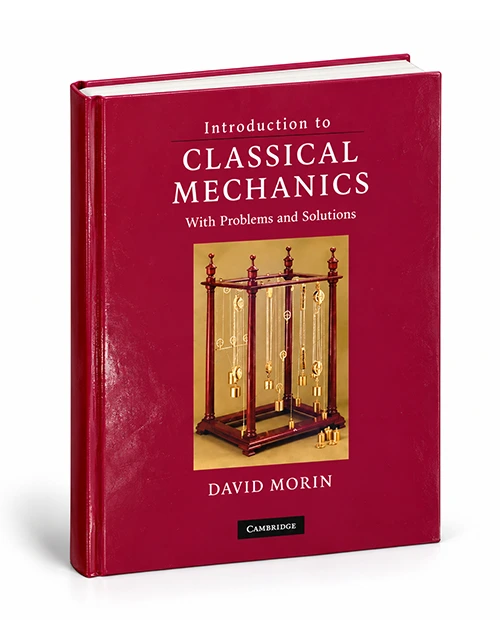


Introduction to Classical Mechanics: With Problems and Solutions
Introduction to Classical Mechanics: With Problems and Solutions by David Morin is a comprehensive physics textbook designed to help students develop a strong understanding of classical mechanics through theoretical explanations, worked examples, and extensive problem-solving practice. Published by Cambridge University Press, the book covers foundational mechanics concepts alongside more advanced topics encountered in undergraduate physics courses.
Classical mechanics provides the mathematical and conceptual foundation for understanding how physical objects move and interact. From Newton’s laws of motion to energy conservation and rotational dynamics, these principles are central to physics, engineering, and many applied sciences. David Morin’s textbook presents these topics through a problem-oriented approach that encourages readers to understand the reasoning behind equations rather than simply memorize formulas.
Explore the Fundamental Principles of Classical Mechanics
The textbook begins with essential mechanics concepts and develops them through systematic explanations and mathematical analysis. Readers can study Newton’s laws, forces, acceleration, momentum, work, energy, and the relationships that govern the motion of physical systems.
These foundational topics help students build the skills required to solve increasingly complex physics problems. By working through examples and exercises, readers can practice translating physical situations into mathematical models, selecting appropriate equations, and interpreting the results.
Develop Strong Problem-Solving Skills
One of the key features of Introduction to Classical Mechanics is its substantial collection of problems and worked solutions. The book includes more than 250 problems with detailed solutions and over 350 additional exercises, making it useful for independent study, homework preparation, and supplementary classroom learning.
Worked solutions allow students to compare their reasoning with a structured solution process and identify gaps in their understanding. The additional exercises provide opportunities to apply concepts independently and develop confidence when approaching unfamiliar questions.
This problem-centered approach is especially useful for students preparing for examinations or studying mechanics beyond the minimum requirements of an introductory course. Regular practice can help improve mathematical reasoning, analytical thinking, and the ability to recognize patterns across different physical systems.
Study Energy, Momentum, and Rotational Dynamics
The book explores important principles involving energy, momentum, angular momentum, oscillations, and rotational motion. These subjects explain a wide range of physical phenomena, from the movement of everyday objects to the behavior of rotating bodies and vibrating systems.
Students can use the material to strengthen their understanding of conservation laws, equilibrium, periodic motion, and the relationships between forces and motion. The mathematical treatment helps connect individual concepts into a coherent framework for analyzing physical systems.
Move Beyond Introductory Mechanics
In addition to standard undergraduate mechanics topics, David Morin introduces more advanced material, including normal modes, Lagrangian mechanics, gyroscopic motion, fictitious forces, four-vectors, and general relativity. These subjects offer opportunities for students to extend their knowledge and explore connections between classical mechanics and broader areas of theoretical physics.
The inclusion of advanced topics makes this textbook particularly useful as a supplementary resource for learners who want to explore mechanics in greater depth. Students can revisit foundational principles while developing familiarity with more sophisticated mathematical methods and physical interpretations.
Understand the Mathematics Behind Physical Systems
Physics requires more than selecting the correct formula. Effective problem solving involves identifying relevant quantities, defining coordinate systems, applying mathematical relationships, and checking whether a result is physically meaningful. The book’s worked examples and exercises help students practice these essential skills.
Its extensive illustrations support the explanations by helping readers visualize physical configurations and understand how different variables relate to one another. Additional remarks throughout the text discuss concepts that may be overlooked in shorter treatments, encouraging a deeper understanding of the subject.
Who Should Read This Classical Mechanics Textbook?
Introduction to Classical Mechanics: With Problems and Solutions is suitable for undergraduate physics students, engineering students studying mechanics, instructors, and independent learners with the necessary mathematical background. It can serve as a supplementary textbook for university courses and as a reference for students who want additional practice beyond their primary course materials.
Instructors may use the problems to support assignments and classroom discussions, while students can use the worked solutions to review methods and check their understanding. The book is also relevant to readers interested in developing a more rigorous foundation for further study in theoretical physics.
Why Choose Introduction to Classical Mechanics by David Morin?
- Comprehensive subject coverage: Includes foundational mechanics and selected advanced physics topics.
- Extensive practice: Features more than 250 problems with detailed solutions and over 350 additional exercises.
- Mathematical reasoning: Encourages structured analysis and a deeper understanding of physical principles.
- Illustrated explanations: Uses figures to help explain physical configurations and concepts.
- University-level learning: Suitable as a supplementary resource for undergraduate classical mechanics courses.
- Independent study support: Helps learners review topics, practice techniques, and evaluate their problem-solving progress.
About the Book
Written by David Morin and published by Cambridge University Press, this textbook was first published in print in 2008. The standard hardback edition is cataloged under ISBN-13 9780521876223 and contains 734 pages according to Cambridge University Press.
Whether you are strengthening your understanding of Newtonian mechanics, practicing energy and momentum problems, or exploring more advanced concepts, Introduction to Classical Mechanics: With Problems and Solutions offers a substantial collection of explanations and exercises for undergraduate-level physics study.
There are no reviews yet.