

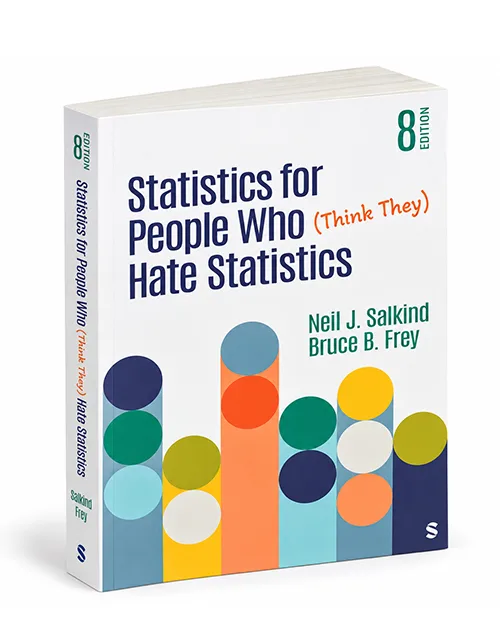


Statistics can feel intimidating when formulas and unfamiliar terminology appear before the purpose behind them becomes clear. Statistics for People Who Think They Hate Statistics 8th Edition takes an approachable route to learning statistical concepts, helping readers understand what statistical methods do, when they are used, and how to interpret their results. Written by Neil J. Salkind and published by SAGE Publications, this textbook is intended for students and readers who want to develop statistical understanding without approaching the subject as a collection of equations to memorize. ISBN 9781071855508 identifies this edition.
Rather than treating statistics as mathematics alone, the book connects statistical procedures with the questions researchers ask and the evidence they collect. Readers explore how data are organized, summarized, compared, and interpreted in research. This foundation helps explain the difference between describing a set of observations and drawing conclusions about a larger population. Understanding that distinction is valuable when reading academic studies, evaluating research findings, or preparing assignments that involve quantitative data.
The text introduces descriptive statistics, including measures of central tendency and variability, to explain what a dataset reveals about its distribution. Concepts such as the mean, median, mode, range, and standard deviation help readers summarize information and recognize differences among groups of observations. Probability, sampling, and statistical inference provide additional context for understanding how researchers move from sample data toward conclusions, while also recognizing that statistical results involve uncertainty.
As readers progress, the book addresses relationships between variables and methods for examining differences. Topics associated with correlation, regression, hypothesis testing, t-tests, analysis of variance (ANOVA), and chi-square procedures help illustrate how statistical techniques answer different research questions. The emphasis is on understanding the purpose of a procedure and making sense of its results, rather than selecting a test simply because its formula is familiar. This approach supports a more thoughtful interpretation of quantitative evidence across academic disciplines.
Statistics for People Who Think They Hate Statistics is particularly relevant to students in psychology, education, sociology, behavioral sciences, and other fields where research methods and data analysis form part of coursework. Graduate students, research beginners, and readers returning to statistics after a long break may also find its accessible teaching approach useful. It can support introductory statistics classes, independent study, research-methods assignments, and preparation for interpreting statistical findings in journal articles. Readers who need advanced mathematical proofs or a specialist statistical reference should consider whether an introductory textbook matches their learning goals.
The eighth edition offers a structured starting point for building confidence with statistical reasoning and understanding how data support research conclusions. For anyone searching for Statistics for People Who Think They Hate Statistics 8th Edition (9781071855508), this SAGE textbook provides an approachable way to study foundational statistical concepts and their applications. Before ordering, check the ISBN and edition information to ensure you select the intended publication rather than another edition or a related statistics title.
There are no reviews yet.