

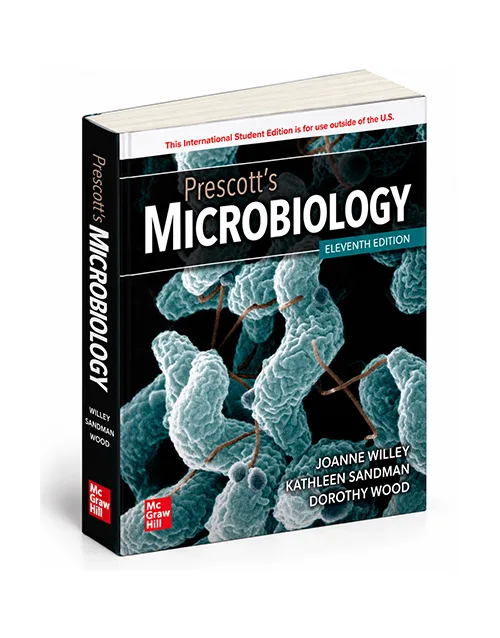


Prescott’s Microbiology, Eleventh Edition – International Student Edition
Prescott’s Microbiology, 11th Edition by Joanne M. Willey, Kathleen M. Sandman, and Dorothy H. Wood is a comprehensive educational textbook covering the scientific foundations, diversity, and applications of microorganisms. Published by McGraw Hill, this edition introduces microbiology through an integrated approach that connects microbial evolution, cell structure, metabolism, genetics, ecology, immunity, infectious diseases, and biotechnology.
Microorganisms play essential roles in human health, ecosystems, agriculture, food production, industry, and environmental processes. Understanding their biology requires knowledge of cellular structures, energy production, genetic regulation, microbial interactions, and the relationships between microorganisms and their hosts. This textbook presents these subjects in an organized framework, helping students understand both the fundamental principles and practical applications of microbiology.
Understand the Foundations of Microbiology
The first part introduces microbiology and the evolution of microorganisms. It explains how the discipline developed and how modern scientific discoveries have expanded our understanding of the microbial world.
Readers explore the evolutionary history of microorganisms, the diversity of microbial life, and the scientific methods used to investigate microorganisms. The discussion also introduces the importance of genomics and metagenomics in modern microbiological research.
This foundation helps students understand how microbial evolution influences biological diversity and why microorganisms are important in nearly every environment on Earth.
Study Microscopy and Microbial Cell Structure
Microscopy is essential for observing and studying microorganisms. The textbook introduces different microscopy methods and explains how scientists use imaging techniques to examine microbial structures and activities.
Topics include bacterial cell structure, archaeal cell structure, and eukaryotic cell structure. Readers can learn about cell membranes, cell walls, cytoplasmic organization, external structures, and other components that contribute to microbial function.
The book also explores viruses and other acellular infectious agents, including viroids, satellites, and prions. This coverage helps students understand the biological differences between cellular microorganisms and infectious agents that depend on host cells.
Understand Microbial Nutrition, Growth, and Control
The second part examines microbial nutrition, growth, and the methods used to control microorganisms. Readers can study the nutritional requirements of bacteria and archaea and the environmental factors that influence microbial growth.
The textbook explains how microorganisms obtain essential nutrients and how environmental conditions affect their growth and survival. These concepts provide a foundation for understanding microbial populations in laboratory, clinical, industrial, and natural environments.
It also covers methods for controlling microorganisms in the environment and introduces antimicrobial chemotherapy. These subjects connect microbial growth principles with sterilization, microbial control, and the use of antimicrobial agents.
Explore Microbial Metabolism
Microbial metabolism is central to understanding how microorganisms obtain and use energy. The book introduces the fundamental principles of metabolism and explains the processes involved in energy release and conservation.
Readers can study catabolism, including the pathways through which microorganisms break down compounds and conserve energy. The textbook also examines anabolism and the use of energy in biosynthesis.
This section helps students understand how metabolic pathways support microbial growth, cellular maintenance, reproduction, and adaptation to different environments.
Study Microbial Molecular Biology and Genetics
The fourth part covers microbial molecular biology and genetics. It introduces the mechanisms that control genetic information, cellular processes, and the inheritance of biological characteristics.
Topics include bacterial genome replication and expression, regulation of cellular processes, and the replication and expression of eukaryotic and archaeal genomes.
The book also examines mechanisms of genetic variation, microbial DNA technologies, and microbial genomics. These topics help readers understand how microorganisms adapt, evolve, and acquire new characteristics.
Explore the Diversity of the Microbial World
The textbook provides extensive coverage of microbial diversity, introducing the major groups of microorganisms and their biological characteristics.
Readers can study archaea, nonproteobacterial Gram-negative bacteria, proteobacteria, Gram-positive bacteria, protists, fungi, and viruses.
The chapters explain how microorganisms differ in cellular organization, structure, physiology, and evolutionary relationships. This material provides an important foundation for identifying microorganisms and understanding their roles in medicine, ecology, and biotechnology.
Understand Microbial Ecology and Symbiosis
Microorganisms interact continuously with other organisms and with their physical environments. The sixth part examines microbial ecology and symbiosis, helping readers understand the importance of microorganisms in natural ecosystems.
It discusses microbial interactions and biogeochemical cycling, including the role of microorganisms in global climate change. Additional topics explore microorganisms in marine, freshwater, and terrestrial ecosystems.
This section connects microbiology with environmental science and explains how microorganisms influence nutrient cycling, ecosystem stability, and relationships among living organisms.
Study Pathogenicity and Host Response
The seventh part explores pathogenicity and the responses of hosts to microorganisms. It introduces the mechanisms through which microorganisms interact with hosts and the biological defenses involved in protecting the body.
Readers can study innate host resistance and adaptive immunity, two major components of the immune response. The textbook also examines the microbe-human ecosystem, infection, and pathogenicity.
These concepts help students understand how microorganisms may cause disease, how hosts respond to infection, and how biological interactions influence the development and progression of infectious conditions.
Explore Microbial Diseases, Detection, and Control
The eighth part focuses on microbial diseases, detection, and methods of control. It explains the role of epidemiology and public health microbiology in understanding how infections spread and how communities respond to infectious disease challenges.
The book also covers clinical microbiology and immunology, connecting laboratory investigations with the identification and understanding of disease-causing microorganisms.
Readers can explore human diseases caused by viruses and prions, bacteria, fungi, and protists. This broad coverage helps students develop an understanding of the diversity of infectious agents and the importance of accurate microbial identification.
Understand Applied Microbiology
The final part introduces applications of microbiology across food production, biotechnology, industrial processes, and environmental management.
Food microbiology examines the relationship between microorganisms and food, while biotechnology and industrial microbiology explore how microorganisms and their biological processes can be applied in practical production systems.
Applied environmental microbiology explains the role of microorganisms in environmental processes and related applications. These subjects demonstrate how microbiological knowledge can contribute to industry, environmental protection, and scientific innovation.
Develop Scientific Understanding Through Modern Microbiology
A key feature of the eleventh edition is its integration of evolution, ecology, and microbial diversity throughout the textbook. Rather than treating these subjects as isolated topics, the authors connect them with microbial cell biology, genetics, metabolism, and disease.
The edition also incorporates developments in genomics and metagenomics, providing context for the modern study of microorganisms. Its explanations, diagrams, scientific examples, and comprehensive subject coverage help students understand how microbiology continues to develop as a scientific discipline.
Who Should Read Prescott’s Microbiology?
Prescott’s Microbiology, 11th Edition is suitable for undergraduate microbiology majors, biology students, and learners enrolled in mixed-major microbiology courses. It can also support students studying biological sciences, medical and health sciences, biotechnology, environmental science, and related subjects.
Instructors and educators can use the textbook for university microbiology courses, lectures, assignments, and laboratory-related learning. Independent learners may also find it useful as a reference for reviewing microbial structure, metabolism, genetics, diversity, and infectious disease principles.
Why Choose the Eleventh Edition?
- Comprehensive coverage: Introduces the major areas of general and applied microbiology.
- Evolutionary perspective: Integrates microbial evolution and diversity throughout the textbook.
- Microbial structure: Covers bacteria, archaea, eukaryotic microorganisms, and viruses.
- Metabolism and genetics: Explains microbial energy processes, gene expression, and genetic variation.
- Ecology and symbiosis: Explores microbial interactions, ecosystems, and global environmental processes.
- Immunity and infectious disease: Covers host resistance, pathogenicity, epidemiology, and microbial diseases.
- Practical applications: Includes food microbiology, industrial biotechnology, and environmental microbiology.
About the Book
Title: Prescott’s Microbiology
Edition: Eleventh Edition
Edition Type: International Student Edition
Authors: Joanne M. Willey, Kathleen M. Sandman, and Dorothy H. Wood
Publisher: McGraw-Hill Education
Publication Year: 2020
ISBN-13: 9781260570021
Format: Paperback
Pages: 1104
Language: English
For students seeking a detailed introduction to microbiology, Prescott’s Microbiology, Eleventh Edition provides a structured foundation in microbial evolution, cell biology, metabolism, genetics, diversity, ecology, immunity, infectious diseases, and applied microbiology.
International edition note: The pictured book is marked for use outside the United States. It is not the same ISBN or distribution edition as the US student edition. Confirm territorial resale rights and disclose the international-edition status accurately in the product listing.
There are no reviews yet.