

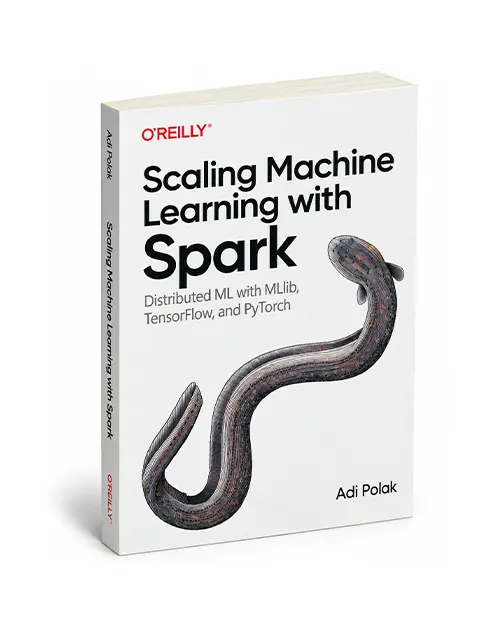


Scaling Machine Learning with Spark: Distributed ML with MLlib, TensorFlow, and PyTorch
Scaling Machine Learning with Spark by Adi Polak is a practical guide to developing and deploying scalable machine learning systems using Apache Spark and distributed computing technologies. Published by O’Reilly Media in 2023, this book explains how data scientists and machine learning engineers can build complete workflows that process large datasets, train predictive models, integrate deep learning frameworks, and deploy models into production environments.
As machine learning projects grow, processing data on a single computer can become challenging. Large datasets require additional computing resources, efficient data pipelines, distributed model training, and reliable infrastructure. This textbook explores how Apache Spark and its associated ecosystem help address these requirements.
The book brings together Spark MLlib, MLflow, TensorFlow, and PyTorch, showing how these technologies can work together in distributed machine learning workflows. It emphasizes a practical approach that connects data engineering, model development, experimentation, and production deployment.
Understand Distributed Machine Learning Fundamentals
The first chapter introduces distributed machine learning terminology and the concepts behind large-scale machine learning systems.
Readers explore the stages of a machine learning workflow and examine the tools and technologies used throughout the pipeline. The chapter explains different distributed computing models, including general-purpose and dedicated distributed computing approaches.
It also introduces distributed systems architecture and examines centralized and decentralized systems, interaction models, and communication between distributed components.
Additional topics include ensemble methods, bias, different types of ensembles, and distributed training topologies. Readers can understand why distributed machine learning systems introduce challenges involving performance, resource management, fault tolerance, privacy, and portability.
This foundation helps developers understand when distributed machine learning is necessary and what architectural considerations must be addressed before building a scalable solution.
Explore Apache Spark and PySpark
Apache Spark is a distributed computing framework used to process large datasets across multiple computing resources. The textbook introduces Spark’s architecture and explains the principles behind distributed data processing.
Readers can study the basic components of Apache Spark, its programming model, and the use of PySpark for writing distributed data-processing applications with Python.
The chapter also explores functional programming concepts in PySpark and demonstrates how code can be executed within a Spark environment.
An important comparison examines pandas DataFrames and Spark DataFrames. Readers can understand the differences between local data processing and distributed DataFrame operations.
The book also compares Scikit-Learn and Spark MLlib, helping readers understand when a local machine learning library may be appropriate and when distributed processing is more suitable.
Manage the Machine Learning Experiment Lifecycle with MLflow
Machine learning development involves more than training a model. Experiments, parameters, datasets, model artifacts, and deployment information need to be organized so that results can be reproduced and managed over time.
The book introduces MLflow as a platform for managing the machine learning lifecycle. Readers can explore the requirements of lifecycle management and the main components of the MLflow ecosystem.
Topics include MLflow Tracking, MLflow Projects, MLflow Models, and the Model Registry. The chapter explains how these components support experiment tracking, project organization, model packaging, and model management.
It also examines how MLflow can be used at scale, helping teams maintain more consistent machine learning workflows across development and production environments.
Learn Data Ingestion, Preprocessing, and Descriptive Statistics
High-quality data is essential for building useful machine learning models. This chapter explains how to ingest and prepare different types of data using Apache Spark.
Readers can explore data ingestion with Spark and practical approaches to working with image data and tabular datasets. The chapter examines the difference between preprocessing and processing and explains why data preparation is an important part of the machine learning workflow.
It introduces Spark MLlib data structures and preprocessing tools, including transformers used to prepare information for model training.
The discussion also covers image preprocessing and practical considerations when saving processed data, including the problem of creating too many small files.
The chapter concludes with descriptive statistics, including calculating statistics, using Spark’s Summarizer, and examining data skewness and correlation. These techniques help data practitioners understand their datasets before building predictive models.
Explore Feature Engineering with Spark
Feature engineering transforms raw information into useful inputs for machine learning models. It is an important step in improving the quality and relevance of the information supplied to predictive algorithms.
The textbook explains how features influence model performance and introduces Spark MLlib’s feature extraction and selection tools.
Readers can explore feature extractors, selectors, and feature transformation techniques. An example involving Word2Vec demonstrates how textual data can be converted into numerical representations suitable for machine learning.
The chapter also examines image feature engineering, including image manipulation and feature extraction through Spark APIs.
For text-based datasets, it introduces Bag-of-Words, TF-IDF, N-Gram techniques, and additional approaches for enriching datasets.
These topics help readers understand how information from images, documents, and structured datasets can be transformed into useful model features.
Train Machine Learning Models with Spark MLlib
Spark MLlib provides tools for developing machine learning models in a distributed computing environment. This chapter explains the algorithms and model-development workflows supported by MLlib.
Readers can explore supervised learning methods, including classification and regression, as well as unsupervised approaches such as frequent pattern mining and clustering.
The book explains how to evaluate supervised and unsupervised models and introduces hyperparameter tuning and experimentation techniques.
It also covers parameter grids, splitting datasets into training and testing sets, and cross-validation as a way to obtain more reliable model evaluations.
An important subject is the development of machine learning pipelines. Readers learn how to construct a sequence of processing and modeling stages, understand how data splitting works with pipeline APIs, and persist trained pipelines for future use.
Connect Apache Spark with Deep Learning Frameworks
Deep learning models may require significant computing resources and specialized training frameworks. The book examines how Spark can work alongside deep learning technologies to support scalable machine learning workflows.
It introduces the two-cluster approach, in which distributed data processing and deep learning workloads can operate in separate computing environments.
The chapter also explores the development of a dedicated data access layer (DAL), including its features and the considerations involved in selecting an appropriate implementation.
Readers are introduced to Petastorm and SparkDatasetConverter, along with the use of Petastorm as a Parquet-based storage solution.
Additional topics include Project Hydrogen, barrier execution mode, accelerator-aware scheduling, and an introduction to the Horovod Estimator API.
These concepts provide a foundation for understanding how distributed data platforms and deep learning frameworks can be integrated into larger machine learning systems.
Learn Distributed Machine Learning with TensorFlow
The TensorFlow chapter introduces the framework and explains the basic neural network concepts needed to understand its distributed training capabilities.
Readers can explore TensorFlow cluster architecture, process roles, responsibilities, and the loading of Parquet data into TensorFlow datasets.
The chapter provides a detailed examination of TensorFlow’s distributed machine learning strategies, including ParameterServerStrategy, CentralStorageStrategy, MirroredStrategy, MultiWorkerMirroredStrategy, and TPUStrategy.
It explains how these strategies differ based on the number of machines, processors, and synchronization requirements involved in model training.
The textbook also covers TensorFlow training APIs, including Keras, custom training loops, and the Estimator API.
Through practical explanations and troubleshooting guidance, readers can understand how to combine Spark-based data preparation with distributed TensorFlow model training.
Explore Distributed Machine Learning with PyTorch
PyTorch is another major deep learning framework covered in this book. The chapter introduces its basic functionality and the internal concepts involved in building and training neural networks.
Readers can explore computation graphs, PyTorch mechanics, and the distributed strategies available for training machine learning models across multiple computing resources.
The chapter introduces distributed data-parallel training and RPC-based distributed training. It also examines communication topologies through PyTorch’s c10d distributed communication package.
Further topics include low-level distributed APIs, loading data with PyTorch and Petastorm, and troubleshooting distributed training challenges.
Practical discussions address mismatched data types, straggling workers, and differences between distributed TensorFlow and PyTorch approaches.
This coverage helps developers understand the technical choices involved when selecting and integrating a deep learning framework into distributed machine learning projects.
Understand Deployment Patterns for Machine Learning Models
Developing and evaluating a machine learning model is only part of a complete machine learning project. Models must also be deployed so that their predictions can be used by applications and business systems.
The book examines different deployment patterns and explains how to select an appropriate approach according to the requirements of a production environment.
Batch Prediction
Batch prediction involves generating predictions for a collection of records at scheduled or controlled intervals. This approach can be suitable for applications that do not require immediate responses to individual requests.
Model-in-Service
The model-in-service pattern makes a trained model available within an application or service. It provides an approach for incorporating predictions into an existing system.
Model-as-a-Service
Model-as-a-Service exposes machine learning predictions through a dedicated service interface. This can allow multiple applications and systems to access model functionality without directly managing the model implementation.
The chapter also discusses production software requirements, monitoring machine learning models, data drift, model drift, concept drift, and distributional domain shift.
Readers can explore monitoring metrics and methods for identifying changes in model performance or underlying data distributions.
Further examples cover deployment using MLlib, Structured Streaming, MLflow, model wrappers, microservices, and Spark user-defined functions (UDFs).
The chapter concludes with an iterative approach to developing and improving production machine learning systems.
Build Complete Distributed Machine Learning Workflows
A major strength of Scaling Machine Learning with Spark is its end-to-end approach. Rather than focusing only on individual machine learning algorithms, the book connects the different stages required to develop a working distributed ML system.
Readers can understand how to combine data ingestion, preprocessing, feature engineering, model training, experiment management, deep learning, and deployment.
The integration of Spark MLlib, MLflow, TensorFlow, and PyTorch provides a practical framework for understanding how different tools can contribute to a complete machine learning architecture.
Who Should Read Scaling Machine Learning with Spark?
Scaling Machine Learning with Spark is suitable for data scientists, machine learning engineers, data engineers, Python developers, software engineers, and technical professionals working with large-scale data and machine learning systems.
It is especially useful for readers who already have some familiarity with machine learning and Python and want to understand distributed computing, large-scale data processing, model training, and production deployment.
Professionals building machine learning pipelines with Apache Spark, MLlib, MLflow, TensorFlow, or PyTorch may also use it as a practical technical reference.
Why Choose This Book?
- Distributed machine learning foundations: Explains distributed systems, computing models, and scalable ML workflows.
- Apache Spark and PySpark: Covers Spark architecture, DataFrames, and distributed data processing.
- Experiment management: Introduces MLflow Tracking, Projects, Models, and Model Registry.
- Data preparation: Covers ingestion, preprocessing, descriptive statistics, and feature engineering.
- Spark MLlib: Explores classification, regression, clustering, model evaluation, and machine learning pipelines.
- Deep learning integration: Explains how Spark can connect with other distributed learning frameworks.
- Distributed TensorFlow: Covers cluster configurations and multiple distributed training strategies.
- Distributed PyTorch: Explores data-parallel and RPC-based training techniques.
- Production deployment: Discusses batch prediction, model services, microservices, and MLflow deployment.
- Model monitoring: Explains data drift, model drift, concept drift, and production monitoring.
About the Book
Title: Scaling Machine Learning with Spark
Subtitle: Distributed ML with MLlib, TensorFlow, and PyTorch
Author: Adi Polak
Publisher: O’Reilly Media, Inc.
Edition: First Edition
Publication Date: April 11, 2023
Copyright Year: 2023
Print ISBN-13: 9781098106829
Format: Paperback
Pages: 291
Language: English
For professionals interested in scalable data science and distributed artificial intelligence, Scaling Machine Learning with Spark provides a practical introduction to using Apache Spark, MLlib, MLflow, TensorFlow, and PyTorch together. Its coverage of data engineering, feature extraction, distributed model training, and production deployment makes it a useful resource for developing end-to-end machine learning systems.
Edition note: This is the original 2023 first edition. The technical examples reflect the software ecosystem and framework versions discussed at the time of publication. Consult current official documentation when using newer Spark, TensorFlow, PyTorch, or MLflow releases.
There are no reviews yet.