

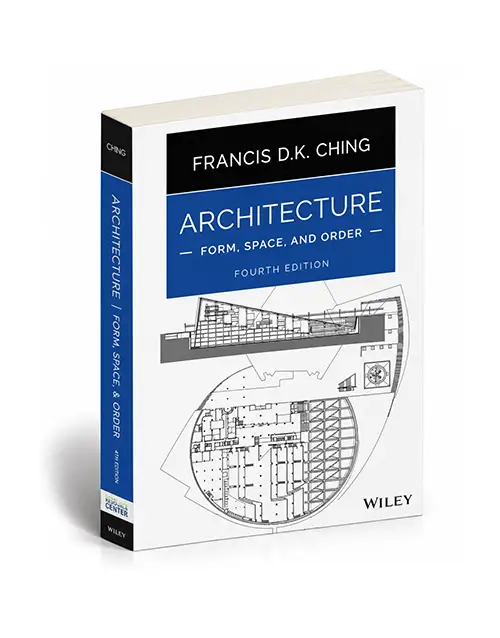


Architecture: Form, Space, and Order, Fourth Edition by Francis D.K. Ching
Architecture: Form, Space, and Order, 4th Edition by Francis D.K. Ching is a comprehensive visual textbook introducing the fundamental principles and vocabulary of architectural design. Published by Wiley, this internationally recognized reference explores the relationship between form, space, geometry, organization, proportion, and scale. Through detailed illustrations and contemporary architectural examples, it helps readers understand how architectural elements combine to create meaningful and functional environments.
Architecture involves more than constructing buildings. It requires an understanding of how spaces are formed, organized, connected, proportioned, and experienced. This textbook presents these concepts through a structured approach that connects fundamental design principles with architectural examples from different historical periods and cultures.
Understand the Fundamental Elements of Architectural Design
The book introduces the basic elements used to develop architectural compositions. Readers explore how points, lines, planes, and volumes contribute to the organization and expression of architectural form.
These elements provide the foundation for understanding how spaces are defined, how structures are arranged, and how visual relationships influence architectural composition. The text explains how simple geometric elements can develop into complex architectural arrangements through careful design and organization.
Explore Form and Space in Architecture
Form and space are central concepts in architectural design. The textbook examines how solid forms and spatial environments relate to one another and how architectural boundaries establish the character of interior and exterior spaces.
Readers can study the relationships between openings, walls, enclosures, views, and natural light. These concepts help explain how architects create spaces that influence movement, visibility, environmental conditions, and human experience.
The book also explores the relationship between positive and negative space, allowing students to understand how architectural composition depends on both the physical elements of a building and the spaces created between them.
Study the Organization of Architectural Space
Architectural spaces can be organized in different ways depending on their intended function and relationships. The book examines several spatial organization principles, including centralized, linear, radial, clustered, and grid-based arrangements.
These organizational systems help architects develop layouts that respond to functional requirements, circulation patterns, spatial hierarchy, and relationships between different areas. Studying them helps students recognize how buildings communicate structure and organization through their plans and spatial arrangements.
Understand Circulation and Spatial Relationships
Circulation describes how people move through buildings and connect different spaces. The textbook explores circulation paths, their configurations, and their relationships with the spaces they serve.
Readers can examine how entrances, corridors, pathways, stairways, and transitional spaces contribute to an architectural layout. Understanding these relationships is essential for designing environments that are accessible, functional, and easy to navigate.
The book also considers how circulation influences the experience of a building, including the sequence of spaces encountered as people move through an architectural environment.
Learn About Proportion and Scale
Proportion and scale influence how architectural forms relate to one another and to the people who experience them. The textbook introduces proportional systems, dimensional relationships, and anthropometry as important considerations in architectural design.
Readers can study how mathematical relationships, human dimensions, and visual balance influence the design of buildings and spaces. These principles provide a foundation for making informed decisions about spatial dimensions and the relationship between architectural elements.
Explore Light, Openings, Views, and Enclosures
Light and visibility play important roles in shaping architectural spaces. The book examines how openings, windows, doors, and enclosure systems influence the relationship between interior and exterior environments.
Readers can understand how natural light, views, and spatial boundaries contribute to the character of a building. These considerations are important when designing spaces that support comfort, visual connection, and functional requirements.
Develop Architectural Thinking Through Visual Examples
A distinguishing feature of Architecture: Form, Space, and Order is its extensive use of detailed architectural drawings and illustrations. The visual presentation helps readers connect abstract design principles with recognizable forms, plans, sections, and built environments.
Contemporary examples and architectural precedents demonstrate how fundamental design principles have been interpreted across different periods and cultures. These examples help students compare architectural approaches and develop a stronger vocabulary for discussing and evaluating design.
Improve Architectural Planning and Design Skills
The concepts presented throughout the book can support early-stage architectural design, spatial planning, and the analysis of existing buildings. Students can use the principles of form, space, organization, circulation, proportion, and scale when developing design concepts and evaluating architectural compositions.
Understanding these fundamentals also provides a useful foundation for more advanced study involving building design, architectural graphics, interior spaces, landscape relationships, and environmental considerations.
Who Should Read Architecture: Form, Space, and Order?
Architecture: Form, Space, and Order, Fourth Edition is suitable for architecture students, practicing architects, interior designers, architectural designers, educators, and professionals interested in design fundamentals.
It can support introductory architectural design courses, studio assignments, independent learning, and professional reference. The visual explanations make it particularly useful for readers who want to develop a stronger understanding of architectural vocabulary and the relationships between fundamental design elements.
Why Choose the Fourth Edition?
- Fundamental design principles: Explores points, lines, planes, volumes, form, and space.
- Spatial organization: Covers centralized, linear, radial, clustered, and grid-based arrangements.
- Circulation concepts: Explains how movement connects architectural spaces.
- Proportion and scale: Introduces proportional systems and anthropometry.
- Visual learning: Features detailed architectural illustrations and design examples.
- Contemporary references: Connects timeless principles with modern architectural developments.
- Academic and professional use: Suitable for architecture education and design reference.
About the Book
Title: Architecture: Form, Space, and Order
Edition: Fourth Edition
Author: Francis D.K. Ching
Publisher: John Wiley & Sons
Publication Date: November 2014
ISBN-13: 9781118745083
Format: Paperback for the matching print ISBN
Pages: 464
For students and professionals looking to understand the vocabulary and principles of architectural design, Architecture: Form, Space, and Order, Fourth Edition offers an extensively illustrated foundation in spatial composition, organization, proportion, circulation, and architectural form.
There are no reviews yet.