



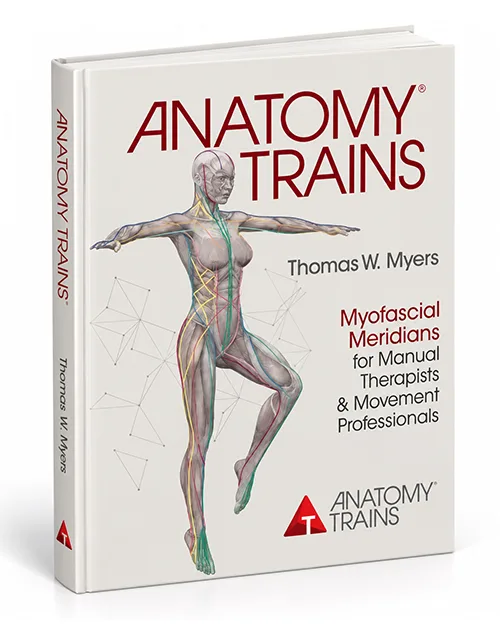





Anatomy Trains: Myofascial Meridians for Manual Therapists and Movement Professionals, 4th Edition
Anatomy Trains, 4th Edition by Thomas W. Myers is a detailed educational reference that explores the relationship between fascia, muscles, posture, and human movement. Published by Elsevier, this book introduces the Anatomy Trains concept, which describes connected myofascial pathways and how tension or movement patterns in one region of the body may relate to function in another region.
Designed for manual therapists, physical therapists, massage therapists, movement instructors, and other professionals, the book connects anatomical theory with clinical assessment and movement-based applications. Its illustrations, updated research, and practical explanations help readers explore the body’s interconnected soft tissues and their relevance to movement and postural patterns.
Understand Myofascial Anatomy
Fascia is connective tissue that surrounds, supports, and connects muscles and other structures throughout the body. Understanding the organization of this tissue can provide additional perspectives on movement, posture, and the way different anatomical regions work together.
Anatomy Trains presents a regional map of myofascial connections, helping readers examine relationships between muscles and connective tissues that may extend beyond a single anatomical area. This perspective complements conventional anatomical study and provides a framework for discussing movement and manual therapy approaches.
Explore the Myofascial Meridians
The book organizes its central concepts around several myofascial lines, including the Superficial Back Line, Superficial Front Line, Lateral Line, Spiral Line, Arm Lines, Functional Lines, and Deep Front Line. These pathways offer a way to study how anatomical structures may participate together in posture and movement.
Readers can explore the proposed relationships between these pathways and practical observations made during movement assessment. The framework can help practitioners develop questions about movement patterns and consider a broader view of anatomical relationships when planning their work.
Connect Anatomy with Movement and Posture
Movement involves coordinated activity across multiple muscles, joints, and connective tissues. The fourth edition examines how myofascial relationships can be considered in posture analysis, gait, functional movement, and physical treatment approaches.
The book discusses how movement strategies and compensatory patterns may be observed and evaluated. These concepts are relevant to professionals who work with mobility, movement education, body awareness, and musculoskeletal function.
The Anatomy Trains framework is an educational model rather than a substitute for established diagnostic methods. Practitioners should apply its concepts thoughtfully and in conjunction with appropriate clinical assessment and current scientific evidence.
Updated Research and Expanded Content
The fourth edition has been revised to reflect developments in fascia research and the scientific understanding of common clinical findings. It includes new photographs and images of fascial tissues, adhesions, and tissue layers, helping readers visualize structures discussed throughout the book.
The updated fascial compendium explores the origins, elements, properties, and neurology of the fascial system. These sections provide additional context for studying connective tissue and its role in human movement.
Anatomy Trains in Motion
This edition includes a dedicated section on Anatomy Trains in Motion by guest contributor Karin Gurtner. Drawing on Pilates-evolved movement approaches, this material explores movement, strength, and adaptability along the proposed myofascial meridians.
This content can be useful for movement educators, Pilates instructors, personal trainers, and rehabilitation professionals who want to consider anatomical connections alongside movement practice. It offers ideas for applying the book’s framework to movement observation and exercise instruction.
Applications in Manual Therapy and Bodywork
The text examines how Anatomy Trains concepts may inform clinical assessment and hands-on treatment approaches. It explores how practitioners can consider relationships between a person’s movement patterns, posture, and the location of reported discomfort when developing an assessment strategy.
The material may be of interest to physical therapists, massage therapists, osteopaths, chiropractors, structural integration practitioners, and other manual therapy professionals. It is intended to complement each practitioner’s professional education, scope of practice, and evidence-informed clinical reasoning.
Explore Structural Integration and Related Perspectives
The book includes appendices examining the relationship between the Anatomy Trains concept and other approaches to bodywork and structural analysis. Topics include the work of Ida Rolf, Louis Schultz’s Meridians of Latitude, structural integration, and correspondences with acupuncture meridians.
It also introduces preliminary investigations into myofascial anatomy in quadrupeds, including horses and dogs. This additional material broadens the discussion of myofascial relationships beyond human anatomy and may interest readers working in animal-related movement and therapy fields.
Visual Learning and Supplementary Resources
The fourth edition features approximately 578 illustrations, including 539 in full color, along with updated photographs and diagrams. Visual material helps readers follow anatomical pathways, compare structures, and connect theoretical explanations with practical observations.
The publisher also describes an enhanced eBook and a larger library of video resources, including demonstrations, animations, and webinars with the author. Digital access and included media may depend on the specific copy and whether its single-use access code has already been redeemed.
Who Should Read Anatomy Trains, 4th Edition?
Anatomy Trains: Myofascial Meridians for Manual Therapists and Movement Professionals is suitable for physical therapists, massage therapists, manual therapists, osteopaths, chiropractors, movement instructors, yoga and Pilates teachers, athletic trainers, personal trainers, and structural integration practitioners.
It can serve as a supplementary educational resource for students and established professionals interested in fascia, musculoskeletal anatomy, posture, and movement. The book’s anatomical maps and explanatory material make it useful for professional reference, continuing education, and the study of movement-based approaches.
Why Choose the Fourth Edition?
- Comprehensive myofascial framework: Explores interconnected anatomical pathways throughout the body.
- Clinical and movement applications: Relates anatomical theory to assessment, posture, and movement practice.
- Updated visual material: Includes approximately 578 illustrations, most in full color.
- Expanded research coverage: Updates material on fascia, its properties, and its neurological relationships.
- Movement education: Features the Anatomy Trains in Motion section.
- Broad professional audience: Relevant to manual therapists, rehabilitation professionals, and movement instructors.
About the Book
Title: Anatomy Trains: Myofascial Meridians for Manual Therapists and Movement Professionals
Edition: Fourth Edition
Author: Thomas W. Myers
Publisher: Elsevier
Publication Date: May 20, 2020
ISBN-13: 9780702078132
Page Count: 378 pages
For readers seeking a deeper understanding of fascia, myofascial meridians, posture, and functional movement, Anatomy Trains, 4th Edition offers an illustrated framework connecting anatomical knowledge with professional movement and manual therapy practice.
Educational note: The book’s model should be considered alongside established anatomy, clinical assessment, and current evidence. It does not replace individualized medical evaluation or professional treatment.
There are no reviews yet.