

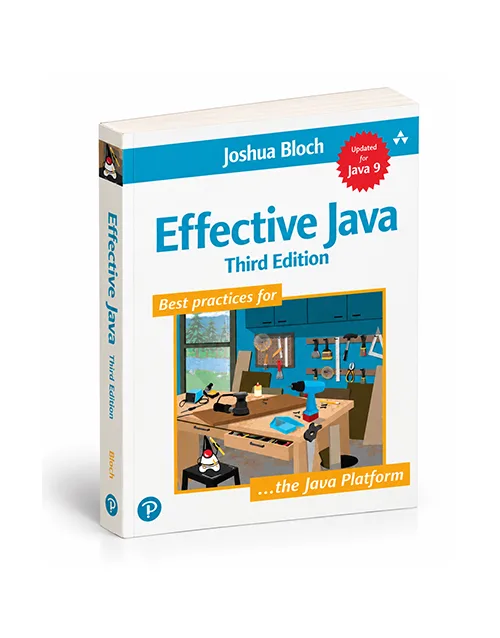


Effective Java, Third Edition
Effective Java, 3rd Edition by Joshua Bloch is an essential programming reference for developers who want to write better Java code. Published by Addison-Wesley Professional, this edition presents practical guidelines for creating efficient, reliable, readable, and maintainable Java applications.
Java is widely used for enterprise software, backend development, application programming, and large-scale systems. Writing effective Java programs requires more than knowing the language syntax. Developers must understand object-oriented design, resource management, generics, concurrency, exception handling, and the behavior of important Java libraries.
This book addresses these challenges through a collection of concise programming recommendations called items. Each item explains a particular best practice, provides examples, identifies common mistakes, and discusses why one approach may be preferable to another.
Understand the Principles of Effective Java Programming
The book emphasizes practical programming decisions that can make Java applications easier to understand, maintain, and extend. Rather than presenting only theoretical descriptions, Joshua Bloch explains how language features should be used in real software development.
Readers learn to recognize common programming pitfalls and understand how small implementation choices can influence software quality. The recommendations are especially useful for developers working on applications that require long-term maintainability, flexibility, and reliability.
Learn How to Create and Destroy Objects
The first major technical chapter focuses on object creation and destruction. Object construction is one of the foundations of Java programming, and the book explains how developers can choose suitable approaches for creating objects.
Topics include static factory methods, constructors, builder patterns, singleton properties, and noninstantiable utility classes. Readers also explore dependency injection and the importance of avoiding unnecessary objects.
The chapter discusses obsolete object references, resource management, finalizers, cleaners, and try-with-resources. These concepts help developers write safer code and reduce problems associated with resource handling and object lifecycle management.
Understand Methods Common to All Objects
Java provides several methods that are inherited from the Object class and are important to the behavior of Java objects. The book explains how to implement these methods correctly and why their contracts matter.
Readers can study equals, hashCode, toString, clone, and Comparable. These methods influence object comparison, hashing behavior, debugging, copying, and ordering.
Understanding their correct implementation helps prevent unexpected behavior when objects are used in collections, sorting operations, and other application components.
Design Better Classes and Interfaces
Effective class and interface design is essential for building flexible and reusable software. This chapter provides recommendations for designing Java types that are easy to use, robust, and maintainable.
Topics include controlling class and member accessibility, designing public APIs carefully, minimizing mutability, preferring composition over inheritance, and designing interfaces for future flexibility.
Readers also learn about the benefits of using interfaces instead of abstract classes in suitable situations and how nested classes can improve program organization.
These practices help developers build software components that are less tightly coupled and easier to maintain as applications evolve.
Explore Generics and Type Safety
Generics are an important feature of Java that allow developers to write reusable components while maintaining stronger compile-time type checking.
The book explains how generic types, methods, bounded wildcards, and generic APIs can make programs safer and clearer. Readers can understand why raw types should generally be avoided and how to design reusable interfaces and classes using appropriate generic declarations.
It also explores the use of generics with collections and other commonly used Java programming structures.
Learn About Enums and Annotations
Enums and annotations provide important tools for expressing information and defining structured behavior in Java applications.
The textbook explains the benefits of enums over traditional integer constants and discusses how enums can be used to represent fixed sets of values safely.
Readers can also explore annotations and annotation types, including their use in documenting program behavior and supporting frameworks and tools.
Understand Functions, Lambdas, and Streams
The third edition expands its coverage of modern Java programming, including lambda expressions and the Streams API introduced in Java 8.
Readers can study functional interfaces, method references, lambda expressions, and streams. These capabilities allow developers to express certain operations more concisely and work with collections and data processing pipelines in a more declarative style.
The book explains where functional programming techniques are useful and why developers should understand the differences between sequential and parallel stream processing.
Improve Method Design
Well-designed methods make Java programs easier to read, test, and maintain. The book provides guidelines for creating practical and consistent method interfaces.
Topics include parameter validation, defensive copying, method signatures, return types, naming conventions, and documentation. Readers can learn why method contracts should be clear and how carefully designed APIs can reduce misuse and unexpected behavior.
These recommendations are particularly valuable for developers creating reusable libraries and public application interfaces.
Develop Better General Programming Practices
The general programming chapter addresses everyday coding decisions that influence software quality. It covers local variables, control structures, libraries, data types, and other foundational Java practices.
Readers can explore techniques for writing clearer expressions, improving code organization, and avoiding unnecessary complexity. The chapter also discusses reflection, native methods, and optimization.
These recommendations encourage developers to prioritize understandable and maintainable code while considering performance only where it is relevant.
Handle Exceptions Effectively
Exception handling is an important part of writing dependable Java software. The textbook explains how exceptions should be used to communicate errors and unexpected situations without making programs unnecessarily difficult to understand.
Readers can study when to use checked and unchecked exceptions, how to create meaningful exception messages, and how to preserve useful information when handling errors.
The chapter also discusses the importance of documenting exceptions and avoiding practices that hide failures or make debugging more difficult.
Write Clear and Correct Concurrent Programs
Modern Java applications often perform multiple operations at the same time. Concurrency can improve responsiveness and performance, but poorly designed concurrent programs may introduce race conditions, synchronization problems, and unexpected behavior.
The book examines concurrency principles and provides guidance on writing clear, correct, and well-documented concurrent programs.
Readers can explore synchronization, thread safety, shared mutable state, executors, concurrent utilities, and the Java concurrency framework. These concepts help developers understand how to build applications that coordinate multiple tasks more reliably.
Understand Java Object Serialization
The final technical chapter discusses object serialization and the risks associated with using it incorrectly. Serialization can be useful for representing and transferring object state, but it also introduces important security and compatibility concerns.
Joshua Bloch explains the potential dangers of serialization and provides recommendations for reducing its risks. Readers can understand why serialization deserves careful consideration when designing application architectures and how safer alternatives may be appropriate in certain situations.
Explore Java 7, Java 8, and Java 9 Language Features
The third edition was extensively updated after the second edition’s publication in 2008. It incorporates major language and library developments introduced in subsequent Java releases, including Java 7, Java 8, and selected Java 9 features.
These updates are especially relevant to developers learning modern Java idioms such as try-with-resources, improved collection practices, functional interfaces, lambda expressions, streams, and enhancements to the concurrency and input/output libraries.
The book focuses on important programming principles and core Java features that remain useful for understanding well-designed Java software.
Learn Through Practical Items and Code Examples
A distinctive feature of Effective Java is its item-based learning format. Each recommendation is presented as a relatively short, independent discussion that addresses a specific programming concern.
The author combines practical advice, explanations of subtle language behavior, and code examples to demonstrate what developers should do, what they should avoid, and why.
This structure makes the book useful for both focused learning and reference. Readers can study individual subjects independently or work through the chapters to develop a broader understanding of Java programming best practices.
Who Should Read Effective Java?
Effective Java, 3rd Edition is suitable for intermediate and advanced Java developers, software engineers, backend programmers, application developers, computer science students, and technical professionals who regularly work with Java.
It is particularly useful for programmers who already understand basic Java syntax and want to improve their knowledge of object-oriented programming, generics, collections, concurrency, exception handling, and API design.
Experienced developers can also use the book as a reference when reviewing coding standards, developing reusable libraries, or improving the design and maintainability of existing Java applications.
Why Choose the Third Edition?
- Practical programming guidance: Presents focused recommendations for writing better Java code.
- Object-oriented design: Explains object creation, class design, inheritance, composition, and interfaces.
- Type safety: Covers generics, collections, enums, and annotations.
- Modern Java features: Includes lambdas, functional interfaces, streams, and selected Java 9 features.
- Reliable programming: Addresses exceptions, resource management, and concurrency.
- Maintainable software: Explores API design, method contracts, libraries, and general programming practices.
- Serialization guidance: Explains serialization risks and ways to minimize them.
- Practical examples: Includes detailed explanations and code examples organized into individual items.
About the Book
Title: Effective Java
Edition: Third Edition
Author: Joshua Bloch
Publisher: Addison-Wesley Professional
Publication Date: December 27, 2017
Copyright Year: 2018
ISBN-13: 9780134685991
Format: Paperback
Pages: 416
Language: English
For Java programmers seeking to improve their software design and coding skills, Effective Java, Third Edition provides practical guidance on object-oriented programming, generics, functional programming, concurrency, exception handling, and reliable Java application development.
Edition note: This third edition covers Java through Java 9. It is a valuable reference for core Java programming practices, but it should be supplemented with documentation for newer Java releases when studying features introduced after Java 9.
There are no reviews yet.