

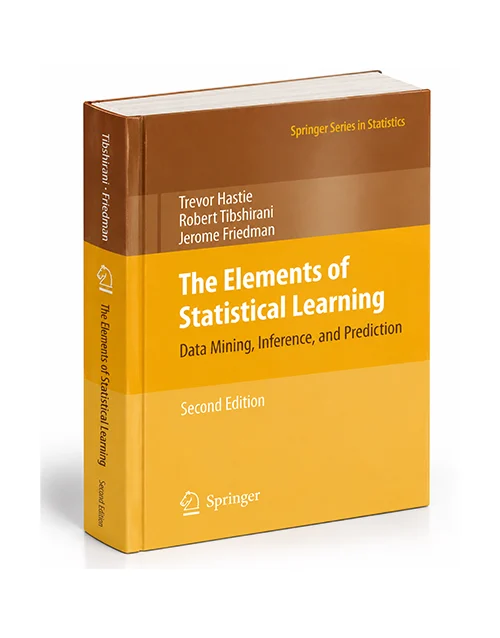


The Elements of Statistical Learning: Data Mining, Inference, and Prediction, Second Edition
The Elements of Statistical Learning, 2nd Edition by Trevor Hastie, Robert Tibshirani, and Jerome Friedman is a comprehensive textbook exploring the statistical foundations and practical methods behind modern predictive modeling and machine learning. Published by Springer as part of the Springer Series in Statistics, this influential reference brings together concepts from statistics, data mining, computational learning, and predictive analytics.
Modern applications in medicine, biology, finance, marketing, and scientific research generate increasingly large and complex datasets. Extracting useful information from these datasets requires methods that can identify patterns, estimate relationships, classify observations, and make predictions. This book presents these methods within a common conceptual framework, emphasizing statistical understanding, practical examples, and visual explanations.
Understand the Foundations of Statistical Learning
The textbook begins by introducing the fundamental ideas behind statistical learning and explaining how learning methods can be used to understand relationships within data. Readers explore the principles of supervised learning, where models use observed examples to predict outcomes or classify new observations.
It also introduces unsupervised learning, which focuses on discovering patterns and structures in data without relying on predetermined outcome labels. These foundations help readers understand how different learning approaches can be selected according to the research question and the characteristics of the available dataset.
Explore Linear Methods for Regression
Regression is one of the central tools used in statistical modeling. The book examines linear methods for regression and explains how relationships between predictor variables and numerical outcomes can be represented and estimated.
Readers can study linear regression, least squares estimation, subset selection, shrinkage methods, and related approaches. These techniques provide a foundation for understanding how statistical models are developed and evaluated.
The discussion also helps explain the trade-offs involved in model complexity, prediction accuracy, and the ability of a model to generalize to new observations.
Learn Linear Methods for Classification
Classification methods are used when the objective is to assign observations to categories or predict discrete outcomes. The textbook introduces linear approaches to classification and explains how they are used in predictive modeling.
Readers can develop an understanding of classification boundaries, statistical decision rules, and the relationship between regression-based methods and classification tasks. These methods are important in applications such as medical diagnosis, customer segmentation, risk assessment, and pattern recognition.
Understand Basis Expansions and Regularization
Many real-world relationships are more complex than simple linear associations. The book explores basis expansions and regularization as approaches for building flexible models while controlling unnecessary complexity.
Topics include polynomial and spline representations, regularization techniques, and the use of the lasso and related path algorithms. These methods help readers understand how statistical models can represent nonlinear relationships and manage large numbers of predictor variables.
The chapter also provides a conceptual foundation for balancing flexibility with predictive performance, an important issue in statistical learning.
Explore Kernel Smoothing Methods
Kernel smoothing methods provide another approach to modeling relationships that may not follow simple linear patterns. The textbook examines techniques for estimating smooth functions from observed data.
Readers can explore how local information contributes to statistical estimation and why smoothing methods are useful when analyzing complex relationships. These concepts provide an introduction to flexible statistical modeling beyond conventional linear methods.
Study Model Assessment and Selection
Building a statistical model is only part of the learning process. Researchers must also evaluate whether a model performs well and determine which modeling approach is most appropriate for the available data.
The book discusses model assessment and selection, including cross-validation, bootstrap methods, and other approaches for evaluating predictive performance.
Readers can understand important concepts such as the bias-variance trade-off, overfitting, prediction error, and model complexity. These principles are essential for selecting reliable predictive models and understanding how their performance may differ between training data and new observations.
Understand Model Inference and Averaging
Model inference and averaging are important topics for understanding uncertainty and combining information from different predictive models. The textbook explores these ideas and their role in statistical learning.
Readers can study approaches for interpreting model results, evaluating uncertainty, and improving predictive performance through model combination. These concepts provide useful context for understanding why a single model may not always offer the most effective solution.
Explore Additive Models, Trees, and Related Methods
The book examines additive models, decision trees, and other related learning methods. These techniques offer alternatives to conventional linear models and can represent complex relationships within datasets.
Readers can explore generalized additive models, tree-based methods, and classification and regression trees (CART). These approaches are useful for modeling interactions, capturing nonlinear patterns, and developing interpretable predictive structures.
Learn Boosting and Additive Trees
Boosting is an important machine learning technique that builds a stronger predictive model by combining multiple learning steps. The textbook provides detailed coverage of boosting and additive tree methods.
It examines how successive models can be developed to improve prediction and how the resulting ensemble contributes to the overall learning process. The material introduces important ideas behind gradient boosting and other additive modeling strategies.
These methods have applications across classification, regression, data mining, and predictive analytics.
Study Neural Networks
Neural networks provide flexible methods for learning complex relationships from data. The book introduces neural network models and explains how they contribute to statistical learning and prediction.
Readers can develop an understanding of the basic principles involved in network structures, learning processes, and nonlinear prediction. This chapter provides a statistical foundation for understanding neural networks alongside other machine learning techniques.
Understand Support Vector Machines and Flexible Discriminants
Support vector machines are powerful techniques used in classification and regression problems. The textbook explains the underlying principles of support vector methods and their relationship to flexible discriminant approaches.
Readers can examine how classification boundaries are developed and how kernel-based methods extend the capabilities of traditional linear classifiers. These approaches are particularly relevant in pattern recognition, data mining, and high-dimensional classification problems.
Explore Prototype Methods and Nearest Neighbors
Prototype methods and nearest-neighbor approaches provide intuitive techniques for classifying observations based on their similarity to other examples.
The book explores these methods and explains how distances, neighborhoods, and representative observations contribute to prediction. Readers can understand how similarity-based approaches differ from parametric models and where they may be useful in practical classification tasks.
Learn Unsupervised Learning Techniques
Unsupervised learning focuses on discovering meaningful structures within data when predefined outcome labels are unavailable. This is an important area of statistical learning, particularly in exploratory data analysis and scientific research.
The textbook covers clustering and other unsupervised learning methods, helping readers understand how patterns, groups, and relationships can be identified within complex datasets.
These techniques are relevant to applications involving biological data, customer behavior, financial information, and other areas where researchers need to discover hidden structures.
Explore Random Forests and Ensemble Learning
Random forests and ensemble learning are major topics added to the second edition. These methods combine the predictions of multiple learning models to improve performance and provide flexible approaches to classification and regression.
The book explains random forest methods and their relationship to tree-based learning. It also examines broader ensemble learning principles, including how different models can be combined to generate improved predictions.
These techniques are particularly relevant to modern data mining and machine learning applications involving large or complex datasets.
Understand Undirected Graphical Models
The textbook introduces undirected graphical models and their role in representing complex statistical relationships. These models provide a framework for expressing dependencies between variables through graphical structures.
Readers can explore how graphical representations contribute to statistical modeling and inference. The material also connects these ideas to broader methods used in probabilistic modeling and machine learning.
Study High-Dimensional Statistical Problems
High-dimensional datasets present unique challenges when the number of predictor variables is large relative to the number of observations. The book dedicates a chapter to problems commonly described as p greater than n, where the number of variables exceeds the number of samples.
Topics include multiple testing, false discovery rates, and the challenges of statistical inference in high-dimensional settings. These methods are especially relevant to fields such as genomics, computational biology, financial modeling, and other areas involving complex data.
Apply Statistical Learning Across Different Fields
The Elements of Statistical Learning presents a common conceptual framework that can be applied across a range of disciplines. Its examples and methods are relevant to medicine, biology, finance, marketing, scientific research, and industry.
The authors emphasize statistical concepts alongside mathematical foundations, allowing readers to understand the ideas behind different methods and how they relate to practical predictive problems.
Learn Through Extensive Illustrations and Examples
A distinguishing feature of the second edition is its extensive use of visual explanations. Springer lists more than 200 pages of four-color graphics, including hundreds of illustrations that help communicate statistical concepts and modeling techniques.
The book combines mathematical explanations with diagrams, examples, and graphical representations. These resources help readers understand model behavior, statistical relationships, and the practical implications of different learning methods.
Who Should Read The Elements of Statistical Learning?
The Elements of Statistical Learning, 2nd Edition is suitable for statisticians, data scientists, machine learning researchers, computer science students, graduate students, and quantitative researchers.
It is especially useful for readers with a foundation in statistics and mathematics who want to study predictive modeling, data mining, statistical inference, and modern machine learning methods in greater depth.
Researchers and professionals working in computational biology, medicine, finance, marketing, artificial intelligence, and scientific data analysis may also use it as an advanced reference.
Why Choose the Second Edition?
- Comprehensive statistical learning: Covers supervised and unsupervised learning in a common statistical framework.
- Predictive modeling: Explores regression, classification, regularization, and model assessment.
- Machine learning techniques: Includes neural networks, support vector machines, boosting, and nearest-neighbor methods.
- Advanced methods: Covers random forests, ensemble learning, and graphical models.
- High-dimensional data: Examines multiple testing and false discovery rates when the number of variables exceeds the observations.
- Extensive illustrations: Includes more than 200 pages of four-color graphics.
- Interdisciplinary applications: Connects statistical learning with medicine, biology, finance, marketing, and scientific research.
About the Book
Title: The Elements of Statistical Learning
Subtitle: Data Mining, Inference, and Prediction
Edition: Second Edition
Authors: Trevor Hastie, Robert Tibshirani, and Jerome Friedman
Publisher: Springer
Series: Springer Series in Statistics
Publication Date: February 9, 2009
Hardcover ISBN-13: 9780387848570
Format: Hardcover
Pages: 745, plus XXII pages of front matter
Language: English
For readers seeking an in-depth reference on statistical learning and predictive modeling, The Elements of Statistical Learning, Second Edition provides an extensive foundation in regression, classification, model assessment, machine learning, data mining, and advanced statistical methods.
There are no reviews yet.