

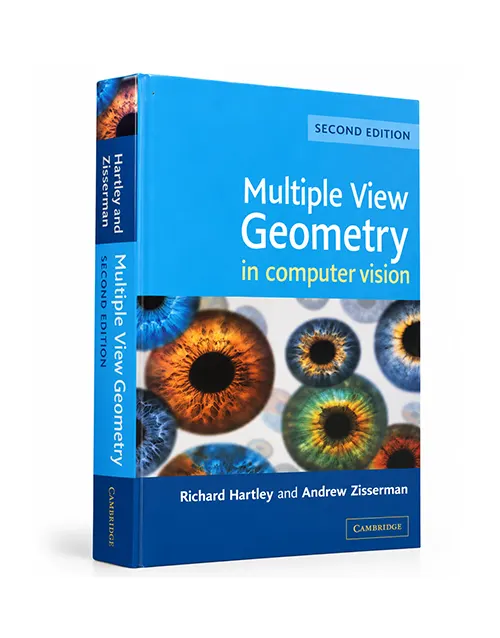


Multiple View Geometry in Computer Vision, Second Edition
Multiple View Geometry in Computer Vision, 2nd Edition by Richard Hartley and Andrew Zisserman is an advanced technical textbook explaining the mathematical principles used to interpret images, recover three-dimensional scene structure, and understand geometric relationships between multiple camera views. Published by Cambridge University Press, this reference connects projective geometry, linear algebra, numerical methods, and computer vision algorithms.
Computer vision systems use images to extract information about objects, environments, movement, and three-dimensional structure. Recovering this information from multiple images requires mathematical models that describe camera projection and the relationships between different viewpoints. This book develops those concepts in a structured way, helping readers understand both the theory and the computational methods behind modern geometric computer vision.
Understand the Mathematical Foundations of Computer Vision
The textbook introduces the mathematical background needed to study geometric relationships in images. It covers projective geometry, geometric transformations, coordinate representations, and estimation methods used to analyze scenes captured from different viewpoints.
These principles help explain how two-dimensional image measurements relate to the three-dimensional world. Readers develop an understanding of the mathematical models used to represent points, lines, planes, camera positions, and geometric relationships within images.
Explore Camera Projection and Multiple Views
Camera projection is a fundamental concept in computer vision. A camera maps points in a three-dimensional environment onto a two-dimensional image, and understanding this relationship is essential for reconstructing spatial information from photographs or video frames.
Multiple View Geometry in Computer Vision examines camera projection matrices and the geometric relationships between images captured from different viewpoints. Readers can study how information from multiple images can be combined to estimate scene structure and recover useful spatial properties.
Study the Fundamental Matrix and Epipolar Geometry
Epipolar geometry describes the geometric relationship between two camera views of the same scene. The fundamental matrix provides an algebraic representation of this relationship and plays an important role in matching corresponding image points between views.
The book explains the geometric principles behind the fundamental matrix and the methods used to estimate and apply it. These concepts are relevant to image matching, camera geometry, stereo vision, and three-dimensional reconstruction.
Understand the Trifocal Tensor and Multiple-View Relationships
When three images of a scene are available, additional geometric relationships can be used to connect corresponding points and lines across views. The trifocal tensor provides a mathematical framework for representing important relationships between three camera views.
The textbook examines the theory and computation of the trifocal tensor, helping readers understand how multiple-view constraints can support geometric analysis and reconstruction. These topics build on the concepts introduced for pairs of images and extend them to more complex configurations.
Learn Three-Dimensional Scene Reconstruction
A major application of multiple-view geometry is reconstructing the structure of a real-world scene from images. The book discusses methods for recovering geometric information, estimating camera relationships, and obtaining three-dimensional scene models from multiple observations.
Readers can explore how projective, affine, and Euclidean properties relate to the reconstruction process. The mathematical framework helps explain how image correspondences and camera geometry contribute to estimates of scene structure.
These concepts are important in applications such as stereo vision, 3D modeling, image-based measurement, visual localization, and robotics research.
Explore Projective Geometry and Geometric Transformations
Projective geometry provides a mathematical framework for describing how geometric structures behave under perspective projection. The textbook develops this subject through transformations and their algebraic representations, creating a foundation for understanding image geometry.
Readers can study projective transformations in two and three dimensions, along with relationships among points, lines, planes, and other geometric structures. These topics help explain the geometric properties that can be recovered from images and the limitations that arise when reconstructing a scene from projected data.
Understand Estimation Algorithms and Computation
Computer vision applications must estimate unknown geometric quantities from image measurements, which may contain noise or uncertainty. The book explores methods of computation and estimation that help solve these problems.
Its mathematical presentation connects theoretical models with real examples and algorithms. Readers with a background in linear algebra and basic numerical methods can use the explanations to understand the underlying calculations and implement relevant algorithms themselves.
Applications in Robotics, Image Processing, and 3D Vision
The concepts in this textbook are relevant to researchers and engineers working in computer vision, robotics, photogrammetry, image processing, and computer graphics. Multiple-view geometry provides tools for understanding spatial relationships, matching image features, estimating camera parameters, and constructing three-dimensional representations.
These methods can contribute to systems involving visual measurement, scene reconstruction, camera calibration, augmented reality, and robot perception. Practical implementation depends on the application, available image data, and the accuracy requirements of the system.
Who Should Read Multiple View Geometry in Computer Vision?
Multiple View Geometry in Computer Vision, Second Edition is intended for graduate students, computer vision researchers, robotics engineers, image-processing specialists, and software developers working with geometric vision algorithms.
Readers benefit from a working knowledge of linear algebra, matrix operations, and basic numerical methods. The book is particularly useful for those who want to understand the mathematics behind vision algorithms instead of relying entirely on software libraries or prebuilt implementations.
Why Choose the Second Edition?
- Strong mathematical foundation: Explores projective geometry, transformations, and estimation methods.
- Camera geometry: Covers projection matrices and the relationships between multiple camera views.
- Core computer vision concepts: Explains the fundamental matrix, epipolar geometry, and trifocal tensor.
- 3D reconstruction: Discusses methods for recovering scene structure from multiple images.
- Theory and computation: Connects mathematical derivations with algorithms and real examples.
- Advanced technical reference: Suitable for graduate-level study and professional research.
About the Book
Title: Multiple View Geometry in Computer Vision
Edition: Second Edition
Authors: Richard Hartley and Andrew Zisserman
Publisher: Cambridge University Press
Publication Date: March 2004
ISBN-13: 9780521540513
Format: Paperback
Pages: 670
For readers seeking an in-depth understanding of geometric computer vision, this textbook provides a rigorous foundation in camera projection, projective geometry, multiple-view relationships, and algorithms for reconstructing three-dimensional scenes from images.
There are no reviews yet.