

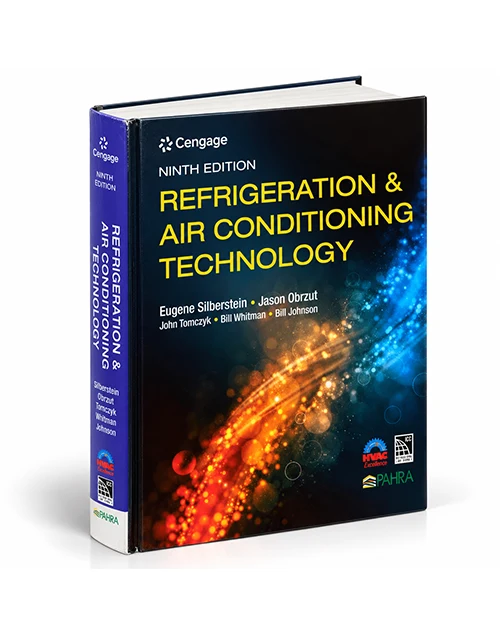


Refrigeration & Air Conditioning Technology, 9th Edition
Refrigeration & Air Conditioning Technology, 9th Edition by Eugene Silberstein, Jason Obrzut, John Tomczyk, Bill Whitman, and Bill Johnson is a comprehensive technical textbook for understanding heating, ventilation, air conditioning, and refrigeration (HVACR) systems. Published by Cengage, this reference combines foundational scientific principles with practical information about equipment, installation, servicing, maintenance, and troubleshooting.
HVACR professionals work with interconnected mechanical, electrical, and refrigeration components that control indoor temperature, humidity, air distribution, and cooling performance. This textbook explains the principles behind these systems and helps learners understand how individual components operate together in residential, commercial, and industrial applications.
Understand the Fundamentals of Refrigeration
The book introduces the theory of heat, temperature, pressure, matter, energy, refrigeration, and refrigerants. These concepts are essential for understanding heat transfer and the way refrigeration cycles move thermal energy from one location to another.
Readers can study how refrigeration systems operate and how their major components work together. The discussion provides a foundation for understanding system performance, recognizing operating conditions, and approaching service and diagnostic tasks systematically.
Explore HVACR Tools, Equipment, and Shop Practices
Proper equipment handling, safe work practices, and the correct use of tools are important parts of HVACR training. The textbook covers general safety practices, tools and instrumentation, fasteners, tubing and piping, and other topics associated with practical service work.
It also addresses leak detection, system evacuation, system cleanup, refrigerant and oil management, system charging, and instrument calibration. These subjects introduce learners to important procedures used when installing, servicing, and maintaining refrigeration and air conditioning equipment.
Learn Electrical Systems, Controls, and Motors
HVACR equipment relies on electrical components and control systems to operate reliably. This textbook covers basic electricity and magnetism, automatic control components, control applications, and troubleshooting techniques.
Additional chapters explore electric motor types, motor applications, motor controls, and motor troubleshooting. Understanding these topics helps students recognize the relationship between electrical theory and the operation of compressors, fans, pumps, and other equipment used in HVACR systems.
Study Commercial Refrigeration Systems
The commercial refrigeration section examines major system components, including evaporators, condensers, compressors, expansion devices, and specialized refrigeration components. Readers can explore how these parts contribute to refrigeration performance and how their operation affects the overall system.
The text also covers commercial ice machines, special refrigeration applications, and typical operating conditions. Troubleshooting content helps learners develop a structured approach to understanding system symptoms and evaluating potential equipment problems.
Explore Heating and Air Conditioning Technology
The book covers electric, gas, oil, and hydronic heating, along with indoor air quality and the principles of air conditioning. Readers can study comfort and psychrometrics, refrigeration applied to air conditioning, air distribution and balancing, and system installation.
Additional topics include heat gain and heat loss in buildings, air-source and geothermal heat pumps, residential energy auditing, room air conditioners, and commercial air conditioning systems. These subjects support a broader understanding of heating and cooling technology across different building types and applications.
Understand Commercial Cooling and Chilled-Water Systems
Commercial cooling systems may use packaged equipment, variable refrigerant flow systems, variable air volume systems, chilled-water equipment, cooling towers, and pumps. The textbook introduces these systems and their relevant operating principles.
Maintenance and troubleshooting topics help learners understand how equipment condition and system performance can be evaluated. This knowledge is useful for students preparing for HVACR technical training and for professionals reviewing the operation of complex building systems.
Develop Practical Troubleshooting Skills
Diagnosing HVACR problems requires understanding how a system should operate and recognizing when observed conditions differ from expected behavior. The book connects foundational theory with practical operating conditions and troubleshooting methods across refrigeration, heating, air conditioning, controls, and motors.
By studying components individually and as part of complete systems, learners can build a more organized approach to service diagnosis. Practical experience, appropriate tools, manufacturer documentation, and safe work procedures remain essential when applying these concepts in the field.
Who Should Read Refrigeration & Air Conditioning Technology?
Refrigeration & Air Conditioning Technology, 9th Edition is suitable for HVACR students, trade-school learners, apprentices, refrigeration technicians, air conditioning technicians, and instructors. It may also serve as a reference for professionals who want to review system components, operating principles, installation practices, and troubleshooting methods.
The book’s combination of technical explanations and practical applications makes it useful for classroom instruction, vocational training, laboratory preparation, and independent study. Readers developing careers in HVACR can use it to establish a foundation before progressing to advanced technical training and supervised field experience.
Why Choose the 9th Edition?
- Comprehensive HVACR coverage: Includes refrigeration, heating, air conditioning, electrical systems, controls, and motors.
- Practical service topics: Covers tools, piping, leak detection, system evacuation, charging, and instrumentation.
- Commercial applications: Explores commercial refrigeration, chilled-water systems, and packaged air conditioning equipment.
- Troubleshooting guidance: Addresses operating conditions and diagnostic approaches across major system types.
- Technical education: Suitable for HVACR coursework, apprenticeships, and professional reference.
- Broad equipment coverage: Connects basic theory with systems used in residential and commercial environments.
About the Book
Title: Refrigeration & Air Conditioning Technology
Edition: Ninth Edition
Authors: Eugene Silberstein, Jason Obrzut, John Tomczyk, Bill Whitman, and Bill Johnson
Publisher: Cengage
Copyright Year: 2021
ISBN-13: 9780357122273
Format: Hardback in the U.S. edition
Pages: 1,701
For learners and professionals seeking a detailed introduction to HVACR systems, Refrigeration & Air Conditioning Technology, 9th Edition offers broad coverage of refrigeration theory, heating and cooling equipment, electrical controls, maintenance, and troubleshooting.
There are no reviews yet.