

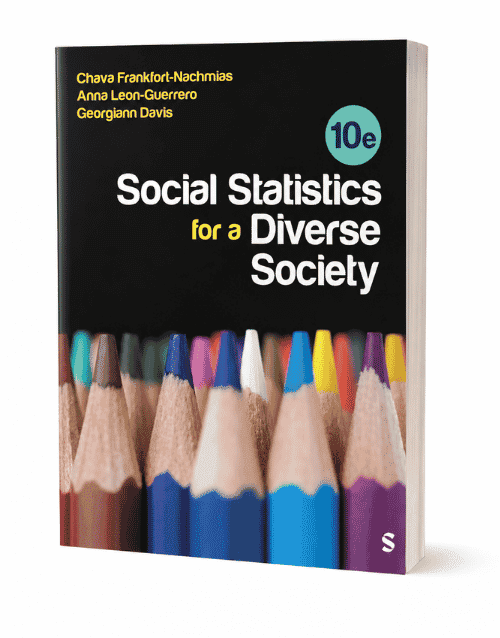


Learning statistics becomes more meaningful when numerical evidence is connected to the social issues it helps explain. Social Statistics for a Diverse Society 10th Edition by Chava Frankfort-Nachmias, Anna Leon-Guerrero, and Georgiann Davis introduces statistical methods through examples involving race, class, gender, inequality, and other dimensions of social life. Published by SAGE, this textbook helps students develop the skills needed to understand data, evaluate research findings, and interpret statistical information encountered in academic studies, workplaces, and public discussions. ISBN 9781071910474 identifies this paperback edition.
Rather than treating statistics as a collection of formulas to memorize, the book emphasizes understanding what statistical methods reveal and how to interpret their results. Early chapters introduce the purpose of statistics, the organization of data, and graphical presentation. Students explore frequency distributions, percentages, measures of central tendency, and measures of variability to learn how information can be summarized and communicated. These foundations provide a starting point for examining patterns in social data and distinguishing meaningful observations from unsupported conclusions.
As the material progresses, the Social Statistics for a Diverse Society textbook introduces probability-related concepts, the normal distribution, sampling distributions, estimation, and hypothesis testing. These topics help readers understand how researchers draw conclusions from samples, assess evidence, and evaluate claims about populations. The text also covers bivariate tables, the chi-square test, measures of association, analysis of variance, regression, and correlation. Together, these methods give students a foundation for examining relationships between variables and interpreting findings from quantitative social research.
A distinctive feature of this tenth edition is its connection between statistical analysis and the study of social diversity. Examples involving real-world social issues help place quantitative techniques in context, encouraging students to consider how differences across social groups appear in research data. This approach is relevant to sociology, social science research, public policy, and related fields where statistical evidence can help investigate patterns of inequality, demographic differences, and social change. The emphasis remains on understanding and interpreting results rather than performing calculations without considering their meaning.
The tenth edition includes fresh topical examples and exercises, along with General Social Survey datasets and step-by-step video demonstrations using SPSS and Excel. These resources can help students connect textbook concepts with statistical software and practical data analysis. They are particularly useful for learners who need to move from understanding a statistical concept to seeing how data can be organized, analyzed, and interpreted in an applied setting.
Social Statistics for a Diverse Society, 10th Edition (9781071910474) is suitable for college students studying sociology, social research methods, and quantitative analysis, as well as instructors seeking a structured introduction to statistical reasoning. Researchers and readers developing their data interpretation skills may also find its explanations and applied examples useful. If you need a textbook that combines core statistical techniques with questions about social diversity and inequality, this SAGE publication provides a clear pathway from basic data organization to more advanced methods of statistical analysis. Check the ISBN and edition before ordering to ensure you select the intended book.
Parker Reed –
Appreciated how this text connects statistical formulas to real world sociological issues like income inequality and demographic shifts.