

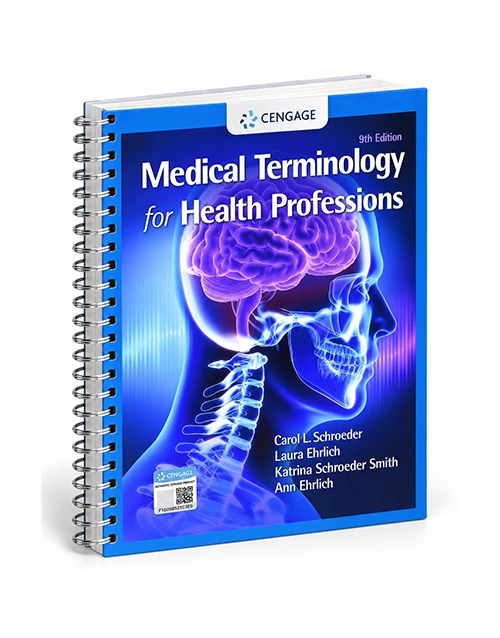


Medical Terminology for Health Professions, Ninth Edition
Medical Terminology for Health Professions, 9th Edition by Ann Ehrlich, Carol L. Schroeder, Laura Ehrlich, and Katrina Schroeder Smith is an educational textbook designed to help students understand and use the medical language commonly encountered in healthcare environments. Published by Cengage, this spiral-bound edition introduces medical terminology through word construction, pronunciation, definitions, clinical examples, and practical exercises.
Medical terminology is an essential part of communication in healthcare. Medical assistants, nurses, laboratory professionals, and other healthcare workers need to understand the words used to describe body structures, diseases, symptoms, diagnostic procedures, and treatments. This textbook simplifies the learning process by explaining how medical terms are constructed from prefixes, word roots, combining forms, and suffixes.
Understand the Fundamentals of Medical Terminology
The textbook begins by introducing medical terminology and explaining why word parts are the foundation of medical language. Readers learn how prefixes, suffixes, and word roots combine to create terms used in healthcare.
The book teaches students how to take unfamiliar medical words apart and use their individual components to understand their meanings. It also introduces combining forms, pronunciation, spelling, and the use of medical dictionaries.
This word-building approach helps learners develop skills that can be applied to thousands of medical terms rather than memorizing every term as an unrelated word.
Explore the Human Body in Health and Disease
The second chapter introduces the human body and the terminology used to describe health, disease, and basic anatomical concepts. Students become familiar with the language used to discuss body organization, medical conditions, and common healthcare terminology.
This foundation prepares readers for the more specialized vocabulary introduced in subsequent chapters covering individual body systems.
Study the Skeletal System
The skeletal system chapter introduces medical terms associated with bones, joints, and the structures that provide support and protection to the body.
Readers can develop familiarity with terminology used to describe skeletal anatomy, disorders, diagnostic procedures, and treatments. Learning these terms is useful in clinical settings involving musculoskeletal assessment and patient care.
Understand the Muscular System
The muscular system section explains vocabulary related to muscles, movement, and muscular conditions. Students learn terminology used in discussions of muscular anatomy, disorders, procedures, and treatment.
This material helps learners recognize and interpret the specialized language used when documenting muscular conditions and discussing related healthcare services.
Explore the Cardiovascular System
The cardiovascular system chapter covers terminology associated with the heart, blood, and blood vessels. It introduces the medical language used to describe cardiovascular anatomy, disorders, diagnostic procedures, and treatment approaches.
Readers can become familiar with terminology related to heart health and circulatory conditions, providing a foundation for understanding common clinical documentation and healthcare discussions.
Learn About the Lymphatic and Immune Systems
The book examines the lymphatic and immune systems and the vocabulary associated with their structures and functions.
Students can study terms related to immunity, lymphatic organs, infectious processes, and disorders affecting these systems. This chapter helps connect specialized medical vocabulary with the language used in patient assessment and healthcare practice.
Understand the Respiratory System
The respiratory system chapter introduces terminology involving the lungs, airways, and breathing-related structures. It covers the words used to describe respiratory conditions, diagnostic procedures, and treatments.
Understanding this vocabulary is important for healthcare learners who encounter documentation involving breathing difficulties, respiratory infections, and other pulmonary conditions.
Study the Digestive System
The digestive system chapter explains medical terminology associated with the organs responsible for digestion and nutrient absorption.
Readers can explore vocabulary relating to digestive anatomy, common disorders, diagnostic procedures, and medical treatments. The material helps students understand terms used in clinical discussions involving the gastrointestinal system.
Explore the Urinary System
The urinary system section covers terminology related to the kidneys, urinary tract, and processes involved in eliminating waste from the body.
It introduces vocabulary associated with urinary conditions, diagnostic examinations, and treatment procedures, helping students understand the language used in healthcare documentation and patient care.
Learn the Nervous System and Mental Health Terminology
The textbook includes a dedicated chapter on the nervous system and mental health. It introduces terminology associated with the brain, spinal cord, nerves, and mental health conditions.
Students can become familiar with vocabulary used to describe neurological structures, disorders, symptoms, and related procedures. This section is particularly useful for learners who may encounter medical terminology involving neurological and mental health services.
Understand the Special Senses: Eyes and Ears
The special senses chapter focuses on medical terminology related to the eyes and ears. Readers learn vocabulary used to describe the structures, conditions, diagnostic examinations, and treatments associated with vision and hearing.
These terms provide a foundation for understanding common terminology encountered in ophthalmology, optometry, audiology, and general healthcare settings.
Study the Skin and Integumentary System
The integumentary system chapter introduces terminology associated with the skin and its related structures. Students can study the language used to describe skin conditions, anatomical features, and dermatological procedures.
The chapter helps learners recognize terminology used in clinical documentation involving skin health, injuries, diseases, and treatments.
Explore the Endocrine System
The endocrine system section introduces medical vocabulary related to hormones and the glands responsible for regulating important bodily functions.
Readers can learn terms associated with endocrine anatomy, hormonal conditions, diagnostic procedures, and treatment. The chapter also provides terminology relevant to understanding diabetes and other endocrine-related conditions.
Understand the Reproductive Systems
The textbook covers terminology related to the male and female reproductive systems, including anatomical structures, medical conditions, diagnostic procedures, and treatments.
This section helps students develop familiarity with reproductive health vocabulary and medical language used in related healthcare specialties.
Learn Diagnostic Procedures and Pharmacology
The final major chapter introduces terminology associated with diagnostic procedures, pharmacology, and complementary medicine.
Students can explore the vocabulary used to describe medical examinations, laboratory procedures, medication-related concepts, and different approaches to healthcare. The material helps connect terminology from the previous body-system chapters with clinical procedures and treatment-related language.
Practice Medical Word Parts and Abbreviations
The textbook includes supplementary appendices that support the study of medical terminology. These reference sections organize prefixes, combining forms, suffixes, and abbreviations with their meanings.
Students can use these resources when reviewing unfamiliar medical terms, building vocabulary, and checking the meanings of common word components and abbreviations.
Reinforce Learning Through Exercises and Real-Life Medical Scenarios
A major strength of Medical Terminology for Health Professions is its practical learning approach. Every chapter includes activities designed to improve the pronunciation and understanding of important medical terms.
Real-life medical scenarios and critical-thinking exercises connect terminology with situations encountered in healthcare environments. Learning exercises also encourage students to write out correct answers, reinforcing spelling skills and understanding.
These activities help transform medical terminology from memorization into practical language skills that learners can apply in academic and professional settings.
Use Removable Flashcards and Comprehensive Review Resources
The Cengage textbook includes removable flashcards designed to test memory and strengthen medical vocabulary knowledge. These learning resources support additional practice and help students review important concepts.
A comprehensive medical terminology review provides study tips, practice exercises, and a simulated final test. These materials help students assess their understanding and prepare for course examinations.
The spiral-bound format also makes the printed textbook convenient to open and use while studying, taking notes, or completing learning exercises.
Updated Content in the Ninth Edition
The ninth edition was revised to reflect changes in healthcare terminology, procedures, illustrations, and clinical information. Cengage highlights expanded coverage of gender identity and gender reassignment, COVID-19, advanced directives, durable medical equipment, dental procedures, diabetic pathology, and nutrition support.
It also includes revised illustrations and photographs featuring patients and healthcare professionals from different backgrounds and age groups. The complementary and alternative therapies section reflects the role of holistic healthcare in contemporary practice.
These updates make the textbook relevant to students learning medical terminology in a variety of modern healthcare education settings.
Who Should Read Medical Terminology for Health Professions?
Medical Terminology for Health Professions, 9th Edition is suitable for medical assisting students, nursing students, allied health students, healthcare administration learners, and individuals preparing for careers in healthcare.
It may also be useful for students in dental assisting, medical office administration, laboratory programs, and other health-related educational courses. Healthcare professionals can use it as a reference when reviewing medical word construction, terminology, and abbreviations.
Why Choose the Ninth Edition?
- Word-building approach: Explains common prefixes, word roots, combining forms, and suffixes.
- Body-system coverage: Includes terminology for all major human body systems.
- Practical learning: Uses pronunciation activities, real-life medical scenarios, and critical-thinking exercises.
- Updated healthcare language: Includes expanded coverage of contemporary medical topics.
- Study resources: Provides removable flashcards, appendices, and a comprehensive review.
- Exam preparation: Includes study tips, practice exercises, and a simulated final test.
- Convenient spiral binding: Makes the textbook easy to open and use during study sessions.
About the Book
Title: Medical Terminology for Health Professions
Edition: Ninth Edition
Authors: Ann Ehrlich, Carol L. Schroeder, Laura Ehrlich, and Katrina Schroeder Smith
Publisher: Cengage
Copyright Year: 2022
Publication Date: February 1, 2023
ISBN-13: 9780357513699
Format: Spiral-Bound / Paperback
Pages: 672
Language: English
For students preparing for healthcare careers, Medical Terminology for Health Professions, 9th Edition provides a structured introduction to medical vocabulary, body-system terminology, word construction, pronunciation, diagnostic procedures, and clinical language. Its exercises, scenarios, flashcards, and review materials support practical learning and terminology retention.
There are no reviews yet.