

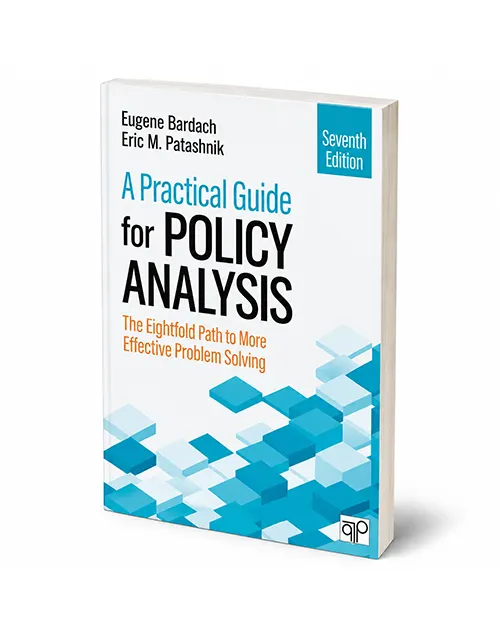


Public policy decisions rarely have simple answers. Analysts must identify the problem, examine available evidence, compare possible solutions, and explain why one approach may be preferable to another. A Practical Guide for Policy Analysis 7th Edition Book, subtitled The Eightfold Path to More Effective Problem Solving, by Eugene S. Bardach and Eric M. Patashnik, provides a structured approach to this work. Published by CQ Press, this paperback textbook is identified by ISBN 9781071884133 and is intended for readers learning or practicing public policy analysis.
At the heart of the book is the Eightfold Path, a practical framework for moving from a broadly defined policy concern to a reasoned recommendation. The approach guides readers through defining the problem, assembling evidence, constructing alternatives, selecting criteria, projecting outcomes, confronting trade-offs, deciding, and communicating the analysis. Rather than treating policy research as a purely theoretical exercise, the framework emphasizes how these tasks connect when a decision must be made under real-world constraints.
Evidence plays a central role in the analytical process. Readers explore how to identify relevant information, assess competing explanations, and use research to support policy judgments. The book also addresses the challenge of comparing alternatives when each option carries different costs, benefits, uncertainties, and consequences. This makes it relevant to questions involving public spending, government programs, institutional decisions, and the design of interventions intended to address social or economic problems. Its emphasis is on developing a defensible line of reasoning rather than assuming that complex policy questions have one universally correct answer.
The seventh edition extends beyond the basic analytical framework. Its contents include guidance on handling a design problem, researching and adapting promising practices from other settings, and understanding what governments and public or nonprofit institutions do. Additional material examines policy analysis in a polarized environment, working effectively with clients, and incorporating big data and rigorous scientific evidence. These subjects help readers consider not only how to evaluate policy options but also how institutional context, communication, evidence quality, and implementation concerns influence practical recommendations.
For students of public policy, public administration, political science, and related disciplines, A Practical Guide for Policy Analysis offers a method they can apply to coursework, case studies, research assignments, and policy projects. Practicing analysts, government professionals, nonprofit staff, and consultants may also find its techniques useful when preparing recommendations or explaining decisions to stakeholders. The book’s step-by-step orientation makes it suitable for readers developing analytical skills as well as experienced practitioners looking to refine their approach.
For anyone seeking A Practical Guide for Policy Analysis 7th Edition, this volume combines a recognizable problem-solving framework with guidance on evidence, alternatives, decision criteria, and persuasive communication. Written by Eugene S. Bardach and Eric M. Patashnik, it brings policy analysis methods together in one focused textbook. If you need the seventh edition for a public policy course, professional development, or a working reference, confirm the title, paperback format, and ISBN 9781071884133 before ordering.
There are no reviews yet.