

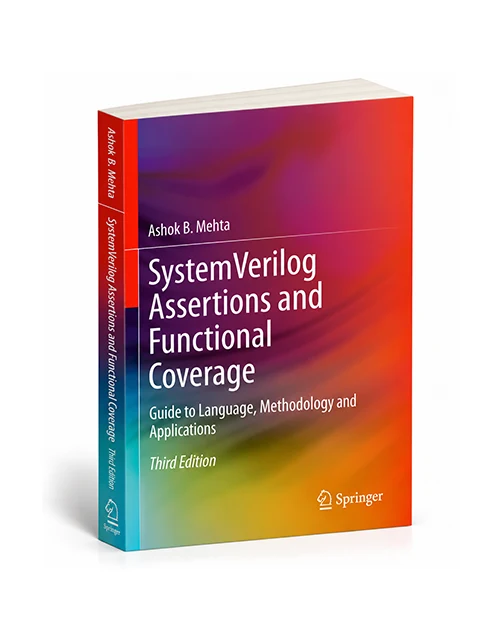


SystemVerilog Assertions and Functional Coverage, Third Edition
SystemVerilog Assertions and Functional Coverage: Guide to Language, Methodology and Applications, 3rd Edition by Ashok B. Mehta is a practical technical reference covering assertion-based verification and functional coverage for digital hardware design. Published by Springer as part of its engineering and electronics publications, this book explains the language features, methodologies, and applications used to verify complex hardware systems.
Modern digital designs, including ASICs, Systems-on-Chip (SoCs), processors, and FPGAs, require careful verification before they can be considered functionally reliable. Simulation and testing must check not only whether a design produces expected results but also whether important timing relationships, operating conditions, and functional scenarios have been adequately verified. This book explains how SystemVerilog Assertions (SVA) and functional coverage can support these verification objectives.
Understand SystemVerilog Assertions (SVA)
The book introduces SystemVerilog Assertions and explains their role in assertion-based verification. SVA provides a language for describing expected design behavior and checking whether a hardware implementation satisfies specified conditions.
Readers can study the syntax and semantics of assertions, along with their use in describing timing relationships and checking design behavior. The third edition covers the IEEE 1800-2012 language reference manual (LRM) features identified by the publisher.
These concepts are particularly useful for engineers developing verification environments for complex digital systems, where carefully written assertions can help identify design errors and make debugging more efficient.
Learn Immediate and Concurrent Assertions
The textbook explains both immediate assertions and concurrent assertions. These approaches provide different ways to express and evaluate conditions during hardware simulation.
Immediate assertions are used to check conditions at a particular point in procedural execution. Concurrent assertions allow engineers to describe properties involving events and relationships across simulation time and clock cycles.
The book introduces the foundations of concurrent assertions, including sequences, properties, and the assert construct. Step-by-step examples help readers understand how assertions are written, evaluated, and applied to practical verification situations.
Explore Sequential Domain Coverage
Sequential domain coverage is an important topic because verification must consider whether relevant sequences of events have occurred during testing. The book discusses the cover property and cover sequence constructs used to describe and measure particular behaviors.
Readers can understand how coverage models help identify scenarios that have been exercised and how these measurements contribute to an assessment of verification progress.
Understand Sampled Value Functions
Sampled value functions are important SystemVerilog features used when evaluating signal values in relation to simulation events and clock sampling.
The book explains sampled value functions and their role in assertion-based verification. Readers can explore how sampled signal information is used to express temporal relationships and evaluate conditions across different clock cycles.
This material provides a foundation for writing more meaningful assertions and understanding how SystemVerilog evaluates signals during simulation.
Study SystemVerilog Assertion Operators
Operators are central to expressing complex temporal conditions and relationships in SVA. The textbook provides detailed coverage of assertion operators and explains how they can be combined to describe expected hardware behavior.
Readers can develop an understanding of the language constructs used to express sequences, timing requirements, Boolean relationships, and other verification conditions. The examples help demonstrate how different operators work within practical assertion statements.
Explore System Functions and Tasks
The book includes coverage of SystemVerilog system functions and tasks and their applications in assertion-based verification.
These features help engineers work with simulation information and express additional verification behavior within a testbench or assertion environment. Understanding their use helps readers develop more complete and useful verification code.
Understand Multiple Clocks and Local Variables
Complex digital designs may contain multiple clock domains and signals operating under different timing conditions. The book dedicates attention to multiple-clock assertions and the challenges of describing relationships between events that occur under different clocks.
It also explains local variables and recursive properties, which provide additional capabilities for expressing more sophisticated assertion behavior. These topics help readers move beyond basic assertion statements and work with more advanced verification requirements.
Learn Sequence Endpoints and Advanced Assertion Constructs
The textbook explores how to detect and use the endpoints of sequences, including the triggered and matched sequence-related concepts. These capabilities help engineers describe and evaluate more complex temporal behavior.
It also covers the expect construct and the use of assume and restrict for simulation and formal verification. These topics demonstrate how assertions can contribute to both simulation-based checking and formal verification methodologies.
Apply Assertions to Clock Domain Crossing Verification
Clock Domain Crossing (CDC) verification is an important challenge in digital hardware design. When signals move between different clock domains, timing and synchronization issues can create functional problems that are difficult to detect through ordinary simulation alone.
The third edition includes a dedicated chapter on Clock Domain Crossing verification using assertions. It explains how assertion-based techniques can be applied to checking relevant behavior and identifying potential verification issues associated with clock-domain interactions.
Study Asynchronous FIFO Assertions
Asynchronous FIFOs are commonly used to transfer data between circuits operating with different clocks. Their verification requires careful attention to data movement, control behavior, synchronization, and timing relationships.
The book includes a dedicated section on asynchronous FIFO assertions. This material demonstrates how SystemVerilog assertions can be applied to practical hardware verification problems involving asynchronous data transfer.
Understand SystemVerilog Functional Coverage
In addition to assertions, the book provides extensive coverage of SystemVerilog Functional Coverage (FC). Functional coverage helps engineers measure whether important design features, behaviors, and scenarios have been exercised during verification.
Readers can learn the language features and methodologies used to construct functional coverage models. These concepts help verification teams organize coverage goals and evaluate how thoroughly a test environment has explored the intended functionality of a design.
Explore Functional Coverage Language Features
The functional coverage section introduces the language constructs used to create and manage coverage models. Readers can understand how coverage specifications are organized and how different language features contribute to the measurement of verification scenarios.
The book also examines coverage options and the performance implications of coverage methodology. These subjects help engineers consider the practical balance between coverage completeness, simulation efficiency, and the organization of a verification environment.
Improve Assertion-Based Verification and Debugging
A key objective of assertion-based verification is to make design behavior easier to check and potential errors easier to locate. Assertions can identify violations of expected conditions and help point verification engineers toward the source of a problem.
The book explains how practical SVA applications can support the modeling of complex checkers, timing checks, and other verification requirements. Its step-by-step approach connects language details with applications derived from real engineering projects.
Practice Through Six Practical Laboratory Exercises
A major feature of SystemVerilog Assertions and Functional Coverage is its inclusion of six practical laboratory exercises. These labs allow readers to apply concepts introduced in the chapters and develop familiarity with assertion and coverage methodologies.
The supplementary exercises help connect theoretical explanations with practical verification activities. Readers can use them to reinforce their understanding of SystemVerilog syntax, assertion construction, and functional coverage techniques.
Understand the IEEE 1800-2012 Standard
The third edition updates its coverage to include the functional features identified in the IEEE 1800-2012 Language Reference Manual. The publisher notes that additional operators and language features are covered, while explanations of concurrent assertions and operators have been expanded with more examples and figures.
This makes the book useful for readers who want to understand the SystemVerilog assertion and functional coverage features associated with that edition of the language standard. Engineers working with newer toolchains and standards should also consult the current applicable language reference and verification documentation.
Who Should Read SystemVerilog Assertions and Functional Coverage?
SystemVerilog Assertions and Functional Coverage, Third Edition is suitable for digital design engineers, ASIC and SoC verification engineers, FPGA developers, processor design engineers, semiconductor professionals, and graduate engineering students.
It is particularly relevant to professionals working in functional verification, assertion-based verification, testbench development, design debugging, and hardware verification methodology. Readers with an understanding of digital design and Verilog or SystemVerilog fundamentals will find the material especially useful when developing more advanced verification skills.
Why Choose the Third Edition?
- Comprehensive SVA coverage: Explains immediate assertions, concurrent assertions, sequences, properties, and operators.
- Functional coverage: Covers SystemVerilog functional coverage language features, methodology, and options.
- IEEE 1800-2012: Includes the language features and syntax identified for the 2012 LRM.
- Advanced verification: Covers multiple clocks, local variables, recursive properties, and sequence endpoints.
- Practical applications: Includes CDC verification and asynchronous FIFO assertions.
- Debugging support: Explains how assertions help identify design and timing problems.
- Hands-on learning: Includes six practical laboratory exercises and real-project examples.
About the Book
Title: SystemVerilog Assertions and Functional Coverage
Subtitle: Guide to Language, Methodology and Applications
Edition: Third Edition
Author: Ashok B. Mehta
Publisher: Springer Cham
Copyright Year: 2020
ISBN-13: 9783030247393
Publication Date: October 18, 2020
Format: Paperback
Pages: 507 Pages
Language: English
For engineers seeking a practical reference on hardware functional verification, SystemVerilog Assertions and Functional Coverage, Third Edition provides a structured guide to assertion-based verification, temporal checking, functional coverage, and practical SystemVerilog applications in ASIC, SoC, processor, and FPGA design verification.
There are no reviews yet.