

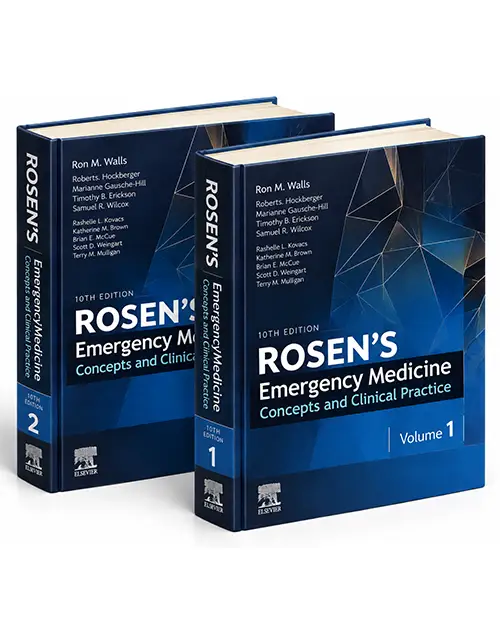


Rosen’s Emergency Medicine: Concepts and Clinical Practice, Tenth Edition
Rosen’s Emergency Medicine: Concepts and Clinical Practice, 10th Edition is a comprehensive two-volume medical reference edited by Ron M. Walls, Robert S. Hockberger, Marianne Gausche-Hill, Timothy B. Erickson, and Susan R. Wilcox. Published by Elsevier, this extensively revised edition provides evidence-based knowledge and practical recommendations for the diagnosis, evaluation, and management of emergency medical conditions.
Emergency medicine requires physicians to make important clinical decisions in time-sensitive situations involving patients with a wide range of symptoms, injuries, and medical conditions. From initial assessment and resuscitation to diagnostic investigations and definitive treatment, healthcare professionals must understand how different emergency conditions present and how they should be managed. This textbook brings together clinical knowledge from experienced emergency medicine specialists to support these responsibilities.
Understand the Fundamentals of Emergency Medicine
The first volume begins with fundamental clinical concepts that establish the foundation for emergency department practice. It explores the initial evaluation and management of critically ill and injured patients, helping readers understand the priorities involved in emergency care.
Major subjects include airway management, mechanical ventilation, noninvasive ventilatory support, shock, brain resuscitation, adult resuscitation, pain management, and procedural sedation and analgesia.
These topics provide essential knowledge for professionals working in emergency departments, intensive care environments, and other acute medical settings.
Learn Resuscitation and Critical Care
Resuscitation and critical care are important components of emergency medicine. The textbook examines techniques and clinical considerations involved in stabilizing patients with life-threatening conditions.
Readers can study emergency airway management, ventilatory support, circulatory instability, shock, and resuscitation approaches. The book also covers brain resuscitation and adult resuscitation, connecting clinical principles with the practical management of critically ill patients.
Additional coverage of pain management and procedural sedation and analgesia supports an understanding of important interventions performed in emergency care environments.
Explore Common Signs, Symptoms, and Clinical Presentations
Patients frequently arrive in emergency departments with symptoms that may have several possible causes. The textbook provides extensive coverage of common clinical presentations and the diagnostic considerations associated with them.
Topics include fever, weakness, cyanosis, syncope, depressed consciousness, coma, confusion, seizures, dizziness, vertigo, headache, diplopia, red and painful eyes, sore throat, hemoptysis, dyspnea, and chest pain.
By organizing information around patient presentations, the book helps readers understand how clinical symptoms can guide evaluation and identify possible underlying conditions.
Study Trauma and Emergency Injury Management
Trauma care is an important part of emergency medicine because patients may present with injuries requiring rapid assessment, stabilization, and coordinated treatment.
The first volume includes a dedicated trauma section covering the evaluation and management principles associated with emergency injuries. Its broader clinical approach connects trauma assessment with resuscitation, diagnostic evaluation, and critical care considerations.
This section is relevant to emergency physicians, trauma-focused healthcare professionals, and medical trainees who need a comprehensive reference for understanding acute injury management.
Understand Cardiovascular and Respiratory Emergencies
Cardiovascular and respiratory problems are frequently encountered in emergency departments. The book covers emergency presentations involving the cardiovascular and respiratory systems and discusses important diagnostic and treatment considerations.
Its coverage connects clinical symptoms and examination findings with evidence-based approaches to emergency evaluation. These topics are useful for understanding how clinicians assess patients with potentially serious cardiac and pulmonary conditions.
Explore Neurological and Other System-Based Emergencies
The textbook includes extensive emergency medicine coverage organized by body system. This approach helps readers develop a structured understanding of conditions affecting different organs and physiological processes.
Neurological emergencies, altered consciousness, seizures, headaches, dizziness, and other acute clinical presentations receive attention within the broader system-based chapters.
The two-volume structure allows readers to explore a wide range of emergency conditions, from initial symptom evaluation to more complex diagnostic and treatment considerations.
Study Environmental Emergencies and Medical Toxicology
The second volume continues the system-based emergency medicine coverage and includes a dedicated section on environmental conditions and toxicology.
These subjects are important for understanding medical emergencies caused by environmental exposures, toxic substances, and other potentially harmful agents. The textbook provides clinical information to support the assessment and management of patients presenting with these conditions.
Its inclusion of toxicology extends the book’s coverage beyond conventional organ-system emergencies and makes it a useful reference for professionals working in diverse emergency care settings.
Understand Emergency Care for Special Patient Populations
Emergency medicine involves treating patients with different ages, medical histories, physiological characteristics, and healthcare needs. The second volume includes a dedicated section on special populations.
This coverage helps readers understand why emergency assessment and treatment may need to be considered differently for particular patient groups. The book brings these considerations into its broader approach to comprehensive emergency medicine practice.
Apply Evidence-Based Diagnostic and Treatment Principles
A major strength of Rosen’s Emergency Medicine is its emphasis on practical, evidence-based clinical information. The tenth edition presents recommendations from clinical experts in a clear and focused format.
Readers can use the information to review diagnostic considerations, evaluate possible medical conditions, and understand treatment approaches across a wide range of emergency presentations.
Current references and organized clinical discussions support further study and help connect important medical concepts with their practical applications.
Learn Through Extensive Illustrations and Clinical References
The tenth edition features approximately 1,800 illustrations that support the explanation of emergency medical concepts and clinical conditions. These visual resources help readers understand complex medical information and review relevant anatomical, diagnostic, and clinical details.
The textbook also includes extensive references and focused writing to make its large amount of information more accessible to healthcare professionals and medical trainees.
Use a Comprehensive Two-Volume Medical Reference
The two-volume organization provides extensive coverage of emergency medicine across multiple clinical specialties.
Volume 1 includes fundamental clinical concepts, resuscitation and analgesia, signs and symptoms, trauma, and the beginning of system-based emergency medicine.
Volume 2 continues the emergency medicine by-system chapters and covers environmental conditions, toxicology, and special patient populations.
Together, the two volumes provide a broad clinical reference intended to support emergency medicine education, clinical training, and professional practice.
Who Should Read Rosen’s Emergency Medicine?
Rosen’s Emergency Medicine: Concepts and Clinical Practice, 10th Edition is suitable for emergency physicians, emergency medicine residents, medical students, physician assistants, critical care professionals, and other healthcare practitioners involved in acute patient care.
It is especially useful for emergency medicine training programs, clinical rotations, postgraduate medical education, and hospital reference collections. Professionals can also use it to review emergency assessment, resuscitation, trauma management, toxicology, and system-based emergency conditions.
Why Choose the Tenth Edition?
- Comprehensive coverage: Addresses emergency medicine across two extensive volumes.
- Resuscitation and critical care: Covers airway management, ventilation, shock, and emergency resuscitation.
- Symptom-based evaluation: Explores a wide range of common and complex emergency presentations.
- Trauma management: Includes dedicated coverage of emergency injury assessment and treatment.
- System-based medicine: Covers emergency conditions affecting multiple organ systems.
- Toxicology and environmental medicine: Includes a dedicated section on environmental emergencies and toxicology.
- Clinical illustrations: Features approximately 1,800 illustrations and extensive references.
- Evidence-based guidance: Presents practical recommendations from experienced emergency medicine specialists.
About the Book
Title: Rosen’s Emergency Medicine: Concepts and Clinical Practice
Edition: Tenth Edition
Set: Two-Volume Set
Editors: Ron M. Walls, Robert S. Hockberger, Marianne Gausche-Hill, Timothy B. Erickson, and Susan R. Wilcox
Publisher: Elsevier
Publication Date: August 3, 2022
Copyright Year: 2023
Print ISBN-13: 9780323757898
Format: Hardcover, Two-Volume Set
Total Pages: 2,768
Language: English
For emergency medicine professionals and medical trainees seeking a comprehensive clinical reference, Rosen’s Emergency Medicine: Concepts and Clinical Practice, 10th Edition provides extensive information on resuscitation, trauma, acute medical conditions, diagnostic evaluation, toxicology, and emergency treatment across a broad range of patient populations.
There are no reviews yet.