

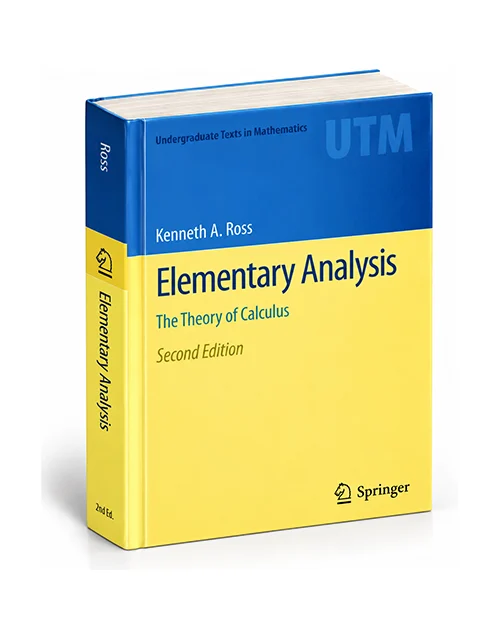


Elementary Analysis: The Theory of Calculus, Second Edition
Elementary Analysis: The Theory of Calculus, 2nd Edition by Kenneth A. Ross is an undergraduate mathematics textbook that introduces students to the rigorous foundations of calculus and mathematical analysis. Published by Springer as part of the Undergraduate Texts in Mathematics series, this book is designed for learners transitioning from standard calculus courses to more advanced mathematical subjects.
Calculus introduces students to limits, continuity, differentiation, and integration, but a deeper understanding of these subjects requires familiarity with mathematical definitions and rigorous proofs. This textbook bridges that gap by explaining the theoretical foundations of calculus in a clear and carefully structured manner.
Its presentation emphasizes motivation, precise mathematical reasoning, complete proofs, well-chosen examples, and exercises ranging from routine calculations to challenging problems. The second edition preserves the author’s accessible writing style while adding new topics, examples, and improved proofs.
Understand the Foundations of Mathematical Analysis
The introductory material establishes the mathematical ideas needed to study analysis beyond elementary calculus. Readers develop an understanding of mathematical definitions, logical reasoning, and the construction of rigorous proofs.
The book is particularly suitable for students who understand basic calculus but have limited experience writing formal mathematical proofs. It helps them move from intuitive explanations toward precise arguments based on definitions, theorems, and logical deductions.
This approach provides a useful foundation for future studies in real analysis, complex variables, differential equations, Fourier analysis, numerical analysis, multivariable calculus, and statistics.
Study Sequences and Their Mathematical Properties
The chapter on sequences introduces one of the most important foundations of real analysis. Sequences provide a structured way to investigate convergence, limits, and the behavior of numerical expressions.
Readers can study convergence and divergence, monotone sequences, subsequences, and the mathematical principles used to establish the existence of limits. The chapter also develops the reasoning required to prove statements about sequences rigorously.
These concepts are essential for understanding continuity, infinite series, differentiation, and integration. The textbook uses detailed explanations and exercises to help students become comfortable with the logical methods behind convergence.
Explore Continuity and Continuous Functions
Continuity is a fundamental concept connecting the intuitive ideas of calculus with the formal methods of mathematical analysis. The textbook develops this subject through mathematical definitions, properties, examples, and complete proofs.
Readers can understand how continuity is established and how the behavior of continuous functions is connected to limits and sequences. The chapter also provides a foundation for studying important theorems concerning continuous functions.
The discussion helps students recognize why continuity is more than a graphical idea and how its mathematical properties support the broader theory of calculus.
Understand Sequences and Series of Functions
The third major area of the textbook examines sequences and series of functions. This topic extends the study of numerical sequences to collections of functions and their convergence behavior.
Readers can explore how sequences of functions are studied and how the convergence of a sequence or series of functions relates to the properties of the functions involved.
The material develops concepts that are important for advanced calculus, approximation methods, and the study of more complicated function spaces. It also prepares students for further mathematical analysis involving power series and other function-based representations.
Learn the Theory of Differentiation
The differentiation chapter explains the theoretical foundations of derivatives and develops the rigorous reasoning behind familiar calculus results.
Students can study how derivatives are defined, how differentiability relates to continuity, and how mathematical theorems establish important properties of differentiable functions.
The discussion goes beyond applying differentiation formulas by examining why derivative rules work and how they can be justified mathematically. This makes it useful for students who want to understand the theoretical basis of differential calculus.
Study the Theory of Integration
Integration is another central subject in the textbook. The chapter develops the mathematical principles underlying integration and connects them with the foundations established in earlier chapters.
Readers can explore the theoretical meaning of integration, the properties of integrable functions, and the relationship between differentiation and integration.
The coverage supports a deeper understanding of the calculus techniques students may already know from introductory courses. It also helps prepare them for more advanced studies in real analysis and related mathematical subjects.
Explore Additional Topics in the Second Edition
The second edition introduces several new topics that extend the mathematical coverage of the original book.
These additions include the irrationality of pi, the Baire category theorem, Newton’s method and the secant method, and continuous nowhere-differentiable functions.
These subjects provide further opportunities to explore the depth of mathematical analysis, including the theoretical properties of numbers, the structure of mathematical spaces, numerical approximation, and unusual examples of continuous functions.
Understand Rigorous Proof Writing
A central educational objective of Elementary Analysis is to help students develop the ability to write and understand mathematical proofs.
The author presents proofs in full and emphasizes why each mathematical step is justified. This allows readers to follow the logical structure of arguments rather than relying on unexplained formulas or informal reasoning.
The book is especially useful for students encountering proof-based mathematics for the first time. Its carefully motivated explanations help bridge the difference between computational calculus and abstract mathematical reasoning.
Learn Through Examples and Challenging Exercises
The textbook contains a large collection of well-selected examples and exercises. Problems range from routine practice to more challenging questions that require deeper reasoning and the application of mathematical theorems.
These exercises encourage students to develop independent problem-solving skills, apply rigorous definitions, and construct logical arguments. They also provide opportunities to reinforce concepts introduced in each chapter.
The combination of full proofs, explanatory examples, and exercises makes the textbook suitable for both classroom instruction and independent mathematical study.
Build a Foundation for Advanced Mathematics
Elementary analysis is an important transition subject for students who intend to continue into advanced mathematics. The concepts developed in this textbook are relevant to many subsequent areas of study.
Students preparing for courses in real analysis, complex variables, differential equations, Fourier analysis, numerical analysis, multivariable calculus, and statistics can benefit from the rigorous foundations introduced throughout the book.
The textbook is also recommended for future secondary-school mathematics teachers who want to strengthen their understanding of the theoretical foundations of calculus.
Who Should Read Elementary Analysis?
Elementary Analysis: The Theory of Calculus, 2nd Edition is suitable for undergraduate mathematics majors, students who have completed introductory calculus, and learners preparing for advanced courses in mathematical analysis.
It is especially useful for students who want to improve their proof-writing skills and understand the theoretical principles behind sequences, continuity, differentiation, and integration.
Mathematics educators, university instructors, and independent learners may also use it as a reference for studying the foundations of real analysis.
Why Choose the Second Edition?
- Clear transition from calculus to analysis: Designed for students beginning rigorous mathematics.
- Complete mathematical proofs: Emphasizes precise definitions and logical reasoning.
- Comprehensive core topics: Covers sequences, continuity, function sequences, differentiation, and integration.
- New mathematical material: Adds topics such as the irrationality of pi and the Baire category theorem.
- Numerical methods: Includes Newton’s method and the secant method.
- Challenging exercises: Provides problems ranging from routine to advanced.
- Advanced study preparation: Builds foundations for real analysis and other higher mathematics courses.
About the Book
Title: Elementary Analysis
Subtitle: The Theory of Calculus
Edition: Second Edition
Author: Kenneth A. Ross
Publisher: Springer New York
Series: Undergraduate Texts in Mathematics (UTM)
Publication Date: February 8, 2015
Copyright Year: 2013
ISBN-13: 978-1493901289
Format: Paperback
Pages: 424
Language: English
For students seeking a rigorous introduction to the theoretical foundations of calculus, Elementary Analysis: The Theory of Calculus, Second Edition provides a structured study of sequences, continuity, differentiation, integration, and proof-based mathematics. Its accessible explanations and carefully developed exercises make it a valuable reference for undergraduate mathematical analysis.
There are no reviews yet.