

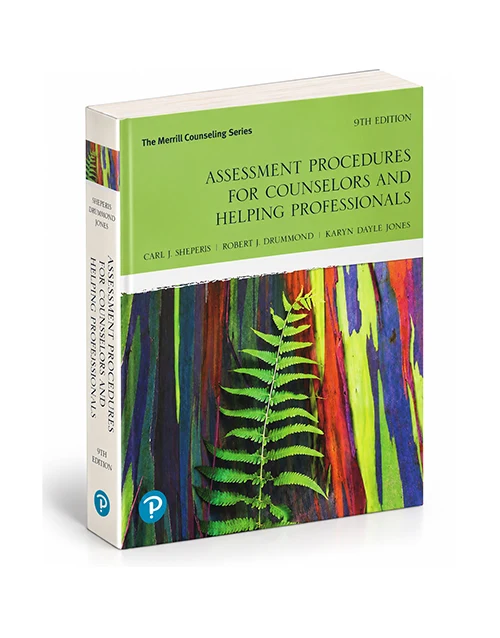


Assessment Procedures for Counselors and Helping Professionals, 9th Edition
Assessment Procedures for Counselors and Helping Professionals, 9th Edition by Carl J. Sheperis, Robert J. Drummond, and Karyn D. Jones is a comprehensive educational textbook introducing the principles, methods, and procedures used in professional assessment. Published by Pearson as part of The Merrill Counseling Series, this book helps readers understand how assessment supports counseling, psychological evaluation, educational planning, and professional decision-making.
Assessment is an essential part of counseling and other helping professions. Professionals use information from interviews, observations, standardized tests, and other assessment instruments to understand individual needs and make informed recommendations. This textbook explains the foundations of assessment and connects theoretical concepts with examples of commonly used assessment tools.
Understand the Principles of Professional Assessment
The book begins with an introduction to assessment and its role in counseling and helping professions. Readers explore the purposes of assessment, the different sources of information available to practitioners, and the importance of selecting appropriate assessment methods.
It explains how assessment information can support professional understanding of individual abilities, educational performance, personal characteristics, and areas requiring additional support. These foundational concepts help readers recognize that assessment involves more than administering a test; it requires careful selection, interpretation, and responsible use of information.
Explore Ethical and Legal Issues in Assessment
Ethics and professional responsibility are central to effective assessment. The textbook discusses ethical and legal considerations that influence how assessment instruments are selected, administered, scored, interpreted, and communicated.
Readers can develop an understanding of professional responsibilities, appropriate test use, confidentiality, and the importance of considering the purpose and limitations of assessment information. These topics are particularly relevant for counselors and helping professionals who work with individuals from different backgrounds and with diverse needs.
Understand Assessment with Diverse Populations
Assessment practices must consider individual differences and the backgrounds of the people being evaluated. The book addresses assessment issues involving diverse populations and the importance of considering cultural and contextual factors when interpreting results.
Readers learn why assessment instruments and interpretations should be evaluated carefully rather than applied without considering the individual. This perspective supports more responsible assessment practices and helps professionals understand how cultural and personal differences may influence the assessment process.
Study the Foundations of Psychological Assessment
A strong understanding of measurement principles is essential for interpreting assessment results. The textbook introduces statistical concepts and explains how scores are developed, understood, and used in professional assessment.
It covers reliability and precision, helping readers understand the consistency of assessment measurements. The book also explores validity and the importance of determining whether an assessment instrument measures what it is intended to measure.
These concepts provide the foundation for evaluating assessment tools and interpreting their results appropriately. They are useful for students learning how to assess the quality and limitations of standardized tests.
Learn How to Select, Administer, Score, and Interpret Tests
Choosing and using an assessment instrument requires a structured process. The book examines the steps involved in selecting appropriate tests, administering them correctly, scoring results, and interpreting the information obtained.
Readers can explore how assessment procedures relate to the purpose of an evaluation and the characteristics of the individual being assessed. The material also helps develop an understanding of how professionals communicate findings and use assessment information in counseling and educational settings.
Explore Intelligence and General Ability Assessment
The textbook discusses the assessment of intelligence and general ability, introducing widely used methods and instruments in this area. Readers can become familiar with the purpose of intelligence testing and the types of information such assessments may provide.
The discussion supports an understanding of how ability measures are interpreted within a broader assessment process. It also encourages consideration of the appropriate context and limitations when using test results to inform professional decisions.
Understand Achievement and Aptitude Assessment
Achievement and aptitude assessments provide different types of information about an individual’s learning and potential performance. The book explores these assessment areas and introduces instruments commonly used to evaluate educational achievement and aptitude.
Achievement assessment can help professionals understand acquired knowledge and skills, while aptitude assessment focuses on abilities and potential related to particular tasks or learning areas. These concepts are useful in educational counseling, student support, and academic planning.
Study Career and Employment Assessment
Career and employment assessment is an important area of counseling practice. The textbook explores assessment approaches used to understand career interests, abilities, and employment-related characteristics.
These methods can help counselors organize information relevant to career exploration and professional development. The subject is especially useful for school counselors, career counselors, vocational guidance professionals, and individuals working in employment-related helping services.
Explore Personality and Clinical Assessment
The book includes dedicated chapters on personality assessment and clinical assessment. These topics introduce readers to methods used to understand individual characteristics, patterns of behavior, and information relevant to clinical counseling contexts.
The material explains the role of assessment instruments in gathering and interpreting information that can support professional understanding. It also reinforces the importance of considering assessment results alongside other relevant information rather than relying on a single test score.
Understand Assessment in Educational Settings
Educational assessment supports decisions involving student learning, performance, and educational needs. The textbook explores assessment in education and its relationship to counseling and other helping professions.
Readers can study how assessment information may be communicated and used to support educational planning. These topics are relevant to school counselors, educational professionals, and practitioners working with students across different learning environments.
Learn to Communicate Assessment Results
Assessment results are most useful when they are communicated clearly and responsibly. The book includes a chapter on communicating assessment results, helping readers understand the importance of presenting findings in a way that is appropriate for the intended audience.
Professional communication requires attention to the meaning and limitations of test scores and the context in which information is used. This knowledge helps counselors and other professionals explain results without overstating what an assessment can establish.
Updated Standards and Assessment Instruments
The ninth edition was updated to align with the 2014 Standards for Educational and Psychological Testing, as well as the ICD-10 and DSM-5 frameworks identified by Pearson. The authors also updated information throughout the chapters to reflect newer editions of commonly used assessment instruments and developments in assessment strategies.
These updates help readers become familiar with established professional standards and the assessment resources relevant to counseling practice at the time of publication. Because this is the ninth edition, users should also consult current professional standards and newer assessment editions when applying the material in practice.
Who Should Read Assessment Procedures for Counselors and Helping Professionals?
Assessment Procedures for Counselors and Helping Professionals, 9th Edition is suitable for counseling students, school counseling students, psychology students, mental health counselors, career counselors, and other professionals working in helping professions.
It can support coursework in counseling assessment, psychological testing, educational measurement, and professional evaluation. The book is also useful for learners who want to become familiar with standardized assessment instruments and understand the principles involved in responsible testing and interpretation.
Why Choose the Ninth Edition?
- Comprehensive assessment coverage: Explores the principles and procedures used in counseling and helping professions.
- Ethical and legal foundations: Discusses professional responsibilities and appropriate assessment practices.
- Measurement principles: Covers statistical concepts, reliability, precision, and validity.
- Multiple assessment areas: Includes intelligence, achievement, aptitude, career, personality, clinical, and educational assessment.
- Practical test knowledge: Explains selection, administration, scoring, and interpretation of assessment instruments.
- Professional communication: Addresses how assessment findings should be communicated.
- Updated assessment guidance: Reflects the standards and diagnostic frameworks identified for the ninth edition.
About the Book
Title: Assessment Procedures for Counselors and Helping Professionals
Edition: Ninth Edition
Series: The Merrill Counseling Series
Authors: Carl J. Sheperis, Robert J. Drummond, and Karyn D. Jones
Publisher: Pearson
Publication Year: 2019
ISBN-13: 9780135186022
Format: Paperback
Pages: 464
For students and professionals seeking a structured introduction to assessment in counseling and helping professions, Assessment Procedures for Counselors and Helping Professionals, 9th Edition provides a foundation in ethical practice, measurement principles, standardized testing, and interpretation of assessment information.
There are no reviews yet.