

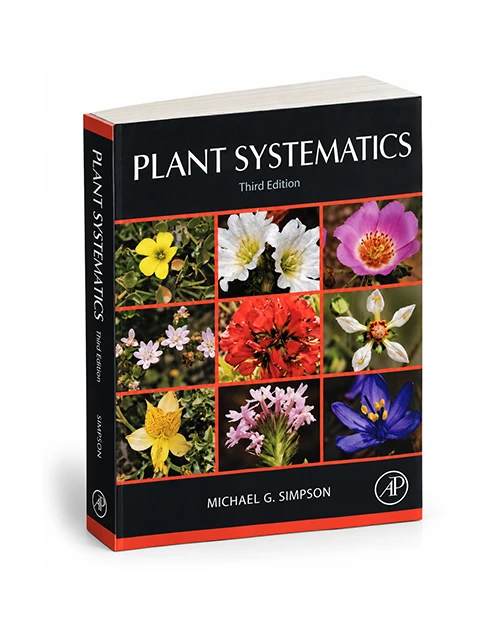


Plant Systematics, Third Edition
Plant Systematics, 3rd Edition by Michael G. Simpson is a comprehensive academic textbook introducing the principles, methods, and scientific evidence used to study plant diversity, evolution, identification, and classification. Published by Academic Press, an imprint of Elsevier, this edition provides a detailed foundation in plant taxonomy and phylogenetic systematics for undergraduate and graduate students.
Plant systematics is the scientific study of plant diversity and evolutionary relationships. It involves identifying plants, describing their characteristics, assigning scientific names, and understanding how different plant groups are related through evolutionary history. This textbook connects these concepts with plant morphology, anatomy, physiology, molecular biology, and conservation.
Understand the Foundations of Plant Systematics
The first unit introduces plant systematics and explains its objectives, methods, research approaches, and terminology. Readers learn how scientists investigate plant diversity and organize information about different plant groups.
It also introduces phylogenetic systematics, which uses evidence from plant characteristics and evolutionary relationships to understand the history of plant lineages.
These foundations help students understand how modern plant classification is developed and why evolutionary relationships are important when studying botanical diversity.
Explore Phylogenetic Systematics
Phylogenetic systematics focuses on reconstructing the evolutionary history of organisms and identifying relationships among different groups.
The textbook explains the principles and evidence used in phylogenetic analysis. Readers can study evolutionary relationships, classification methods, and the interpretation of cladograms and other scientific diagrams.
The third edition also includes an updated explanation of maximum-likelihood and Bayesian inference algorithms, helping readers understand important methods used in modern evolutionary research.
Study the Evolution and Diversity of Green and Land Plants
The second unit explores the evolution and diversity of plants, beginning with green plants and the emergence of land plants.
Readers can examine major evolutionary developments that contributed to the diversity of plant life and understand how different groups evolved and adapted to terrestrial environments.
This material provides a foundation for studying the origins and diversification of modern plant groups.
Understand the Evolution of Vascular and Seed Plants
The book continues with the evolution and diversity of vascular plants, woody plants, and seed plants.
It explores the characteristics that distinguish major plant lineages and explains how evolutionary innovations contributed to the development of different plant groups.
These topics help readers understand the relationship between plant structure, reproduction, adaptation, and evolutionary history.
Explore the Evolution and Classification of Flowering Plants
Flowering plants represent an extensive and diverse group of organisms. The textbook examines their evolutionary history and the principles used to classify their major lineages.
It covers flowering plant groups including Amborellales, Nymphaeales, Austrobaileyales, magnoliids, Ceratophyllales, monocots, and eudicots.
The third edition includes expanded treatments of flowering plant families and tropical trees, supported by full-color botanical plates. This material helps students compare plant characteristics and understand classification across different flowering plant groups.
Learn Plant Morphology and Descriptive Terminology
Plant morphology examines the external form and structure of plants. The textbook explores the characteristics used to describe and compare plant organs, including roots, stems, leaves, flowers, fruits, and seeds.
Readers can develop an understanding of botanical descriptive terminology and how morphological characteristics contribute to plant identification and classification.
The third edition includes enhanced material on plant morphology, helping students connect observable plant features with systematic research.
Study Plant Anatomy and Physiology
Plant anatomy and physiology explain the internal organization and functional processes of plants.
The textbook introduces the structures and tissues that support plant growth and explains how physiological activities contribute to plant development and survival.
These subjects provide important scientific background for understanding plant structure, adaptation, and evolutionary relationships.
Explore Plant Embryology
Plant embryology examines the development of plants from reproductive cells through early developmental stages.
The chapter introduces the biological processes associated with plant reproduction and development, helping readers understand how developmental characteristics contribute to the study of plant diversity and classification.
Understand Palynology and Plant Reproductive Biology
Palynology is the study of pollen and spores. It provides important evidence for understanding plant reproduction, evolutionary relationships, and the identification of different plant groups.
The textbook also explores plant reproductive biology, introducing the structures and processes involved in plant reproduction.
These subjects help readers understand how reproductive characteristics can be used as evidence in systematic research and plant classification.
Explore Plant Molecular Systematics
Modern plant systematics increasingly uses molecular evidence to investigate evolutionary relationships. The book examines plant molecular systematics and the role of molecular biology in reconstructing plant evolutionary history.
Readers can understand how molecular information contributes to classification, phylogenetic research, and the study of evolutionary relationships among plant groups.
The third edition highlights research developments in plant molecular biology and provides updated explanations of important analytical approaches.
Learn Plant Identification and Nomenclature
Accurate plant identification and scientific naming are fundamental activities in botany. The fourth unit examines the resources and methods used to identify plants and establish consistent scientific names.
Readers can explore the principles of plant identification and plant nomenclature, including the terminology and procedures used in botanical classification.
These topics are especially valuable for students and researchers who work with plant collections, botanical surveys, taxonomy, and biodiversity documentation.
Understand Plant Collecting and Documentation
Plant collecting and documentation are important parts of systematic research. The textbook discusses methods used to collect, describe, and record botanical specimens.
It explains why accurate specimen information and documentation are necessary for scientific research, plant identification, and future verification of botanical findings.
This material is relevant to field botanists, students conducting plant surveys, researchers, and professionals working with biological collections.
Explore Herbaria and Botanical Information Systems
Herbaria preserve plant specimens and associated information for research, education, and conservation. The book introduces the role of herbaria and data information systems in plant systematics.
Readers can understand how botanical collections are organized, documented, maintained, and used to support scientific studies.
These resources are particularly important for comparing plant specimens, examining historical records, supporting taxonomic research, and documenting plant diversity.
Study Species Concepts and Conservation Biology
The final unit explores species concepts and the relationship between plant systematics and conservation biology.
Readers can examine how species are defined and studied and why understanding evolutionary relationships is important for assessing biodiversity.
The book connects systematic research with conservation considerations, demonstrating how accurate plant identification and classification contribute to understanding and protecting plant diversity.
Learn Through Cladograms, Botanical Illustrations, and Color Photographs
A major strength of Plant Systematics is its use of scientific illustrations and visual material to explain complex botanical concepts.
The textbook includes detailed cladograms, botanical drawings, photographs, and full-color plates. These resources help readers compare plant structures, recognize botanical characteristics, and understand evolutionary relationships.
Appendices also provide information about plant description, botanical illustrations, scientific journals in plant systematics, and statistics and morphometrics.
Who Should Read Plant Systematics?
Plant Systematics, Third Edition is suitable for undergraduate and graduate students studying botany, plant taxonomy, plant systematics, plant anatomy, plant pathology, ecology, and biological sciences.
It is particularly useful for university courses, botanical research, plant identification studies, and advanced learning about plant evolution and classification.
Botanists, ecologists, conservation researchers, herbarium professionals, and other plant science specialists may also use it as an academic reference.
Why Choose the Third Edition?
- Comprehensive botanical coverage: Explores plant evolution, diversity, morphology, anatomy, and classification.
- Phylogenetic systematics: Explains evolutionary relationships and methods of phylogenetic analysis.
- Flowering plant diversity: Includes expanded coverage of flowering plant families and tropical trees.
- Molecular research: Covers developments in plant molecular biology and updated phylogenetic methods.
- Plant identification: Explains botanical nomenclature, collecting, and specimen documentation.
- Scientific illustrations: Features detailed cladograms, drawings, photographs, and color plates.
- Conservation knowledge: Connects species concepts and systematic research with conservation biology.
About the Book
Title: Plant Systematics
Edition: Third Edition
Author: Michael G. Simpson
Publisher: Elsevier
Imprint: Academic Press
Publication Date: October 15, 2019
Copyright Year: 2019
Print ISBN-13: 9780128126288
Format: Paperback
Pages: 774
Language: English
For students and researchers interested in botanical science, Plant Systematics, Third Edition provides a detailed foundation in plant evolution, phylogenetic classification, morphology, anatomy, molecular systematics, plant identification, and conservation. Its illustrations, scientific explanations, and practical botanical information make it a valuable academic reference for plant sciences.
There are no reviews yet.